GlobalEye
The "eye in the sky" that broke Boeing's monopoly — Saab's GlobalEye puts a long-range AESA radar on a business jet to watch air, sea and land at once, out past 550 km. Flown by the UAE, Sweden and France, it was picked in 2026 to replace NATO's ageing AWACS fleet.
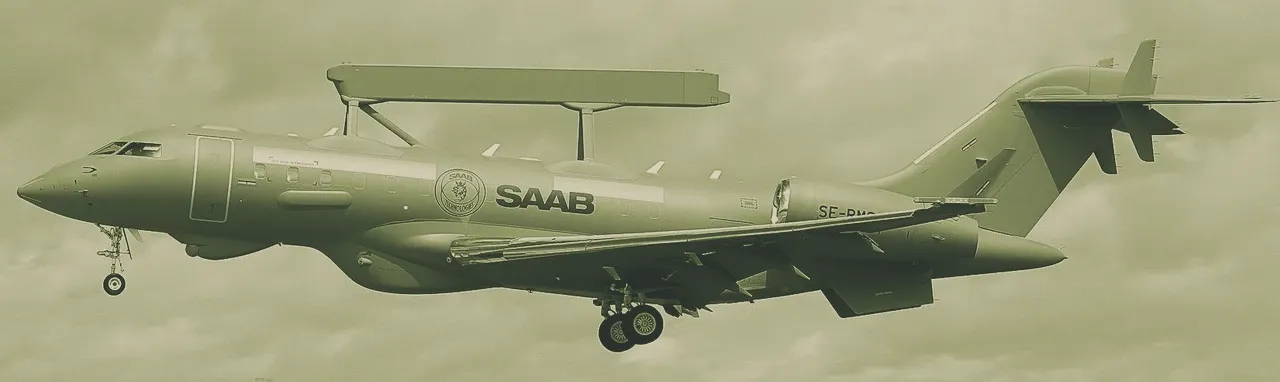
The eye in the sky that broke Boeing's monopoly — Saab's GlobalEye mounts a long-range active-array radar on a long-range business jet to watch the air, the sea and the land simultaneously, detecting targets out past 550 km. A Swedish-Canadian pairing in a field long dominated by big American jets, it is flown by the United Arab Emirates, Sweden and France — and in 2026 it was selected to replace NATO's ageing AWACS fleet, a landmark win for European airborne surveillance.
Overview
The GlobalEye is a multi-role airborne early warning and control (AEW&C) aircraft from Sweden's Saab, built by installing Saab's Erieye ER (Extended Range) AESA radar and a multi-domain command-and-control mission system into a Bombardier Global 6000/6500 long-range business jet. Its defining feature is multi-domain surveillance: a single aircraft tracks air, maritime and ground targets at once, fusing them into one picture for commanders, where older AEW platforms specialized mainly in air. The combination of a modern gallium-nitride AESA radar, the Global jet's long endurance and high-altitude reach, and a business-jet's far lower operating cost than a converted airliner makes the GlobalEye an efficient, capable surveillance node. It entered service in 2020 and has become the most prominent European challenger to the American (Boeing) grip on the AEW&C market.
Development
Saab launched the GlobalEye program in February 2016, integrating an extended-range evolution of its long-running Erieye radar (previously flown on the Saab 340, Saab 2000 and Embraer R-99/EMB-145) onto the larger, longer-ranged Bombardier Global 6000 jet, per Wikipedia and GlobalSecurity. The launch customer was the United Arab Emirates, which first flew the aircraft in 2018 and put it into service in April 2020; Sweden subsequently ordered GlobalEye to replace its older Saab 340 AEW aircraft, and France selected it for its airborne-surveillance needs. The capstone came in 2026, when NATO selected the GlobalEye as the successor to its long-serving Boeing E-3 AWACS fleet — the Saab-Bombardier aircraft prevailing in a field that, as analysts noted, had "historically been an American preserve," with the UAE service record, the mature Erieye ER radar, and the Global airframe's endurance and small-airfield performance cited as decisive.
Design & capabilities
The heart of the GlobalEye is the Erieye ER radar — a gallium-nitride active electronically scanned array in a dorsal "ski-box" antenna that, combined with the mission system, detects and tracks aircraft, missiles, ships and ground targets at ranges reported to exceed 550 km, per Aerotime. It is a genuinely multi-domain system: alongside the air-surveillance radar it carries maritime and ground-moving-target sensors and a command-and-control suite, so one aircraft can run air-battle management, maritime patrol and ground surveillance together. The Bombardier Global 6000/6500 airframe gives it long endurance (many hours on station), high cruise altitude (extending radar horizon), the ability to use modest airfields, and far lower acquisition and operating costs than a Boeing 707- or 737-based platform. The aircraft is a networked node, sharing its fused picture across a coalition force. Its limitations are those of any AEW platform — a small fleet is a high-value, somewhat vulnerable asset that adversary long-range missiles (and counter-AEW weapons) specifically target — but its sensor reach and multi-domain fusion make it a force-multiplier well beyond its numbers.
Variants
GlobalEye is a single principal product on the Global 6000/6500 airframe, with national mission-system configurations for the UAE, Sweden, France and (prospectively) NATO. Saab's broader Erieye family includes earlier AEW fits on the Saab 340, Saab 2000 and Embraer EMB-145 platforms (operated by Sweden, Brazil, Greece, Mexico, Pakistan, Thailand and others), of which GlobalEye is the third-generation, business-jet-based flagship.
Combat record / operational use
The GlobalEye has no public combat record in the sense of direct engagements — as a surveillance and battle-management aircraft, its "operations" are providing the air, sea and ground picture that enables everyone else. It has been in UAE service since 2020 (relevant to Gulf and regional tensions), is entering Swedish and French service, and its NATO selection in 2026 puts it on track to become the alliance's primary airborne surveillance platform. Its operational value is as a multi-domain sensor-and-C2 node: extending radar coverage far beyond surface systems, managing air battles, cueing air and missile defences, and watching maritime and ground movements — exactly the capability that has become more, not less, important as air-and-missile threats proliferate. Its significance is also industrial and political: a European (Swedish-Canadian) aircraft displacing the American incumbent in NATO's most prestigious surveillance role.
Advantages
- Multi-domain — tracks air, sea and ground targets simultaneously from one aircraft.
- Long-range AESA radar — gallium-nitride Erieye ER detecting out past 550 km.
- Efficient airframe — Global jet endurance, high altitude, small-airfield use, low operating cost.
- Networked C2 — fuses and shares a coalition-wide picture; a force multiplier beyond its numbers.
- Proven and chosen — UAE service record; selected by Sweden, France and NATO (2026).
Drawbacks / limitations
- High-value target — a scarce, expensive aircraft that adversary long-range/counter-AEW weapons prioritize.
- Small fleets — few aircraft cover a theatre; loss or unavailability is keenly felt.
- Business-jet payload limits — less internal volume/crew than a large-airliner AEW platform.
- Cost — a sophisticated radar-and-C2 aircraft is expensive to buy and sustain.
- Support, not shooter — a sensor/management node; depends on other platforms to act on its picture.
Counterparts
The GlobalEye competes with the American AEW&C incumbents — the legacy Boeing E-3 Sentry (AWACS) it is replacing in NATO and the newer Boeing E-7 Wedgetail — and with adversary systems like Russia's A-50 Mainstay and China's KJ-500. Within Saab's own line it is the business-jet flagship above the earlier Erieye fits on the Saab 340/2000 and Embraer EMB-145. Its distinction is the combination of multi-domain (air/sea/land) surveillance on an efficient, long-endurance business jet at lower cost than airliner-based rivals — the package that won it the UAE, Sweden, France and, decisively, NATO, breaking the long American dominance of high-end airborne early warning.
Outlook
The GlobalEye's trajectory is defined by its 2026 NATO selection — a landmark that, alongside UAE, Swedish and French orders, establishes the Saab-Bombardier aircraft as a leading global AEW&C platform and a genuine European alternative to Boeing. The variables to watch are the NATO fielding (numbers, timeline and how it integrates the alliance's surveillance architecture), further export wins, and the evolution of the Erieye ER radar and multi-domain mission system. The strategic context is an air-and-missile threat environment — drones, cruise and ballistic missiles, contested airspace — in which long-range, multi-domain situational awareness is more valuable than ever, even as the AEW aircraft themselves become priority targets. For Sweden, the GlobalEye is a flagship export and a statement of high-end aerospace capability; for NATO and its operators, it is the eye that will increasingly watch their skies, seas and frontiers.
Key specifications
| Spec | Value |
|---|---|
| Type | Airborne early warning & control (AEW&C) / multi-domain surveillance |
| Origin | Sweden — Saab (airframe: Bombardier, Canada) |
| Airframe | Bombardier Global 6000/6500 business jet |
| Radar | Saab Erieye ER (Extended Range) gallium-nitride AESA |
| Detection range | >550 km (reported) |
| Domains | Air, maritime and ground surveillance simultaneously |
| In service | April 2020 (UAE first flight 2018) |
| Operators | UAE, Sweden, France; NATO (selected 2026) |
| Endurance | Long (many hours on station); high-altitude, small-airfield capable |
| Status | In service |
Sources
- GlobalEye — Wikipedia
- GlobalEye AEW&C — Saab
- Saab GlobalEye — GlobalSecurity.org
- NATO picks Saab GlobalEye as new AWACS — Aerotime
- GlobalEye: Saab's third-generation surveillance ship — Key.Aero
- Erieye — Wikipedia
🔒 The Analyst Section on GlobalEye is for BattlePolicy Pro members. Below the line: procurement and contract history, the suppliers and companies behind the system, our head-to-head analyst view of the systems it actually competes with, and the BattlePolicy assessment note. Unlock the full file with BattlePolicy Pro →