L3Harris Put Shield AI's Drone Detection on a Launcher the Army Already Bought
L3Harris licensed Shield AI's Tracker counter-drone software onto VAMPIRE, putting the startup's detection stack on a launcher the US Army has already ordered up to $106 million of.
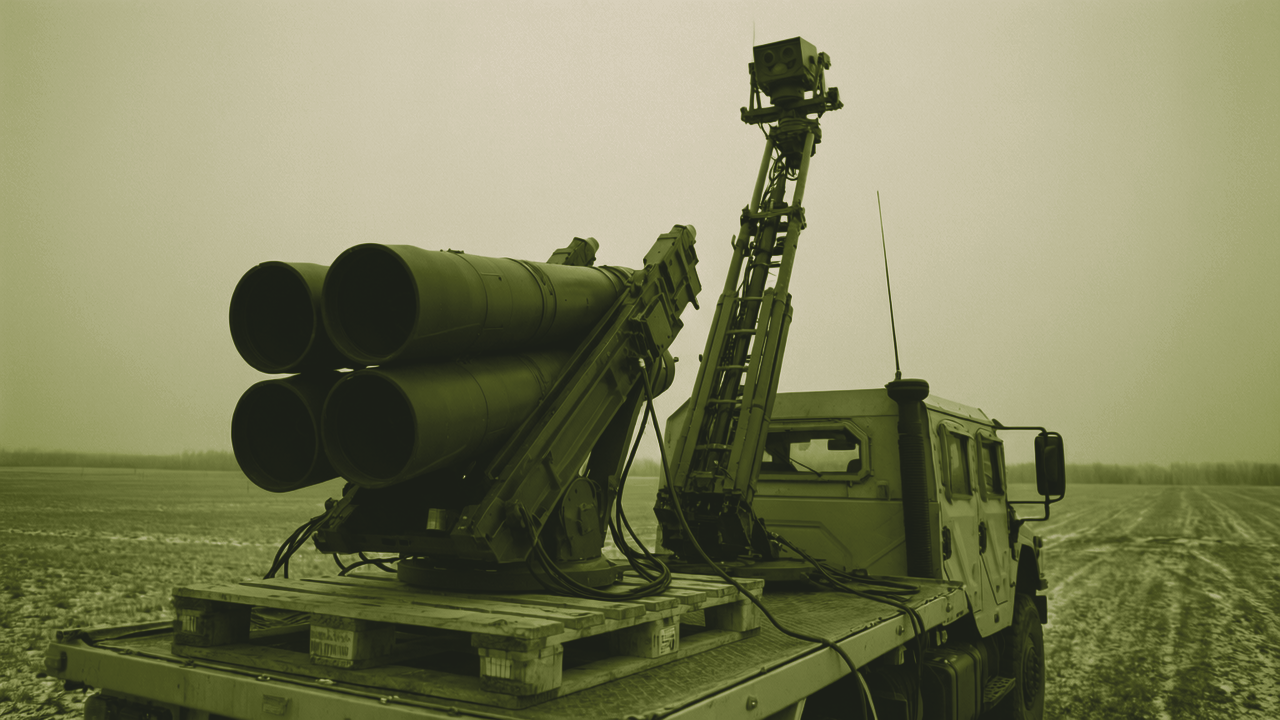
Shield AI's counter-drone software reaches a fielded weapon without Shield AI having to build one.
L3Harris Technologies has licensed Shield AI's Tracker Counter-Unmanned Aircraft System software to equip its VAMPIRE counter-drone platform, Shield AI announced on Sept. 1. Neither company disclosed financial terms. The arrangement pairs Shield AI's detection and tracking with VAMPIRE's guided-rocket engagement in one system. Shield AI, founded in 2015 and privately held, said it is also offering Tracker C-UAS for licensing onto other platforms operators already field.
Frequently Asked Questions
What did L3Harris and Shield AI actually agree?
L3Harris licensed Shield AI's Tracker Counter-Unmanned Aircraft System software to equip its VAMPIRE counter-drone platform, per Shield AI's Sept. 1 announcement. Financial terms were not disclosed.
What does Tracker C-UAS do?
It uses computer vision to detect, discriminate and track aerial threats in electro-optical and infrared video, per Shield AI. It works passively, without radar or radio-frequency emissions, so the operator's position is not broadcast.
What is VAMPIRE?
A palletized L3Harris kit that installs on most vehicles with a cargo bed and fires APKWS or other laser-guided munitions, with a WESCAM MX-10D electro-optical sensor on a telescoping mast, per L3Harris.
Who is buying VAMPIRE?
The US Army selected L3Harris to deliver the system on June 10 under an order the company put at up to $106 million. High-volume production opened in Huntsville, Alabama, in March. Militarnyi reports the system is in service with Ukraine's Defense Forces.
What is still unknown?
Neither company published a schedule, a unit count, or whether the Tracker-equipped configuration sits inside the Army order.
AI-generated summary, reviewed by an editor. More on our AI guidelines.
Below this point
4 more sections.
Tracker C-UAS uses computer vision to detect, discriminate and track aerial threats in electro-optical and infrared video, Shield AI said. It runs passively, with no radar or radio-frequency emission, so an operator can pick up a drone without broadcasting a position. What Shield AI does not own is a launcher. L3Harris supplies that half. VAMPIRE is a palletized kit that installs on most vehicles with a cargo bed, firing APKWS or other laser-guided munitions from a four-round launcher, with a WESCAM MX-10D electro-optical sensor mounted on a telescoping mast.
The launcher already has a buyer. The US Army selected L3Harris to deliver VAMPIRE on June 10 under an order the company put at up to $106 million. L3Harris opened a high-volume VAMPIRE line in Huntsville, Alabama, in March, built to raise volume as demand moves. It counts more than 350,000 operational hours for the system since 2023 and hundreds of drones shot down, mostly in European operations. VAMPIRE is in service with Ukraine's Defense Forces, Militarnyi noted.
The terms that would size the deal are missing. Neither company published a schedule, a unit count, or whether the Tracker configuration falls inside the Army order. L3Harris already describes the VAMPIRE family as using artificial intelligence and machine learning to detect and defeat small drones, so what Tracker adds is passive detection reach rather than a capability the launcher lacked outright. The companies point to an earlier demonstration that reached "ranges beyond those achievable with existing systems" and published no figure for it.
Deliveries against the $106 million Army order run out of Huntsville. Whether the units leaving it carry Tracker, and whether the Army pays for the software inside that order, is the first observable test of the licence.

Marcus Schuler
Marcus Schuler edits BattlePolicy, a daily defense-technology brief connecting the companies and capabilities behind modern war to the contest among Europe, the US, Russia, and China.