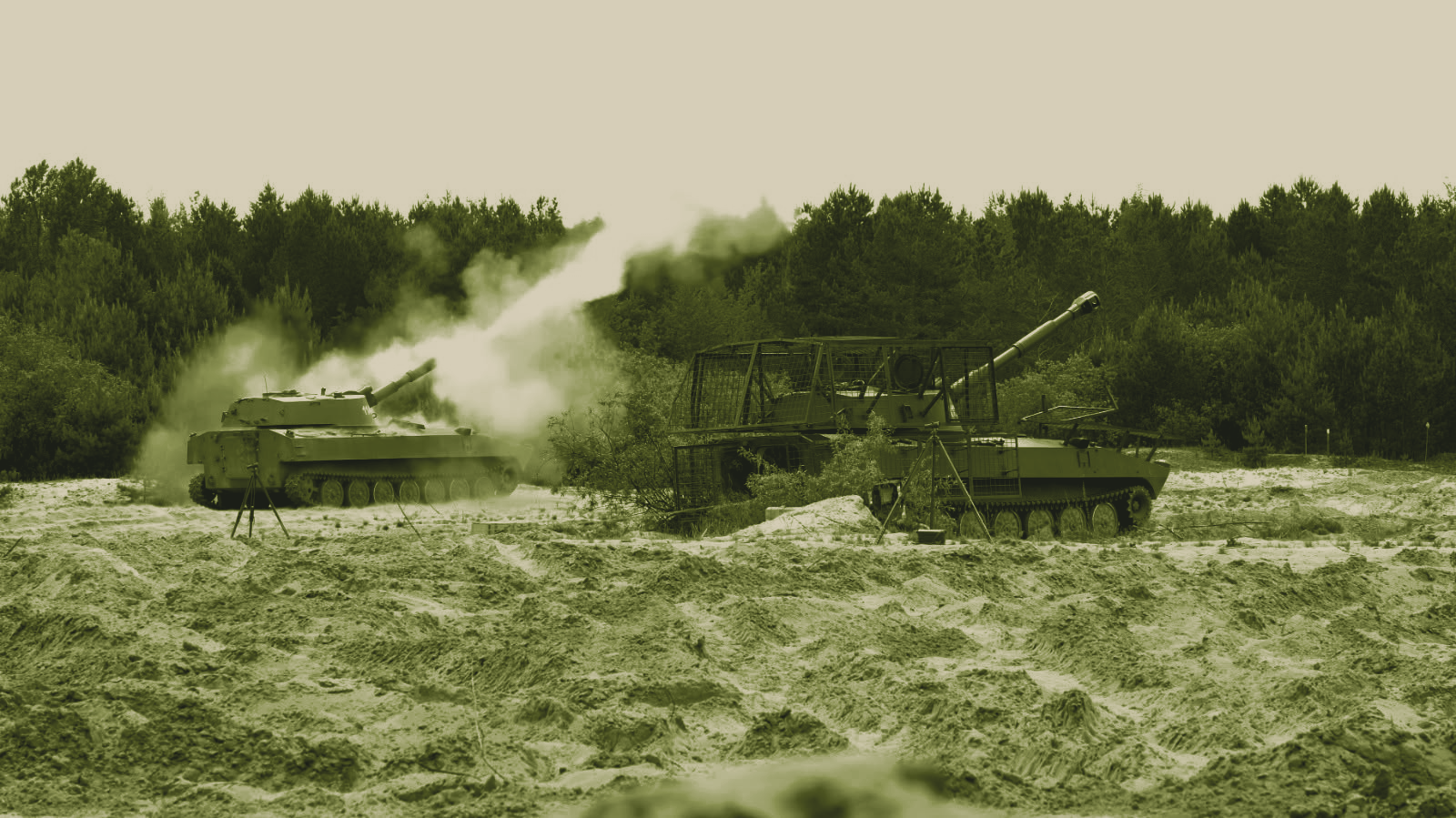
2S1 Gvozdika
The amphibious 122 mm howitzer that both armies still fire daily, and that both are losing faster than they can replace. Nearly 90% of Ukraine's pre-war Gvozdika fleet is assessed destroyed — and Russia is stripping the barrels off its own for spares.
The amphibious 122 mm howitzer that both armies still fire daily and that both are losing faster than they can replace. Nearly 90% of Ukraine's pre-war Gvozdika fleet is assessed destroyed, and Russia has begun stripping barrels off its own for use elsewhere.
Overview
The 2S1 Gvozdika ("Carnation"), designated M1974 by NATO, is a Soviet 122 mm self-propelled howitzer built on a lengthened MT-LB armoured chassis. It entered service in 1971 as divisional artillery, was produced in enormous numbers, and remains in use by both Russia and Ukraine — which is precisely why it matters here. It is not an exotic system; it is one of the guns that has actually been firing across the contact line for four years.
Its defining characteristics are ordinary: 122 mm calibre, about 15.2 km range, 4–5 rounds per minute, roughly 15,700 kg, forty rounds carried, and an amphibious hull. Nothing about it is competitive with a modern PzH 2000 or Caesar. What it offers is that it exists in quantity, both sides know how to maintain it, and 122 mm ammunition is the calibre Russia produces at scale.
By 2026 the story is attrition. Russian losses of the type exceed 174 destroyed or captured by one tally; Russian sources claim Ukraine has lost over 300; and one analysis assesses that nearly 90% of Ukraine's pre-war Gvozdika fleet has been confirmed destroyed.
Development
The 2S1 was developed in the late 1960s at the Kharkiv Tractor Plant to give Soviet motor-rifle divisions a self-propelled equivalent of the towed D-30 122 mm howitzer, whose ordnance it essentially adopted. The design priority was mobility and commonality rather than performance: the MT-LB-derived chassis is light, amphibious without preparation, and shares automotive components with a widely fielded armoured tractor.
Around 10,000 were produced in the Soviet Union and under licence in Poland, and the type was exported broadly across the Warsaw Pact, the Middle East and Africa. It was never significantly modernised in Russian service in the way the 2S19 Msta-S line was, and it entered the 2022 war essentially as designed.
The relevant 2020s development is not an upgrade programme but a cannibalisation one. OSINT analyst Jompy, reviewing Russian depot activity, reported that Russia rarely restores self-propelled guns from storage and instead removes barrels for reuse — Giatsint-B barrels onto the new wheeled 2S44 Giatsint-K, Msta-B barrels onto Msta-S, and 2S1 Gvozdika barrels removed for replacement elsewhere. The Gvozdika is being consumed as a spare-parts source as much as fielded as a weapon.
Design & capabilities
The 2S1 is a light, fully enclosed, turreted self-propelled howitzer.
- Calibre: 122 mm (2A18 howitzer, derived from the towed D-30)
- Range: approximately 15.2 km with standard high-explosive ammunition
- Rate of fire: 4–5 rounds per minute
- Combat weight: approximately 15,700 kg
- Ammunition carried: about 40 rounds
- Chassis: lengthened MT-LB with seven road wheels per side; amphibious without preparation
- Crew: 4
- Protection: thin steel armour sufficient against small arms and shell splinters only — it is an artillery vehicle, not an armoured one
Its role, per Soviet doctrine and current practice, is destroying enemy troops, artillery positions and fortifications, and clearing paths through minefields and obstacles. The amphibious capability and low ground pressure suit it to the soft, waterlogged terrain that characterises much of the Ukrainian front in spring and autumn — a genuine and under-remarked advantage over heavier Western systems.
Against the modern battlefield its limitations are severe. Fifteen kilometres of range places it well inside the reach of counter-battery radar and reconnaissance drones, its rate of fire does not support the shoot-and-scoot tempo that survival now demands, and its armour offers nothing against a top-attack FPV drone.
Variants
- 2S1 (baseline): The Soviet production standard, 122 mm on MT-LB-derived chassis.
- 2S1T / Goździk: Polish-built and modernised variants, some with updated fire control.
- Field-modified vehicles: Both sides have added cage and net anti-drone protection, and Ukrainian and Russian units have fitted assorted electronic-warfare emitters.
No significant Russian modernisation programme for the 2S1 has been identified; investment has gone to the Msta-S, Malva and 2S44 Giatsint-K lines instead.
Combat record / operational use
The 2S1 is used by both belligerents and is among the most frequently destroyed artillery systems of the war, which together make it a useful index of the artillery attrition problem.
Russian losses: visually confirmed destroyed or captured 2S1s exceeded 174 units by January 2026 per Militarnyi's tally — significant, though not the highest among Russian artillery losses, with the 2S3 Akatsiya exceeding it at 191.
Ukrainian losses: Russian state media claimed in January 2026 that Ukraine had lost more than 300 2S1s, noting that Western partners had largely stopped supplying self-propelled artillery, leaving Soviet-era systems prominent in Ukrainian units. Of roughly 300 Ukrainian self-propelled guns Russian sources claimed destroyed during 2025, 133 were 2S1 and 29 were 2S3. One independent analysis assessed that nearly 90% of Ukraine's pre-war Gvozdika fleet has been confirmed destroyed.
The proximate cause is drones. Typical engagements now follow a pattern visible in released footage: a Gvozdika is detected moving to or occupying a firing position and struck by an FPV drone before it fires a single round. Ukrainian units have destroyed 2S1s in Kursk Oblast and across the Donetsk axis; Russian unmanned-systems units have destroyed Ukrainian Gvozdikas near Kupyansk. Neither side's crews can rely on the vehicle surviving a detected firing position.
Misidentification between the 2S1 and 2S3 is common enough in combat footage that Ukraine's 81st Airmobile Brigade publicly corrected one such claim in May 2026 — the two Soviet howitzers look similar from a drone camera.
Advantages
- Available in quantity — roughly 10,000 built, and both sides inherited large fleets.
- 122 mm commonality — the same calibre as the widely held D-30 towed howitzer, and the calibre Russia produces at scale within an assessed ~7 million shells a year.
- Light and amphibious — 15.7 tonnes with low ground pressure and unprepared water crossing, well suited to soft Ukrainian terrain.
- Mechanically simple — MT-LB commonality means parts and expertise are widespread on both sides.
- Fully enclosed and turreted — protects the crew from splinters and small arms, unlike a towed gun.
- Understood by both armies — no training or doctrine transition required.
- Cheap to lose — a consideration that matters when the expected life of an artillery vehicle in a drone-saturated environment is short.
Drawbacks / limitations
- Short range — 15.2 km puts it inside the reach of counter-battery fire and reconnaissance drones for almost its entire engagement envelope.
- Slow rate of fire — 4–5 rounds per minute does not support modern shoot-and-scoot survival tactics.
- Negligible protection — thin steel offers nothing against top-attack FPV drones, which now account for most losses.
- Catastrophic loss rates — ~90% of Ukraine's pre-war fleet assessed destroyed; 174+ Russian vehicles confirmed lost.
- No modernisation path — neither side has invested meaningfully in upgrading it, and Russia is stripping barrels rather than restoring hulls.
- Barrel wear under wartime tempo — guns firing thousands of rounds a year against a design life of a few hundred are wearing out faster than they can be re-tubed.
- Small warhead for the mission — 122 mm is light against the fortified positions that dominate current fighting, where 152 mm and heavier are preferred.
Counterparts
- 2S3 Akatsiya (Russia/Ukraine) — the 152 mm Soviet stablemate, also used by both sides.
- Msta-S and Msta-B (Russia) — the 152 mm systems Russian investment has gone to instead.
- Malva (Russia) — the modern Russian wheeled 152 mm system replacing tracked SPGs.
- Bohdana (Ukraine) — Ukraine's domestically produced 155 mm wheeled howitzer, the intended successor.
- PzH 2000, Caesar, Krab, Zuzana 2 — the Western systems supplied to Ukraine that outrange it substantially.
- Fiber-optic FPV drone — the weapon most responsible for its losses.
Outlook
The 2S1's future is consumption. Neither side is modernising it, Russia is treating stored examples as a barrel supply, and loss rates on both sides exceed any realistic replacement. Ukraine's answer is the domestically built Bohdana and continued Western deliveries; Russia's is the Malva and 2S44 Giatsint-K wheeled systems and continued Msta-S production. The Gvozdika is what fills the gap until those arrive in sufficient numbers, and it is being spent doing so.
The barrel question deserves attention beyond this entry. Wartime firing rates — systems cycling through thousands of rounds a year against design lives of a few hundred — mean artillery is being lost to wear as well as to enemy action, and Jompy's observation that Russia strips barrels from stored Gvozdikas rather than restoring the vehicles is direct evidence that tubes, not hulls, are the binding constraint. Russian shell production assessed by Estonia at around 7 million rounds a year only intensifies that pressure.
The wider lesson is about what artillery survivability now requires. A gun that must sit at 15 km, fire slowly, and be seen doing it is not viable against pervasive drone reconnaissance. The systems that survive are those that shoot from further out and move immediately, which is exactly the design brief of the wheeled howitzers both sides are now buying.
Key specifications
| Spec | Value |
|---|---|
| Type | 122 mm tracked self-propelled howitzer |
| Calibre | 122 mm (2A18, D-30 derived) |
| Range | ~15.2 km with standard HE |
| Rate of fire | 4–5 rounds per minute |
| Combat weight | ~15,700 kg |
| Ammunition carried | ~40 rounds |
| Crew | 4 |
| Chassis | Lengthened MT-LB, amphibious without preparation |
| Protection | Thin steel — small arms and splinters only |
| Produced | ~10,000 in the USSR and Poland |
| Losses | 174+ Russian destroyed/captured (Jan 2026); Russian claims of 300+ Ukrainian; ~90% of Ukraine's pre-war fleet assessed destroyed |
Sources
- Militarnyi — "Drone from the 210th Assault Regiment Destroys Russian 2S1 Gvozdika." https://militarnyi.com/en/news/drone-from-the-210th-assault-regiment-destroys-russian-2s1-gvozdika/
- Odessa Journal — "OSINT researcher reports significant outflow of Russian artillery from military depots" (barrel cannibalisation). https://odessa-journal.com/public/osint-researcher-reports-significant-outflow-of-russian-artillery-from-military-depots
- UNITED24 Media — "Ukrainian Drones Wipe Out Russian 2S1 Gvozdika and D-30 Artillery Pieces." https://united24media.com/latest-news/ukrainian-drones-wipe-out-russian-2s1-gvozdika-and-d-30-artillery-pieces-video-11698
- Rossiyskaya Gazeta — "ВСУ потеряли более 300 самоходок 2С1 'Гвоздика'." https://rg.ru/2026/01/16/vsu-poteriali-bolee-300-shtuk-samohodok-2s1-gvozdika.html
- Tiscali — 2S1 vs 2S3 specification comparison and FPV engagement. https://www.tiscali.cz/video-rusti-delostrelci-se-zrovna-chystali-k-palbe-kdyz-je-zaskocili-ukrajinci-utekli-ale-s-delem-byl-konec-676237
- Army Recognition — "Estonia Warns Russia Expands War Preparations Against NATO as Artillery Shell Output Hits 7M." https://www.armyrecognition.com/news/army-news/2026/estonia-warns-russia-expands-war-preparations-against-nato-as-artillery-shell-output-hits-7m
- RBC-Ukraine — "Ukrainian paratroopers destroy Russian self-propelled gun in Kursk region." https://newsukraine.rbc.ua/news/ukrainian-paratroopers-destroy-russian-self-1766584361.html
🔒 The Analyst Section on 2S1 Gvozdika is for BattlePolicy Pro members. Below the line: procurement and contract history, the suppliers and companies behind the system, our head-to-head analyst view of the systems it actually competes with, and the BattlePolicy assessment note. Unlock the full file with BattlePolicy Pro →
Below this point
- Analyst Section
- Procurement & contracts
- Suppliers & related companies
- Comparable systems — analyst view
- Analyst note