The Wire · live GRID-REF 37°47′N 122°25′W
DISPATCH 03/26 · 4 Sep 2026
BattlePolicy
Startup to front line. Strategy to consequence.
Lexicon · Russia

2S3 Akatsiya

The 152 mm half of the Soviet self-propelled artillery pair still fighting on both sides. It outranges and outweighs the Gvozdika, it is the most-destroyed Russian artillery system by one tally, and drones now kill it before it fires.
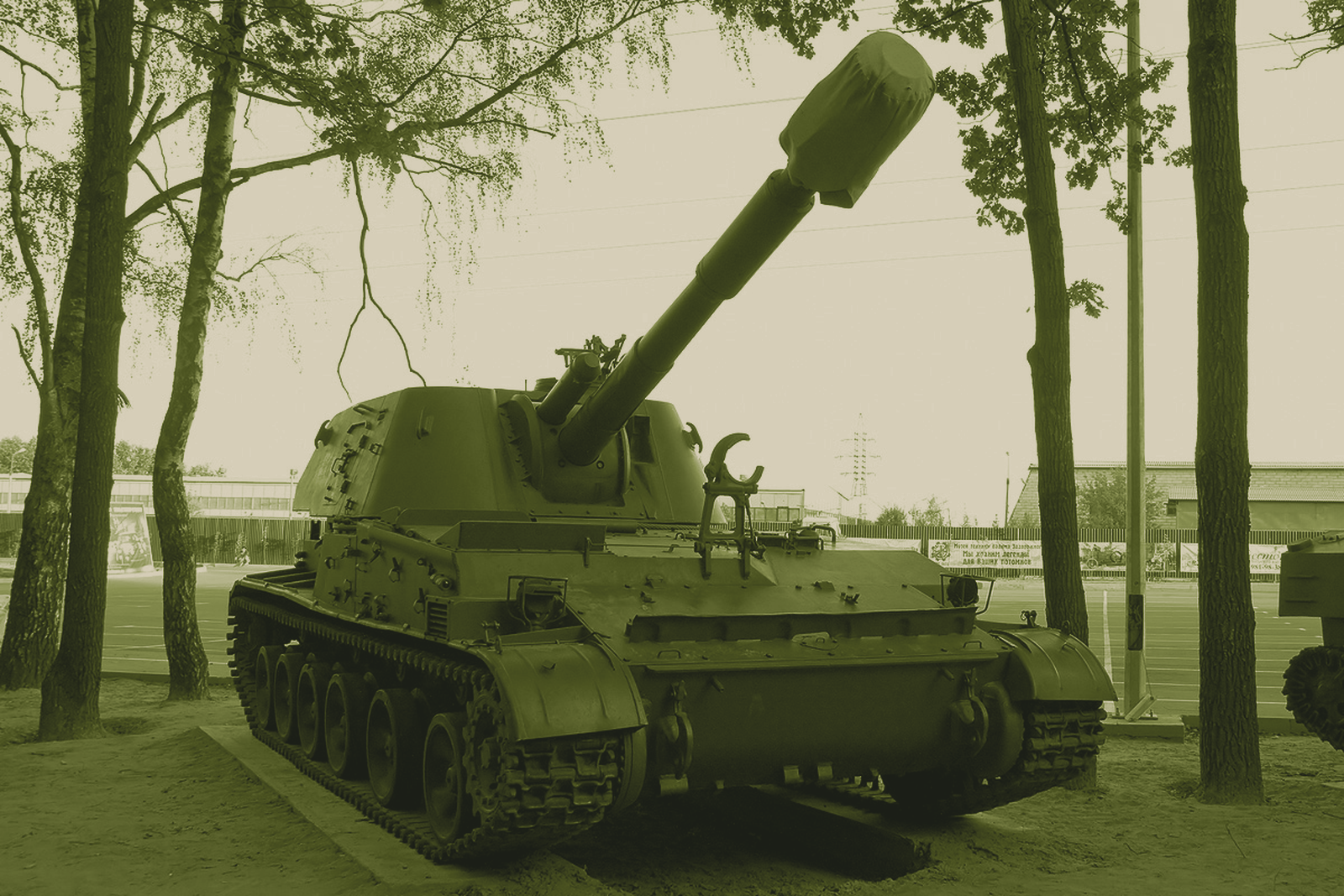
2S3 Akatsiya
FIG.01 · Russia Image - A 2S3 Akatsiya 152 mm self-propelled howitzer. Photo by Dmitry A. Mottl, CC BY-SA 3.0, via Wikimedia Commons.
The 152 mm half of the Soviet self-propelled artillery pair still fighting on both sides of this war. It outranges and outweighs the Gvozdika, it leads Russian artillery loss tallies, and the characteristic engagement now is a drone killing it before it fires a round.

Overview

The 2S3 Akatsiya ("Acacia"), designated M1973 by NATO, is a Soviet 152 mm tracked self-propelled howitzer that entered service in 1971 as the heavier partner to the 122 mm 2S1 Gvozdika. Where the Gvozdika was divisional artillery on a light amphibious chassis, the Akatsiya was army-level fire support: 17.3–20 km range, 3–4 rounds per minute, 27,500 kg, and 45 rounds carried.

Like the Gvozdika, it is fielded by both Russia and Ukraine — a fact that makes both systems awkward to report on, since destroyed vehicles in gun-camera footage are routinely misidentified by the side that killed them. It is also, by at least one tally, the most heavily lost Russian artillery system of the war: 191 destroyed or captured against 174 for the Gvozdika.

The 152 mm calibre is what keeps it relevant. Against the fortified positions that dominate the fighting in Donetsk Oblast, 152 mm does work that 122 mm does not, and it is a calibre Russia produces in volume.

Development

The 2S3 was developed at Uraltransmash in Sverdlovsk as the Soviet Army's standard 152 mm self-propelled howitzer, entering service alongside the 2S1 in 1971 as part of a comprehensive re-equipment of Soviet artillery from towed to self-propelled systems. Roughly 4,000 were built. Its ordnance derives from the D-20 towed gun-howitzer family, and its chassis is a purpose-built tracked hull rather than an adapted armoured tractor.

It was superseded in Soviet and Russian service by the 2S19 Msta-S, which offers substantially greater range and a modern fire-control system, and by later wheeled systems including the Malva and 2S44 Giatsint-K. The Akatsiya was not the subject of a significant Russian modernisation programme, and entered the 2022 war essentially in its Soviet configuration.

As with the Gvozdika, the notable 2020s development is depot behaviour rather than design. OSINT analysis of Russian storage sites found that self-propelled guns are rarely restored, with barrels harvested for newer platforms instead — Msta-B tubes going onto Msta-S, Giatsint-B tubes onto the wheeled 2S44. Stored Akatsiyas are subject to the same logic.

Design & capabilities

The 2S3 is a conventional tracked, turreted self-propelled howitzer of Soviet design.

  • Calibre: 152.4 mm (2A33, D-20 derived)
  • Range: 17.3–20 km with standard ammunition
  • Rate of fire: 3–4 rounds per minute
  • Combat weight: approximately 27,500 kg
  • Ammunition carried: about 45 rounds
  • Operational range: approximately 500 km on roads
  • Crew: 4
  • Protection: steel armour adequate against small arms and shell splinters; nothing more

The comparison with its stablemate is the useful frame:

2S1 Gvozdika 2S3 Akatsiya
Calibre 122 mm 152.4 mm
Range 15.2 km 17.3–20 km
Rate of fire 4–5 rds/min 3–4 rds/min
Weight 15,700 kg 27,500 kg
Rounds carried 40 45

The Akatsiya trades mobility and rate of fire for shell weight and reach. In terrain terms that is a real cost — at 27.5 tonnes it is not amphibious and handles soft ground far worse than the MT-LB-based Gvozdika — but 152 mm delivers roughly twice the explosive payload per round, which matters against dug-in infantry and fortifications.

Neither figure is competitive with modern systems. A PzH 2000 reaches beyond 40 km with base-bleed ammunition and fires at three times the rate; the Akatsiya's 20 km ceiling places it inside the counter-battery and drone-reconnaissance envelope for its entire engagement range.

Variants

  • 2S3 (baseline): The 1971 production standard.
  • 2S3M: Improved ammunition stowage and loading arrangement, increased ready rounds.
  • 2S3M1: Added a new sighting system and command-and-control equipment.
  • 2S3M2 / M3: Later Russian upgrade proposals with modernised fire control; not widely fielded.
  • Field modifications: Both sides have added cage and net anti-drone protection and improvised electronic-warfare fittings.

Combat record / operational use

The 2S3 is used by both belligerents and appears constantly in loss reporting from both directions.

Russian losses of the type exceeded 191 destroyed or captured by January 2026 — the highest among Russian artillery systems in Militarnyi's tally, ahead of the 2S1 Gvozdika at 174-plus. Ukrainian losses are harder to verify: Russian claims put 29 Ukrainian 2S3s destroyed during 2025 against 133 Gvozdikas, and one independent analysis assessed that over a quarter of Ukraine's pre-war Akatsiya fleet has been confirmed destroyed — a considerably better survival rate than the Gvozdika's ~90% loss figure, though from a smaller starting fleet.

The engagement pattern is consistent and telling. In May 2026, Ukraine's 81st Separate Airmobile Brigade released footage of a Russian 2S3 destroyed on the Slovyansk axis before it could reach a firing position and open fire — the brigade initially identified it as a Gvozdika and corrected the identification afterwards, an illustration of how similar the two look through a drone camera. In February 2026 the same brigade's Apache unmanned-systems battalion destroyed a 2S3 among eleven Russian artillery systems killed in a single week in the Serebrianskyi Forest.

That week's tally is the more instructive datum. Eleven artillery pieces destroyed by one drone battalion in seven days, in one forest, describes the tempo of artillery attrition that both sides now sustain — and explains why systems designed for a 1970s counter-battery environment are being consumed at rates no production line matches.

Advantages

  • 152 mm shell weight — roughly twice the explosive payload of a 122 mm round, and the calibre needed against fortifications and dug-in infantry.
  • Longer reach than the Gvozdika — 17.3–20 km against 15.2 km, a meaningful margin when both are inside counter-battery range.
  • Available in quantity — around 4,000 built, and inherited by both sides.
  • Calibre commonality — 152 mm is shared with Msta-S, Msta-B, 2S5 Giatsint and the towed D-20 family, and produced by Russia at scale.
  • Turreted and enclosed — full crew protection from splinters and small arms, unlike towed 152 mm guns.
  • Long road range — around 500 km without resupply.
  • Familiar to both armies — no training or logistics transition required.

Drawbacks / limitations

  • Outranged by everything modern — 20 km against 40 km-plus for Western systems with base-bleed ammunition means it cannot fight from outside counter-battery reach.
  • Slow rate of fire — 3–4 rounds per minute is inadequate for shoot-and-scoot survival.
  • Heaviest losses in the Russian artillery park — 191-plus destroyed or captured, more than any other Russian artillery system by one tally.
  • Poor soft-ground mobility — at 27.5 tonnes and non-amphibious, it is far more terrain-constrained than the Gvozdika.
  • Negligible protection against drones — killed routinely before firing.
  • No modernisation path — Russian investment went to Msta-S, Malva and 2S44 instead; stored examples are barrel donors.
  • Barrel wear — sustained wartime firing rates exhaust tubes far faster than peacetime design assumptions.

Counterparts

  • 2S1 Gvozdika (Russia/Ukraine) — the 122 mm stablemate, lighter, shorter-ranged and even more heavily lost.
  • Msta-S and Msta-B (Russia) — the 152 mm systems that superseded it.
  • 2S5 Giatsint and Malva (Russia) — the long-range and wheeled systems Russian investment has moved to.
  • Bohdana (Ukraine) — Ukraine's domestic 155 mm wheeled howitzer.
  • PzH 2000, Krab, Zuzana 2, Caesar — Western 155 mm systems supplied to Ukraine.
  • Fiber-optic FPV drone — the weapon killing it before it fires.

Outlook

The Akatsiya is being spent, not sustained. Neither side modernises it, Russia harvests stored examples for barrels, and losses on both sides exceed replacement by a wide margin. It persists because 152 mm ammunition is abundant, the crews know the vehicle, and there is nothing else available to fill the tube count while Msta-S, Malva and Bohdana production works through backlogs.

Its loss profile carries a lesson that generalises beyond Ukraine. The 2S3 was designed for a counter-battery environment in which finding a firing position took a radar fix, a fire mission and minutes of processing. It is now employed in one where a $500 drone finds it during displacement and kills it before the first round leaves the tube — as the 81st Airmobile Brigade's May 2026 footage documents precisely. No amount of cage armour changes that; the answer is range and displacement speed, which is why both sides are buying wheeled howitzers that shoot from 40 km and move in under a minute.

Watch the tube supply. With Russian shell output assessed at around 7 million rounds a year and barrels being stripped from stored vehicles, the constraint on Russian artillery is shifting from ammunition to the guns that fire it — and the Akatsiya, as the most-lost system in the park, is where that shortage will show first.

Key specifications

Spec Value
Type 152 mm tracked self-propelled howitzer
Calibre 152.4 mm (2A33, D-20 derived)
Range 17.3–20 km with standard ammunition
Rate of fire 3–4 rounds per minute
Combat weight ~27,500 kg
Ammunition carried ~45 rounds
Operational range ~500 km on roads
Crew 4
Protection Steel armour — small arms and splinters only
Produced ~4,000 in the USSR
Losses 191+ Russian destroyed/captured (Jan 2026) — highest of any Russian artillery system by that tally; over a quarter of Ukraine's pre-war fleet assessed destroyed

Sources

  1. UNITED24 Media — "Ukraine's FPV Drones Catch Russian 2S3 Akatsiya Artillery System Before It Can Open Fire." https://united24media.com/war-in-ukraine/ukraines-fpv-drones-catch-russian-2s3-akatsiya-artillery-system-before-it-can-open-fire-video-19138
  2. Militarnyi — "Drone from the 210th Assault Regiment Destroys Russian 2S1 Gvozdika" (comparative loss tallies). https://militarnyi.com/en/news/drone-from-the-210th-assault-regiment-destroys-russian-2s1-gvozdika/
  3. ArmyInform — "Guns Don't Live Long — 11 Russian Artillery Systems Destroyed in One Week in the Serebrianskyi Forest." https://armyinform.com.ua/en/2026/02/06/guns-dont-live-long-11-russian-artillery-systems-destroyed-in-one-week-in-the-serebrianskyi-forest/
  4. Odessa Journal — "OSINT researcher reports significant outflow of Russian artillery from military depots." https://odessa-journal.com/public/osint-researcher-reports-significant-outflow-of-russian-artillery-from-military-depots
  5. Tiscali — 2S1 vs 2S3 specification comparison. https://www.tiscali.cz/video-rusti-delostrelci-se-zrovna-chystali-k-palbe-kdyz-je-zaskocili-ukrajinci-utekli-ale-s-delem-byl-konec-676237
  6. GlobalMilitary.net — "2S3 Akatsiya Self-Propelled Howitzer." https://www.globalmilitary.net/vehicles/2s3-akatsiya/
  7. Army Recognition — "Estonia Warns Russia Expands War Preparations Against NATO as Artillery Shell Output Hits 7M." https://www.armyrecognition.com/news/army-news/2026/estonia-warns-russia-expands-war-preparations-against-nato-as-artillery-shell-output-hits-7m
🔒 The Analyst Section on 2S3 Akatsiya is for BattlePolicy Pro members. Below the line: procurement and contract history, the suppliers and companies behind the system, our head-to-head analyst view of the systems it actually competes with, and the BattlePolicy assessment note. Unlock the full file with BattlePolicy Pro →

Below this point

  • Analyst Section
  • Procurement & contracts
  • Suppliers & related companies
  • Comparable systems — analyst view
  • Analyst note
Related
Russia · Ukraine · air defensePro

Igla-S

A shoulder-fired infrared missile that Russia now launches from helicopters to hunt Ukrainian drones — and bolts to Shahed airframes so the drone can shoot back at the aircraft sent to intercept it.

Russia · Ukraine · air defensePro

Strela-10

A 1976 Soviet missile system built to shoot down low-flying jets, now hunting Lancets and Hornets. Its infrared seeker was never designed to find something the size of a quadcopter — which is why Ukraine bolted an electro-optical sight to nine of them.

Ukraine · Russia · air defensePro

ZSU-23-4 Shilka

A 1965 Soviet anti-aircraft gun built to shoot down jets, now one of the cheapest ways Ukraine kills Shahed drones. Sixteen modernised Shilkas funded by a charity recorded their first Shahed shootdowns in December 2025.