Alexa Spatium
Ukraine's first domestically built jet-powered interceptor drone, codified in August 2026 to close the speed gap that Russia's turbojet Geran-4 and Geran-5 opened over the cheap propeller interceptors that had been beating the Shahed.
Overview
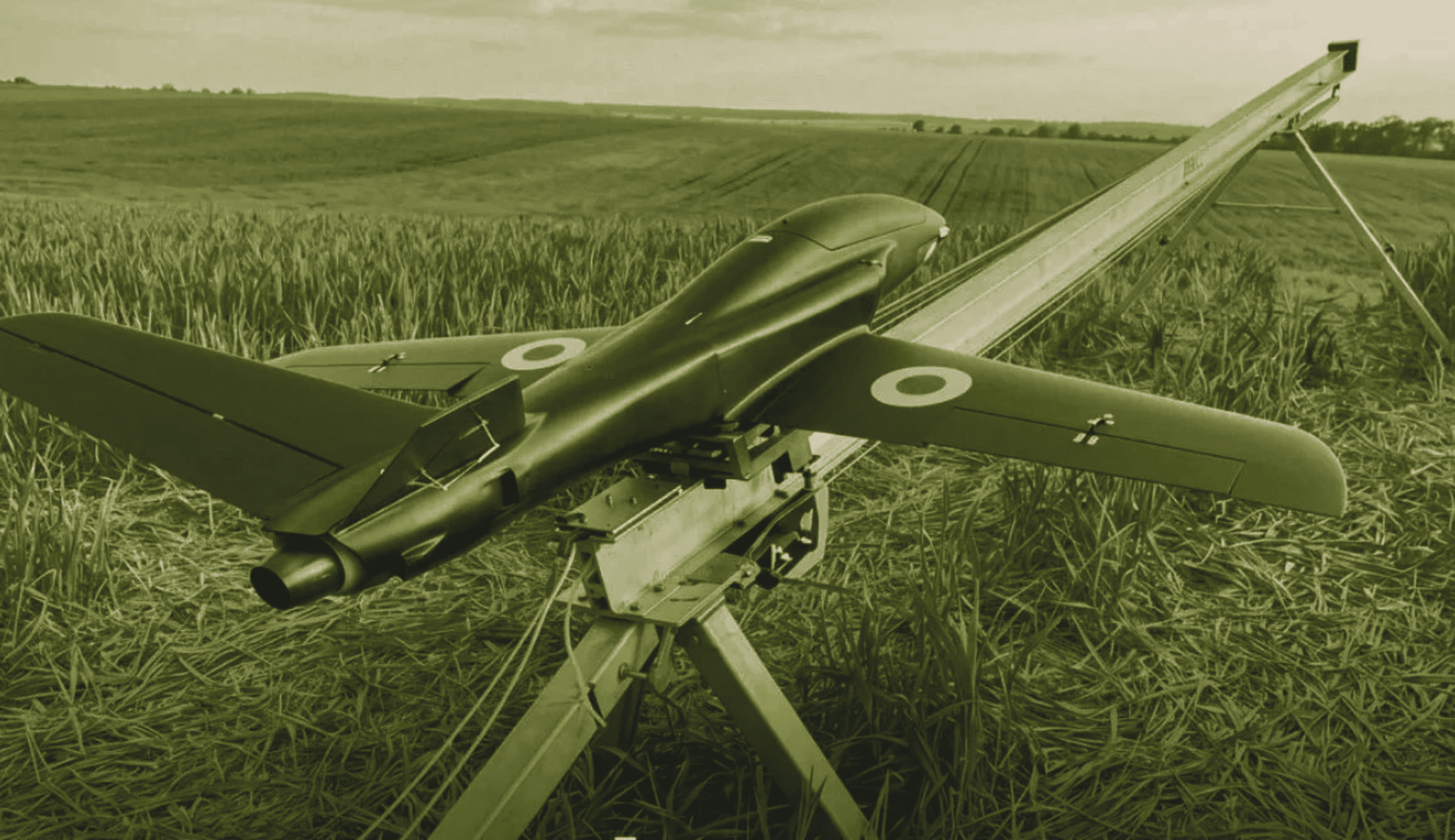
The Alexa Spatium is a turbojet-powered interceptor drone accepted into service with Ukraine's Defence Forces on 21 August 2026, the first Ukrainian-built interceptor designed specifically to engage jet-powered one-way attack drones. It exists to solve a problem Ukraine created for itself and Russia then solved around: cheap, electrically powered interceptor drones costing on the order of $1,000–5,000 had become the effective answer to the 180 km/h piston Shahed-136, so Russia moved to turbojet airframes — the Geran-4 at 350–500 km/h and the Geran-5 at up to 600 km/h — that simply outran them.
The Ukrainian Ministry of Defence describes an airframe roughly 1.5 by 1.7 metres, launched from a mobile catapult within minutes, guided by television and infrared sensors, carrying interchangeable warheads, and — unusually for an interceptor — able to return to its launch point for reuse if it does not expend itself on a target.
A note on sourcing. Ukraine has published unusually little about this system. The manufacturer has not been disclosed, and no official maximum speed, range or ceiling has been released. Figures above 600 km/h circulate widely in secondary and social-media reporting but do not appear in any ministry-confirmed specification, and are not stated as fact here.
Development
Alexa Spatium is the product of an urgent, explicitly stated capability gap. Through the first half of 2026 Ukraine's interceptor-drone force was killing the bulk of subsonic Shahed-type drones, but Russian jet-drone use rose fivefold between June and July 2026, and in some raids turbojet types made up half to two-thirds of the strike package. A Ukrainian counter-drone specialist told RFE/RL in late August that there was still "no effective means that can intercept them on a large scale and with certainty."
The Defence Ministry announced on 21 August 2026 that Alexa Spatium had been codified — Ukraine's formal acceptance step — and had met the tactical and technical specifications recorded during testing, per Militarnyi. The ministry emphasised that it was developed and manufactured by Ukrainian engineers, while withholding the producer's identity, a common protective measure for Ukrainian firms exposed to Russian strikes.
It is not the only candidate. Defence Minister Yevhen Khmara said on 30 August 2026 that four interceptor designs had been field-tested against jet Gerans, and that the task was to bring them to the required standard and scale production to thousands of units. Competing Ukrainian designs include F-Drones' LITAVR+, advertised against targets above 400 km/h, the UV Military Cluster's Crazy, and upgraded versions of the established Sting.
Design & capabilities
Public detail is thin and deliberately so. What the Ministry of Defence and Ukrainian defence media have confirmed:
- Propulsion: a turbojet engine — the defining change from the electric and piston interceptors that preceded it, and the reason the type can be pointed at a Geran-4 or Geran-5 at all.
- Airframe: approximately 1.5 × 1.7 m, described as a V-tail unmanned aircraft of modular design.
- Launch: from a mobile catapult, deployable within minutes — important because jet Gerans cross the border at high speed and altitude, compressing the warning-to-engagement window and rewarding dispersed, quickly relocated launch positions.
- Sensors and guidance: television and infrared seekers, with the drone flown either to pre-programmed coordinates or under direct operator guidance.
- Warheads: interchangeable, with high-explosive fragmentation, shaped-charge and thermobaric options reported.
- Envelope: a high operational ceiling, extended combat radius, and low-to-medium operating altitudes are claimed without numbers attached.
- Reusability: the system is reported able to return to launch for reuse where the intercept is not completed — a meaningful economic feature for a jet-powered airframe that necessarily costs far more than the $1,000-class propeller interceptors it supplements.
The declared target set is broader than jet drones alone: Geran-3, Geran-4 and Geran-5 strike drones, the Shahed-131, reconnaissance drones, helicopters, and small ground and surface targets.
Variants
No variants have been disclosed. The modular design and interchangeable warhead options suggest a family is intended rather than a single fixed configuration, but nothing has been publicly confirmed. Alexa Spatium should be read as one entrant in a field of at least four Ukrainian jet or high-speed interceptor programmes rather than as a settled national standard.
Combat record / operational use
No confirmed intercepts have been publicly attributed to Alexa Spatium as of early September 2026. Codification on 21 August means the type has passed testing and entered procurement, not that it has accumulated a combat record; Ukrainian officials have described the immediate task as scaling production rather than reporting kills.
The context it enters is punishing. Russia produces roughly 3,000 Geran-4 and Geran-5 airframes a month, more than the piston Geran-2 line, and holds an assessed stockpile of about 6,200 Geran-type drones with salvos of 150–200 and occasionally around 300. On 1 September 2026 Ukrainian air defence downed 82 attack drones during daylight hours, 57 of them jet-powered. Any interceptor entering service now is measured against a threat arriving in the hundreds per night, concentrated on energy infrastructure, logistics and rail.
Reported kills of jet Gerans in the same period have been credited to the existing Sting rather than to Alexa Spatium.
Advantages
- Speed class matched to the threat — a turbojet interceptor can be vectored at a Geran-4 or Geran-5, which propeller and electric interceptors physically cannot catch.
- Reusable — return-to-launch recovery spreads the cost of an expensive airframe across multiple sorties, partly offsetting the economics that make jet interception unattractive.
- Dual-mode seeking — television plus infrared gives an engagement path that does not depend on a satellite-navigation fix, useful against low-signature targets at night.
- Rapid, dispersed launch — mobile catapult deployment in minutes suits the short warning times jet drones impose and complicates Russian counter-battery targeting.
- Warhead flexibility — interchangeable HE-fragmentation, shaped-charge and thermobaric options allow tuning against drones, helicopters or surface targets.
- Domestic production — no export licence, no partner-nation approval, and no foreign delivery schedule between the requirement and the airframe.
Drawbacks / limitations
- Almost nothing is verified — speed, range, ceiling, cost, production rate and manufacturer are all undisclosed. Widely repeated "600+ km/h" figures have no official source.
- No combat record — codification is an administrative milestone, and the type had no publicly confirmed intercepts as of early September 2026.
- Cost asymmetry runs the wrong way — a turbojet interceptor is far dearer than the $1,000-class drones that beat the piston Shahed, so Ukraine is now paying up to defend, exactly as Russia paid up to attack.
- Scale is the unsolved problem — the minister's own framing is that these designs must reach "thousands of units," against a threat produced at 3,000 a month.
- One of four — it is not yet clear that Alexa Spatium is the design Ukraine will mass-produce; three other candidates are in test.
- Weather-limited — cloud and fog already degrade optically guided interceptors, and a TV/IR seeker inherits that constraint.
Counterparts
- Sting (Ukraine) — the established interceptor drone that scored the first kills against jet-powered Shaheds; slower, cheaper, far more numerous.
- Geran-4 and Geran-5 (Russia) — the primary targets, and the reason this system exists.
- Geran-3 (Russia) — the slower jet Geran, repeatedly intercepted, whose vulnerability drove Russia to the faster variants.
- Fortem DroneHunter F700 (USA) — a Western reusable counter-drone interceptor built on capture rather than kinetic kill.
- Anduril Roadrunner (USA) — a reusable, vertical-launch jet interceptor pursuing the same recoverable-effector logic at higher cost.
Outlook
Alexa Spatium is best read as a marker in a race rather than a solution to it. Its significance is that Ukraine has demonstrated it can field a domestically designed turbojet interceptor within months of the threat that motivated it — the Geran-4 entered combat in May 2026 and a Ukrainian jet answer was codified in August. That iteration speed is the genuinely notable fact.
What it does not yet demonstrate is economics or scale. Deputy commander-in-chief Andriy Lebedenko said in July 2026 that Ukraine's most scalable answer would be armed aircraft-type platforms manoeuvring at 300–800 km/h at jet-Shahed altitudes, "economically viable" and mass-producible — a description that fits this class of system but describes a programme, not an inventory. Three questions decide whether Alexa Spatium matters: whether it or one of the other three candidates is selected for mass production, whether unit cost lands low enough to trade favourably against a Geran-4 carrying a $35,000–40,000 Chinese turbojet, and whether reusability survives contact with real intercept geometry. Until production numbers are public, the type is a capability statement.
Key specifications
| Spec | Value |
|---|---|
| Type | Jet-powered interceptor drone (reusable) |
| Range | Not disclosed; "extended combat radius" claimed |
| Speed | Not officially disclosed; unofficial reports of 600+ km/h are unsourced |
| Warhead (type & weight) | Interchangeable — HE-fragmentation, shaped-charge or thermobaric; weights not disclosed |
| Guidance | Television and infrared seekers; pre-programmed coordinates or direct operator guidance |
| Accuracy (CEP) | Not applicable / not disclosed |
| Launch platform(s) | Mobile catapult, deployable within minutes |
| Propulsion | Turbojet |
| Length / diameter / launch weight | Airframe footprint ~1.5 × 1.7 m; V-tail configuration; weight not disclosed |
| Target set | Geran-3/4/5, Shahed-131, reconnaissance drones, helicopters, small ground and surface targets |
Sources
- Militarnyi — "Alexa Spatium Jet Interceptor Enters Ukrainian Defense Forces Service." https://militarnyi.com/en/news/alexa-spatium-jet-interceptor-enters-ukrainian-defense-forces-service/
- The Defense Post — "Ukraine Adds Jet-Powered Interceptor to Neutralize Shahed-Type Drones." https://thedefensepost.com/2026/08/24/ukraine-jet-powered-interceptor/
- Euromaidan Press — "Meet Alexa Spatium, which can carry thermobaric warheads and fly back home." https://euromaidanpress.com/2026/08/22/ukraine-has-shown-its-answer-to-russias-most-powerful-drones-for-first-time-meet-alexa-spatium-which-can-carry-thermobaric-warheads-and-fly-back-home/
- Army Technology — "Ukraine targets Russian UAVs with new Alexa Spatium drone interceptor." https://www.army-technology.com/news/ukraine-alexa-spatium-russia/
- Militarnyi — "Ukraine Tests Four Interceptors to Counter Jet-Powered Geran Drones." https://militarnyi.com/en/news/ukraine-tests-four-interceptors-to-counter-jet-powered-geran-drones/
- RFE/RL — "Russia's Jet-Powered Drones: A Major New Threat To Ukraine Amid Speeding Arms Race." https://www.rferl.org/a/russia-ukraine-jet-powered-drones-shahed-geran/33841747.html
- The Register — "Ukraine unveils native jet-powered drone interceptor." https://www.theregister.com/offbeat/2026/08/25/ukraine-unveils-native-jet-powered-drone-interceptor/5292081
- Kyiv Post — "Meet 'Alexa Spatium' — Ukraine's New Jet-Powered Interceptor Drones." https://www.kyivpost.com/post/83175
- UNITED24 Media — "How Ukraine's LITAVR+ Interceptor Hunts Jet-Powered Shahed Drones." https://united24media.com/defense-tech/how-ukraines-litavr-interceptor-hunts-jet-powered-shahed-drones-21540
🔒 The Analyst Section on Alexa Spatium is for BattlePolicy Pro members. Below the line: procurement and contract history, the suppliers and companies behind the system, our head-to-head analyst view of the systems it actually competes with, and the BattlePolicy assessment note. Unlock the full file with BattlePolicy Pro →
Below this point
- Analyst Section
- Procurement & contracts
- Suppliers & related companies
- Comparable systems — analyst view
- Analyst note