The Wire · live GRID-REF 37°47′N 122°25′W
DISPATCH 03/26 · 4 Sep 2026
BattlePolicy
Startup to front line. Strategy to consequence.
Lexicon · Russia

Kh-59

The precision half of Russia's air-launched arsenal. Where the Kh-22 lands within half a kilometre of where it was aimed, the Kh-59MK2 is credited with metres — and it is the missile Ukrainian air defence reports intercepting one at a time.
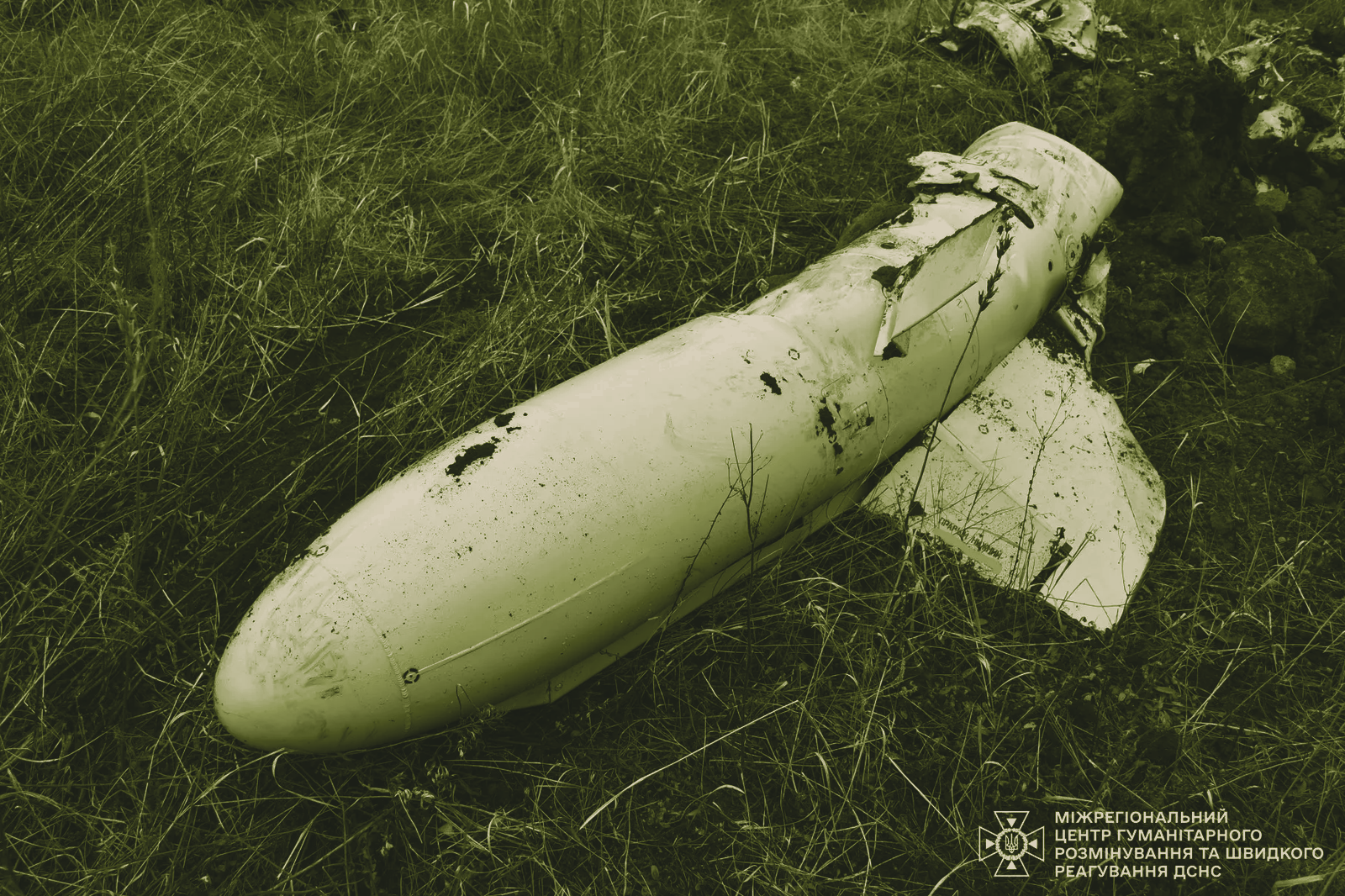
Kh-59
FIG.01 · Russia Image - A Kh-59 air-launched standoff missile. Photo by State Emergency Service of Ukraine, CC BY 4.0, via Wikimedia Commons.
The precision half of Russia's air-launched arsenal. Where a Kh-22 lands within a few hundred metres of where it was aimed, the improved Kh-59 is credited with single-digit metres — and unlike the drones that dominate the nightly tallies, it arrives one or two at a time against targets someone chose carefully.

Overview

The Kh-59 "Ovod" (Gadfly), designated AS-13 Kingbolt by NATO, is a Soviet-designed air-launched standoff missile that has been progressively stretched from a 40 km television-guided weapon into a family reaching close to 290 km. It is subsonic, turbojet-powered after a solid-rocket boost, and flies low — as low as 4 m in the latest variants — which is what makes it survivable rather than speed.

It sits at the opposite end of the Russian inventory from the Kh-22. Where the Kh-22 delivers nearly a tonne of explosive somewhere in the vicinity, the Kh-59MK2 is credited with a circular error probable of 2–3 m and a 310–320 kg warhead. Ukrainian Air Force reporting routinely groups it with its newer, low-observable derivative as "Kh-59/69," and the pairing appears in daily strike tallies alongside Kalibr and Kh-101 cruise missiles — usually in ones and twos rather than the dozens that characterise drone waves.

Development

The Kh-59 entered Soviet service in the early 1980s as a television-command-guided air-to-surface missile developed by the Raduga Design Bureau, giving strike aircraft a way to hit point targets from outside short-range air-defence coverage. The baseline weapon was modest: roughly 40–45 km of range and a 148 kg warhead, with an operator watching a TV picture relayed from the missile and steering it onto the target.

Every subsequent variant has traded that operator dependence for range and autonomy. The Kh-59M added a turbojet sustainer and a heavier 320 kg warhead, pushing range to 115 km (200 km in some export configurations). The Kh-59MK was optimised for large naval targets at around 285 km. The Kh-59MK2 — the version most relevant to the Ukraine war — replaced television command guidance with inertial navigation plus satellite correction, extended range to 285–290 km, and shortened the airframe considerably in updated builds.

The line continues in the Kh-69, a low-observable derivative with a flattened cross-section designed for internal carriage. Russian sources attribute roughly 400 km to the domestic Kh-69 against the 290 km cited in export material, and it has been integrated onto the Su-57 for standoff strike missions reported in August 2026. Because the two are hard to tell apart from radar tracks and debris, Ukrainian reporting treats them as one category.

Design & capabilities

The Kh-59 family shares an airframe concept — a slender fuselage with pop-out wings, a solid-rocket booster in the tail for launch and a turbojet in an underslung pod for cruise — while differing substantially in range, guidance and warhead.

Variant Range Launch mass Warhead Guidance
Kh-59 (base) 40–45 km 760–790 kg ~148 kg Television command
Kh-59M / ME 115 km (ME to 200 km) ~930 kg 320 kg penetrating / 280–283 kg cluster TV + inertial
Kh-59MK ~285 km up to 930 kg 320 kg Active radar (anti-ship)
Kh-59MK2 285–290 km 770–900 kg 310–320 kg Inertial + satellite correction
  • Speed: 750–1,080 km/h depending on variant and profile — firmly subsonic, and slower than a Kalibr at terminal.
  • Flight altitude: 15–1,100 m on the base missile, 7–1,000 m on the Kh-59M, and 4–300 m on the MK2. That last figure is the survivability mechanism: a missile at 4 m over rolling terrain is below the horizon of most ground radars until it is very close.
  • Accuracy: improved variants are credited with 2–3 m CEP under favourable conditions, an order of magnitude better than the Kh-22 family and comparable to Western standoff weapons.
  • Length: 5.37 m on the base missile, 5.7 m on the M and MK, with updated MK2 builds reported around 4.2 m.
  • Carriage: Su-24M, Su-30, Su-34 and Su-35 aircraft; the Kh-69 derivative extends to the Su-57.

Variants

  • Kh-59 (base): Television command guidance, 40–45 km, 148 kg warhead. Largely superseded.
  • Kh-59M / Kh-59ME: Turbojet sustainer, 320 kg penetrating or 280–283 kg cluster warhead, 115–200 km.
  • Kh-59MK: Anti-ship variant with active radar homing, ~285 km against large surface targets.
  • Kh-59MK2: The current land-attack standard — inertial plus satellite guidance, 285–290 km, 310–320 kg warhead, very low cruise altitude.
  • Kh-69: Low-observable successor with a flattened cross-section for internal carriage, ~290 km declared and 300–400 km assessed. Fielded on the Su-57.

Combat record / operational use

The Kh-59 has been used against Ukraine throughout the full-scale war, and its signature in the record is its scarcity rather than its volume. Ukrainian Air Force tallies list it in single figures: on 14 March 2026, alongside 402 drones, 25 Kalibr and 24 Kh-101 cruise missiles, Ukraine reported downing one Kh-59/69. On the night of 16–17 July 2026 ISW recorded seven Kh-59/69 launched from occupied Crimea alongside one Kh-31P and 130 drones. On 10 August 2026 a single Kh-59/69 was fired from the Black Sea with 126 drones and three Banderol loitering munitions, and Ukrainian countermeasures prevented it reaching its target.

That pattern is the useful observation. The Kh-59 is not a saturation weapon. It is launched in ones and sevens against targets that justify a precision missile fired from a manned aircraft, and it accompanies drone packages that occupy the defence.

Its use has extended to maritime targets. In July 2026 a Turkish merchant vessel was struck by three Kh-59/Kh-69 missiles, an attack that drew attention to the type's low-altitude approach and the difficulty of engaging it over water where terrain masking is absent but detection ranges are still compressed by altitude.

The Kh-69 derivative has meanwhile become the standoff weapon associated with Su-57 operations, giving Russia a low-observable launch platform paired with a low-observable missile.

Advantages

  • Genuinely precise — 2–3 m CEP on improved variants puts it in the same class as Western standoff weapons and far ahead of the rest of Russia's Soviet-legacy air-launched inventory.
  • Very low cruise altitude — 4–300 m on the MK2 keeps the missile below ground-radar horizons for most of its flight.
  • Long reach for a tactical weapon — 285–290 km lets Su-34s and Su-35s launch from well inside Russian-controlled airspace.
  • No operator dependence — inertial plus satellite guidance on the MK2 removed the datalink and the vulnerable operator-in-the-loop of the original design.
  • Broad carriage — compatible with the Su-24M, Su-30, Su-34 and Su-35 fleets already in service.
  • Modernisation path proven — the same airframe concept has been stretched from 40 to 290 km and evolved into the low-observable Kh-69.

Drawbacks / limitations

  • Subsonic and interceptable — at 750–1,080 km/h it is well within the engagement envelope of Patriot, NASAMS, IRIS-T SLM and even gun systems once detected, and Ukraine downs them.
  • Small warhead relative to Soviet peers — 310–320 kg is a third of a Kh-22's payload and is a precision weapon's warhead, not a demolition one.
  • Requires a manned launch aircraft — every sortie exposes a Su-34 or Su-35 crew, unlike a ground-launched drone.
  • Satellite-guidance dependence — the MK2's accuracy relies on GLONASS correction, which Ukrainian electronic warfare targets directly.
  • Expensive per effect — a precision cruise missile fired in ones and twos cannot compete on cost with 3,000 jet Gerans a month, which is why it is reserved for specific targets.
  • Variant confusion — public reporting conflates Kh-59 and Kh-69 into a single category, so type-specific performance data is scarce.

Counterparts

  • Kh-69 (Russia) — the low-observable successor in the same family, reported at 300–400 km.
  • Kh-101 (Russia) — the strategic air-launched cruise missile with far greater range and a larger warhead.
  • Kh-22 (Russia) — the supersonic heavyweight at the opposite end of the accuracy spectrum.
  • Kh-31 (Russia) — the supersonic anti-radiation and anti-ship missile carried by the same aircraft.
  • Storm Shadow (UK/France) — the Western equivalent in the precision standoff class, used by Ukraine.
  • ERAM (USA) — the low-cost American answer in the same mission space.

Outlook

The Kh-59's future is really the Kh-69's. The older variants are a finite Soviet-era stock being consumed, while the low-observable derivative is the growth line, matched to the Su-57 and to a Russian strike doctrine that increasingly separates cheap mass from expensive precision. Drones and glide bombs do volume; the Kh-59/69 does the targets that need a metre of accuracy.

For Ukrainian air defence the type poses a specific problem that jet drones do not. A missile cruising at 4 m and 1,000 km/h gives very little warning and cannot be engaged by the interceptor drones and mobile gun groups that handle Shaheds — it requires a proper SAM with a low-altitude engagement capability, which is exactly the scarce resource. That the Kh-59 is fired in ones and twos is the only reason this is manageable.

Watch two things: whether Kh-69 production scales enough to shift the mix away from legacy Kh-59 stocks, and whether the Su-57 standoff pairing produces launches from ranges that put Ukrainian defenders outside any counter-launch option.

Key specifications

Spec Value
Type Air-launched standoff cruise missile
Range 40–45 km (base); 115–200 km (M/ME); 285–290 km (MK/MK2)
Speed (Mach / km·s⁻¹) 750–1,080 km/h (~0.6–0.9 Mach), subsonic
Warhead (type & weight) ~148 kg (base); 320 kg penetrating or 280–283 kg cluster (M); 310–320 kg (MK2)
Guidance TV command (base); inertial + satellite correction with terminal EO (MK2); active radar (MK, anti-ship)
Accuracy (CEP) 2–3 m claimed for improved variants under favourable conditions
Launch platform(s) Su-24M, Su-30, Su-34, Su-35; Kh-69 derivative on Su-57
Propulsion Solid-rocket booster plus turbojet sustainer
Length / diameter / launch weight 5.37–5.7 m (MK2 updated ~4.2 m) / 0.38 m / 760–930 kg
Cruise altitude 15–1,100 m (base); 7–1,000 m (M); 4–300 m (MK2)

Sources

  1. Army Recognition — "Kh-59 Ovod AS-13 Kingbolt." https://www.armyrecognition.com/military-products/army/missiles/cruise-missiles/kh-59-ovod-as-13-kingbolt
  2. Army Recognition — "Russia's Su-57 Standoff Strike Operations Signal New Phase in Air-Launched Missile Warfare." https://www.armyrecognition.com/news/aerospace-news/2026/russias-su-57-standoff-strike-operations-signal-new-phase-in-air-launched-missile-warfare
  3. Ukrainska Pravda — "Russia attacks Ukraine with Kh-59/69 missile and 126 drones." https://www.pravda.com.ua/eng/news/2026/08/10/8048034/
  4. Institute for the Study of War — "Russian Offensive Campaign Assessment, March 14, 2026." https://understandingwar.org/research/russia-ukraine/russian-offensive-campaign-assessment-march-14-2026/
  5. Institute for the Study of War — "Russian Offensive Campaign Assessment, July 17, 2026." https://understandingwar.org/research/russia-ukraine/russian-offensive-campaign-assessment-july-17-2026/
  6. L'Indépendant — "La Russie a frappé le navire marchand turc avec trois missiles Kh-59/Kh-69." https://www.lindependant.fr/2026/07/20/guerre-en-ukraine-invisibles-capables-de-porter-des-ogives-nucleaires-et-datteindre-la-barre-des-1000-kmh-la-russie-a-frappe-le-navire-marchand-turc-13476292.php
  7. NGU Info — "Ракета Х-59 Овід: історія, модифікації та бойове застосування." https://ngu.com.ua/raketa-kh59-ovid-istoriia-modyfikatsii-ta-boiove-zastosuvannia/
🔒 The Analyst Section on Kh-59 is for BattlePolicy Pro members. Below the line: procurement and contract history, the suppliers and companies behind the system, our head-to-head analyst view of the systems it actually competes with, and the BattlePolicy assessment note. Unlock the full file with BattlePolicy Pro →

Below this point

  • Analyst Section
  • Procurement & contracts
  • Suppliers & related companies
  • Comparable systems — analyst view
  • Analyst note
Related
Russia · Ukraine · air defensePro

Igla-S

A shoulder-fired infrared missile that Russia now launches from helicopters to hunt Ukrainian drones — and bolts to Shahed airframes so the drone can shoot back at the aircraft sent to intercept it.

Russia · Ukraine · air defensePro

Strela-10

A 1976 Soviet missile system built to shoot down low-flying jets, now hunting Lancets and Hornets. Its infrared seeker was never designed to find something the size of a quadcopter — which is why Ukraine bolted an electro-optical sight to nine of them.

Ukraine · Russia · air defensePro

ZSU-23-4 Shilka

A 1965 Soviet anti-aircraft gun built to shoot down jets, now one of the cheapest ways Ukraine kills Shahed drones. Sixteen modernised Shilkas funded by a charity recorded their first Shahed shootdowns in December 2025.