Leopard 2
Germany's Leopard 2 — the most widely fielded Western main battle tank, a 120 mm four-crew design exported to more than 20 armies and donated to Ukraine, where its 2A4 and 2A6 variants have fought since 2023.
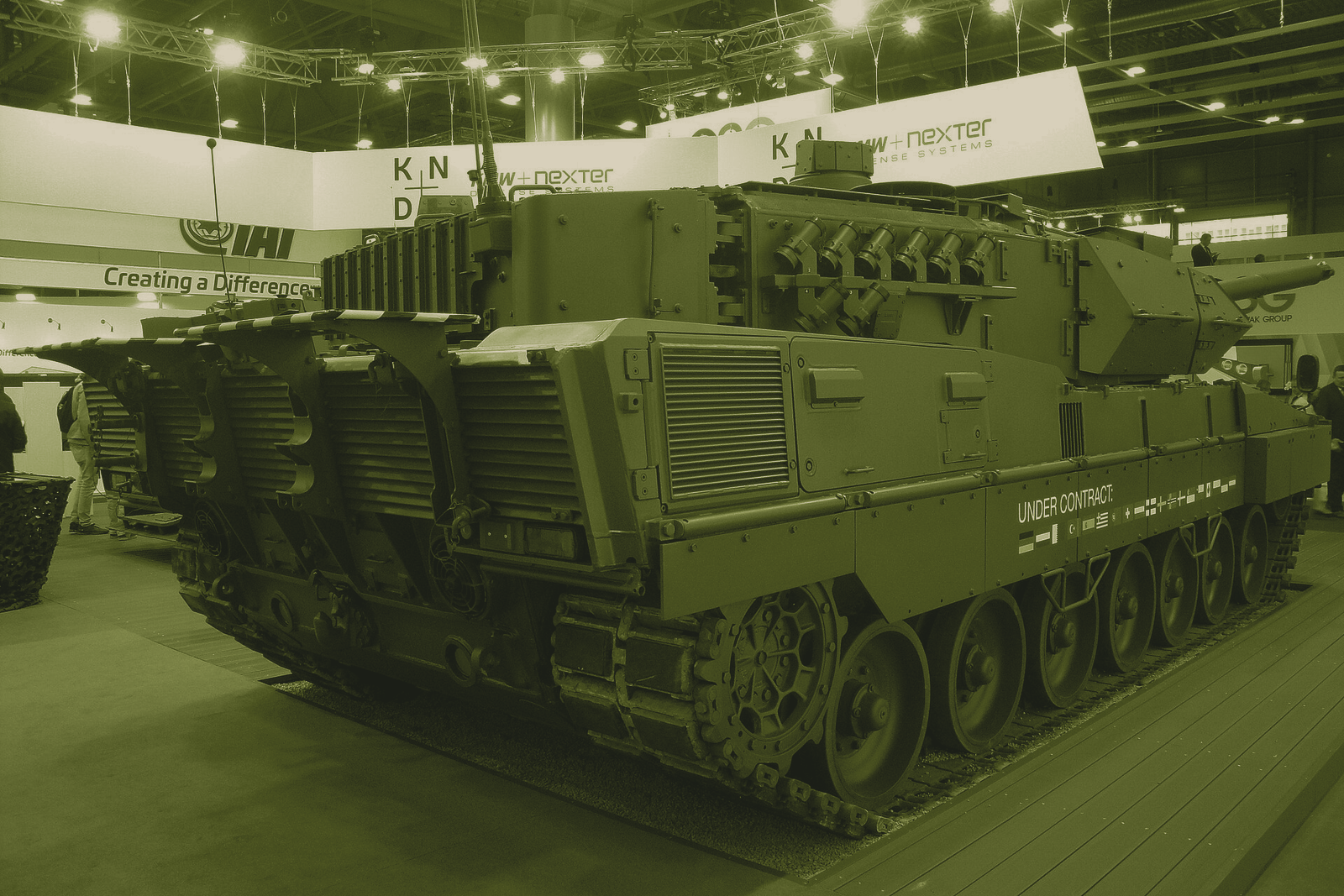

Germany's Leopard 2 — the most widely fielded Western main battle tank, a 120 mm four-crew design exported to more than 20 armies and donated to Ukraine, where its 2A4 and 2A6 variants have fought since 2023.
Overview
The Leopard 2 is the standard main battle tank of Germany and, through four decades of export, the de facto common heavy tank of European NATO. Built by Krauss-Maffei Wegmann — now part of KNDS Deutschland — around a Rheinmetall 120 mm smoothbore gun and an MTU diesel, it is fielded by more than twenty armies in variants spanning the 1980s-vintage 2A4 to the current 2A7V and the newly delivered 2A8. Its blend of firepower, protection and mobility, plus a deep installed base and shared logistics, made it the natural backbone of the Western coalition's tank donations to Ukraine.
Development
KNDS predecessor Krauss-Maffei developed the Leopard 2 as the successor to the Leopard 1, and the type entered Bundeswehr service in 1979, per GlobalSecurity and the Leopard 2 reference record at Wikipedia. The 2A4 — produced in the largest numbers (over 1,800 between 1985 and 1992) and widely held or stored across Europe — became the export workhorse. Later standards added protection and a longer gun: the 2A6 introduced the L/55 barrel around 2001, and the current 2A7V entered Bundeswehr service in the early 2020s, with KMW delivering the final 2A7V to the German Army in 2023, according to Defence-Industry.eu and Below The Turret Ring. Deliveries of the further-improved 2A8 began in 2025–26.
What comes next
The Leopard 2 will remain a central European tank because upgrades can add protection, sensors and a new gun without replacing every hull. The successor question has split into two timelines. Near-term programs modernize Leopard 2 fleets and add active protection against missiles and drones. Longer-term projects, including the KF51 Panther, use autoloaders, new turret layouts and provisions for unmanned systems. BattlePolicy's report on Italy's Panther-based tank plan shows how this transition can reuse parts of the Leopard industrial base while changing the vehicle architecture.
KNDS builds Leopard 2, with Rheinmetall supplying its gun and developing the KF51. Leonardo and Rheinmetall are adapting the Panther concept for Italy. Helsing represents the software side of the next armored force, where autonomous reconnaissance and strike systems operate around crewed vehicles. The useful procurement comparison is not armor thickness alone. Buyers must weigh active protection, drone integration, ammunition supply, repair capacity and whether a heavier platform can still move across the bridges and rail network assigned to it.
🔒 The rest of the Leopard 2 file is for BattlePolicy Pro members. Stop here and you miss the part that actually matters: how it performs and where it falls short, its combat record, how it stacks up head-to-head against its real counterparts, the complete specifications table, and our analysts’ procurement, supplier and assessment notes. Unlock the full file with BattlePolicy Pro →