Raytheon's Record AMRAAM Deal Names 16 Buyers. Ukraine, Which Fires the Missile Daily, Is Not One
The Pentagon's up-to-$20.7 billion AMRAAM contract refills U.S. and allied magazines through 2033. Ukraine, where F-16s and NASAMS fire the missile at Russian cruise missiles and jet drones, is not a named buyer.
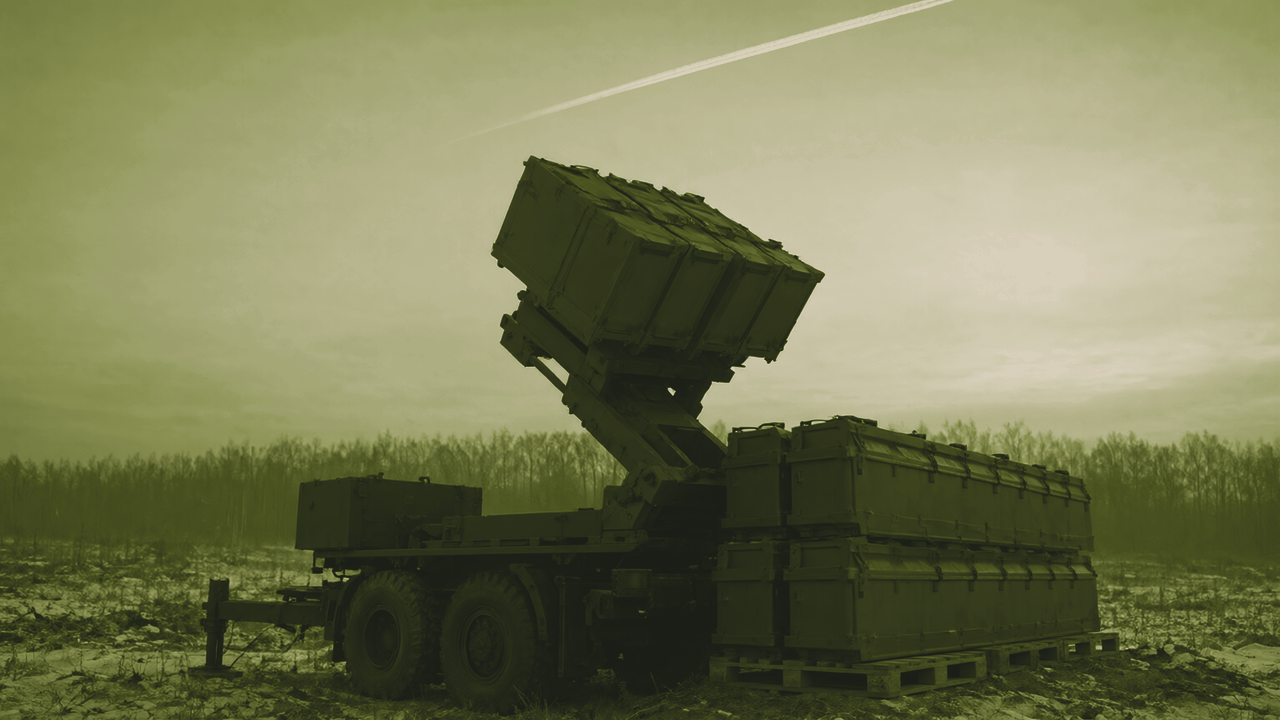
The Pentagon is buying years of missile production for U.S. forces and allies. Ukraine has to answer Russia's jet-powered Gerans on a faster clock than that order runs.
An award worth up to $20.7 billion, running to 2033
The Pentagon's Sept. 25 AMRAAM award gives Raytheon a production horizon reaching June 30, 2033. It does not name Ukraine as a buyer, although Ukrainian F-16s and NASAMS batteries fire the missile at Russian cruise missiles and drones. The Pentagon announced the contract on Sept. 28 as part of its Arsenal of Freedom campaign and said it would nearly double AMRAAM production.
The ceiling of $20.7 billion dwarfs the previous record AMRAAM award, a $3.5 billion contract issued in July 2025. By our arithmetic that is almost six times larger. RTX says the agreement runs for five years with two option years, with the work in Tucson, Arizona.
The timing sharpens the gap between the order and the war. Geopolitical Monitor analyst Simone Chiusa counts more than 2,800 Russian jet-powered Geran launches in August, up from around 450 in June, and puts Ukraine's interception rate against the class at just 60%.
Sixteen buyers and $85,715 in U.S. funds
The Pentagon's contract announcement lists foreign military sales to Australia, Belgium, Canada, the Czech Republic, Denmark, Finland, Germany, Italy, Japan, Kuwait, the Netherlands, Norway, Poland, Sweden, Taiwan and the United Kingdom. Ukraine is absent. The award was sole-source and partly undefinitized, with a not-to-exceed value of $20,699,334,581.
At award, the Pentagon obligated $85,715 in fiscal 2026 Air Force weapons procurement funds and $154,266,225 in foreign military sales funds. The $20.7 billion is a ceiling, not money committed to production. The department thanked Congress for multiyear procurement authority and said it hopes lawmakers will provide more authority and funding. Neither it nor RTX specified how many missiles the contract buys.
A February 2026 framework set the production goal: RTX committed to raising annual output to at least 1,900 AMRAAMs, alongside more than 1,000 Tomahawks and more than 500 Standard Missile-6 interceptors. RTX says it nearly doubled AMRAAM production in 2025 compared with 2024 and is exploring international co-production. The supply base is growing. Ukraine is not a named customer of it.
Frequently Asked Questions
How big is the new AMRAAM contract?
Up to $20.7 billion over five years plus two option years, with work in Tucson running to June 30, 2033, per the Pentagon's contract announcement. The previous record AMRAAM award was $3.5 billion in July 2025.
Is Ukraine a buyer under the contract?
No. The announcement lists foreign military sales to 16 countries, including Germany, Poland, Norway, Japan and Taiwan. Ukraine is not among them and relies on partners' stocks for Western missiles.
How much money is actually committed?
At award the Pentagon obligated $85,715 in Air Force procurement funds and about $154.3 million in foreign military sales funds. The $20.7 billion is a ceiling; Congress has not yet funded the full deal.
How many AMRAAMs will Raytheon build?
Neither the Pentagon nor RTX disclosed a quantity for this contract. A February 2026 framework commits RTX to at least 1,900 AMRAAMs a year, about 160 a month, for all customers.
Why does this matter for Russia's jet-powered Gerans?
Ukraine uses AMRAAMs from F-16s and NASAMS against fast, high-flying threats. Geopolitical Monitor counts more than 2,800 jet Geran launches in August alone, more than a full year of the AMRAAM production target.
AI-generated summary, reviewed by an editor. More on our AI guidelines.
Read next — from the Lexicon
Below this point
- One missile family for F-16s and NASAMS
- Jet Gerans at 4 to 7 kilometers
- About 160 a month against more than 2,800
- $85,715 and $154 million: the factory decision
- Ukraine's allocation sits outside the contract
- Four decisions to watch

Marcus Schuler
Marcus Schuler edits BattlePolicy, a daily defense-technology brief connecting the companies and capabilities behind modern war to the contest among Europe, the US, Russia, and China.