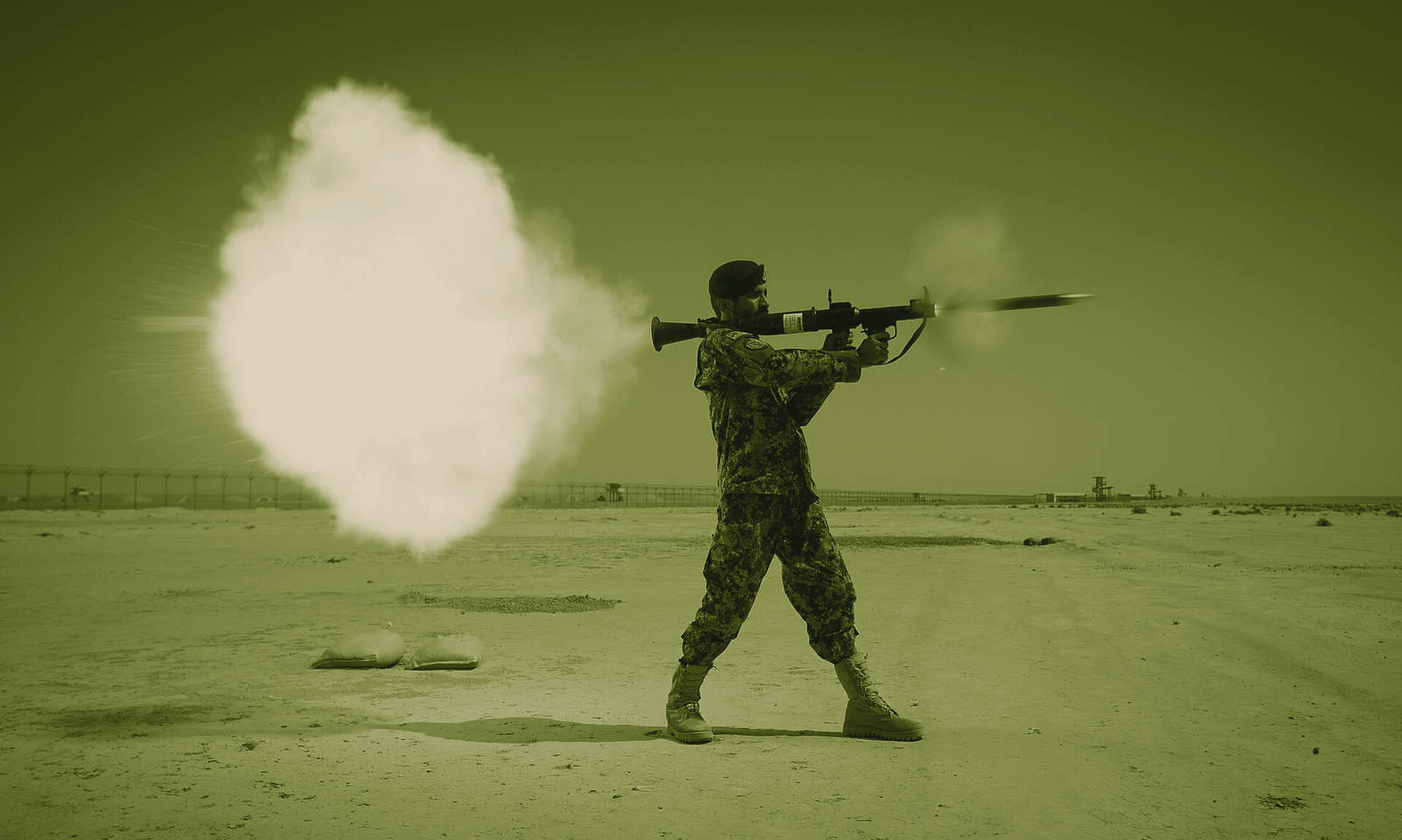
RPG-7
A 1961 shoulder-fired launcher that found a second career nobody designed: its PG-7 shaped-charge warhead is the standard payload on FPV attack drones, which means most drone kills in this war are delivered by RPG ammunition.
A shoulder-fired launcher designed in 1961 that has found a second career nobody planned for it. Its PG-7 shaped-charge warhead is the standard payload on first-person-view attack drones, which means a large share of the armour killed in this war is destroyed by RPG ammunition — just not fired from an RPG.
Overview
The RPG-7 is a Soviet reusable, shoulder-fired, unguided rocket-propelled grenade launcher, in production since 1961 and fielded in essentially every conflict since. It is cheap, mechanically trivial, requires minimal training and accepts a wide family of warheads. Both Russia and Ukraine use it, as does virtually every other armed force and armed group on earth.
Its conventional role in Ukraine is what it has always been: a short-range infantry weapon for engaging vehicles, fortifications and buildings, most useful in urban terrain and close ambush. On that measure it is a declining asset — modern tanks with explosive reactive armour and, increasingly, active protection systems are hard targets for an unguided round fired from a few hundred metres by an exposed operator.
The more consequential fact is what happened to its ammunition. The PG-7 warhead — the shaped charge from an RPG round, stripped of its rocket motor — has become the standard explosive payload for FPV attack drones on both sides. A weapon designed for a soldier to fire at 200 metres now arrives on a quadcopter, from above, at the top armour where it works best.
Development
The RPG-7 was developed by Bazalt and entered Soviet service in 1961, replacing the RPG-2. The design is a reusable launch tube with a simple optical sight; the round is a rocket-assisted, fin-stabilised grenade with a shaped-charge warhead that fits over the tube's muzzle. Nothing about it is complex, which is why it has been produced in the millions and copied worldwide.
Development has been almost entirely in ammunition rather than in the launcher. The current Russian production model, the RPG-7V2, supports the full modern round family and adds the UP-7V telescopic sight for use with the heavier tandem ammunition, alongside the standard 2.7× PGO-7.
The round family as fielded today:
- PG-7VM — 70 mm shaped charge, roughly 500 m effective range
- PG-7VL — 93 mm shaped charge, at least 500 mm RHA penetration, roughly 300 m effective range
- PG-7VR — 105 mm tandem shaped charge designed to defeat explosive reactive armour, roughly 200 m effective range; about three times the weight of a standard round with a pronounced trajectory drop
- OG-7V — high-explosive fragmentation for anti-personnel use
- TBG-7V — thermobaric, for structures and fortifications
The trade across that family is consistent and unavoidable: more penetration means a heavier projectile, which means shorter effective range and a more demanding aiming problem.
Design & capabilities
The launcher is a smoothbore tube of about 40 mm calibre, weighing roughly 7 kg, fired from the shoulder with a backblast danger area behind. Rounds are muzzle-loaded and rocket-boosted after launch.
- Effective range: varies by round from about 200 m (PG-7VR tandem) to 500 m (PG-7VM, PG-7VL). Against moving targets, practical range is considerably shorter.
- Penetration: at least 500 mm RHA for the PG-7VL; the PG-7VR tandem is designed to defeat ERA and reach the main armour behind it.
- Sights: PGO-7 2.7× optical standard; UP-7V telescopic sight on the RPG-7V2 for heavy tandem rounds.
- Crew: one operator, typically with an assistant carrying rounds.
- Signature: substantial backblast and a visible launch signature, which reveals the firing position immediately.
The tandem PG-7VR is the round that matters against modern armour and the one that is hardest to use. At roughly three times the weight of a standard round it drops sharply over distance, requires significant aim adjustment, and cuts effective range to about 200 m — which in an environment of pervasive drone surveillance means the operator must survive getting that close.
Against drones, the RPG-7 is not a solution. Its low effective range, unguided flight and trajectory characteristics make it poorly suited to engaging UAVs, and dedicated air-defence weapons, small arms, nets, cages and electronic warfare are the actual counters. Reporting that presents the RPG as an anti-drone weapon overstates a marginal capability.
Variants
- RPG-7 (baseline): The 1961 launcher.
- RPG-7D: Airborne variant, breaks down for parachute drop.
- RPG-7V2: The current Russian production standard, supporting the full round family with the UP-7V sight.
- Licensed and derivative production: manufactured under licence and copied in many countries, including Bulgaria, Romania, China, Iran and Pakistan.
- PG-7 warhead as drone payload: not a launcher variant, but the most operationally significant current use of the ammunition — the shaped charge fitted to FPV airframes.
Combat record / operational use
The RPG-7 is present throughout the Ukrainian battlefield in its conventional role and is genuinely useful in a narrow band: urban fighting, close ambush against vehicles, and engaging structures and positions with thermobaric and fragmentation rounds. Czech analysis in May 2026 described a weapon designed in 1961 that remains, 65 years on, one of the most widespread killers of armoured vehicles and infantry on the front line. Ukrainian assessments in 2026 make the same point in more measured terms: despite drones, precision missiles and active protection, the RPG-7 and its analogues still matter to infantry units because they are cheap, simple to maintain and versatile in ammunition.
The limitation is equally clear. Against a modern tank with ERA — let alone one carrying Arena-M — an unguided round fired at 200 m by an operator who must expose himself is a low-probability engagement. The weapon's conventional relevance has narrowed to opportunistic and urban use.
The second life is the important one. Analysis of FPV drone payloads in Ukraine finds that the majority consist of PG-7 warheads, with some PG-9 (from the SPG-9 recoilless gun) and a range of improvised or purpose-built charges — but the predominant type is the single-stage HEAT PG-7. The reasons are straightforward: the warhead is mass-produced, cheap, already fuzed for impact, sized appropriately for a small quadcopter's lift capacity, and effective against the thin top and rear armour that a drone attacks.
That inverts the weapon's tactical problem entirely. An RPG operator must close to 200–500 m, expose himself, and hit frontal armour designed to defeat exactly that warhead. A drone carrying the same warhead attacks from above at a range of kilometres, with the operator safe, against armour a fraction as thick. The munition did not change; the delivery system did.
Advantages
- Extremely cheap — rounds cost in the low hundreds of dollars, against thousands for a guided ATGM.
- Simple and reliable — minimal training, no electronics, no maintenance infrastructure.
- Versatile ammunition — shaped charge, tandem, fragmentation and thermobaric rounds from one launcher.
- Ubiquitous — held by both sides in enormous quantity, with global production and no supply constraint.
- Reusable launcher — unlike single-use disposable weapons, the tube is retained.
- Effective in urban terrain — short engagement ranges and abundant cover suit its envelope.
- Its warhead is the drone-war standard — PG-7 shaped charges are the most common FPV payload, giving the ammunition line strategic relevance far beyond the launcher.
Drawbacks / limitations
- Unguided — hit probability falls sharply with range and against moving targets.
- Short effective range — 200 m for the tandem PG-7VR, and the operator must survive reaching that distance under drone observation.
- Heavy tandem round — the PG-7VR is roughly three times the weight of a standard round with pronounced drop, demanding significant aim correction.
- Defeated by modern protection — ERA, and now active protection systems, substantially degrade a single unguided shaped charge.
- Exposes the operator — backblast and launch signature reveal the position immediately, which in a drone-saturated environment is often fatal.
- Not an anti-drone weapon — despite occasional claims, its range and trajectory make it poorly suited to engaging UAVs.
- Superseded for its primary role — Javelin, NLAW, Stugna-P and FPV drones all kill armour more reliably.
Counterparts
- Javelin (USA) and NLAW (UK/Sweden) — the guided, top-attack weapons that displaced it for serious anti-armour work.
- Stugna-P (Ukraine) and Konkurs (Russia) — the guided ATGMs at the next tier up.
- Kornet (Russia) — the heavy guided ATGM at the top of the same mission.
- Fiber-optic FPV drone — the delivery system that now carries the RPG's own warhead.
- Arena-M (Russia) — the active protection system that defeats single unguided shaped charges.
- Lancet (Russia) — the loitering munition occupying the tactical anti-materiel niche.
Outlook
The RPG-7's conventional future is slow decline into a specialist urban and opportunistic weapon — still carried, still occasionally decisive, no longer a primary anti-armour answer. Nothing about the launcher will change; it has not needed to for sixty-five years.
The ammunition is a different question, and it is the one worth tracking. If the majority of FPV drone payloads are PG-7 warheads, then PG-7 production capacity is drone-strike capacity, and both sides' shaped-charge output becomes a strategic variable in a way that had nothing to do with the launcher it was designed for. That has procurement implications well beyond Ukraine: a state stockpiling RPG rounds is, whether it intends to or not, stockpiling drone munitions.
It also raises an obsolescence question worth watching. As FPV drone production matures, purpose-designed warheads optimised for drone delivery — better fuzing for top attack, shaped for the airframe, with standoff arranged for the approach angle — should displace repurposed RPG rounds. The persistence of the PG-7 as the dominant payload four years into the war suggests that transition is slower than expected, most likely because the existing round is cheap, abundant and good enough.
Key specifications
| Spec | Value |
|---|---|
| Type | Reusable shoulder-fired unguided rocket-propelled grenade launcher |
| Calibre | 40 mm tube; oversize warheads of 70–105 mm |
| Launcher weight | ~7 kg |
| Effective range | ~500 m (PG-7VM); ~300 m (PG-7VL); ~200 m (PG-7VR tandem) |
| Penetration | ≥500 mm RHA (PG-7VL); PG-7VR tandem designed to defeat ERA |
| Ammunition | PG-7VM, PG-7VL (HEAT); PG-7VR (tandem HEAT); OG-7V (HE-frag); TBG-7V (thermobaric) |
| Sights | PGO-7 2.7× optical; UP-7V telescopic for heavy tandem rounds (RPG-7V2) |
| Crew | 1 operator plus assistant |
| In service | Since 1961; current production model RPG-7V2 |
| Secondary use | PG-7 shaped-charge warheads are the predominant FPV drone payload on both sides |
Sources
- Armádní zpravodaj — "60leté sovětské RPG-7 na Ukrajině řádí, ničí nejlepší tanky i pěšáky" (RPG-7V2 ammunition family and ranges). https://armadnizpravodaj.cz/vyzbroj/rpg-7-nici-nejlepsi-tanky-i-pesaky/
- Visnyk NANU — "РПГ це ручний протитанковий гранатомет: характеристики, принцип дії та роль у сучасних конфліктах." https://visnyk-nanu.org.ua/rpg-cze-ruchnyj-protytankovyj-granatomet-harakterystyky-prynczyp-diyi-ta-rol-u-suchasnyh-konfliktah/
- r/WarCollege — "What kind of warhead do FPV drones carry in Ukraine?" (PG-7 predominance among FPV payloads). https://www.reddit.com/r/WarCollege/comments/1pgm33b/what_kind_of_warhead_do_fpv_drones_carry_in/
- Arma Platform — RPG-7 round types and effective ranges. https://x.com/ArmaPlatform/status/2013264835815870500
- Institute for the Study of War — "Russian Offensive Campaign Assessment, August 9, 2026" (Arena-M anti-drone capability context). https://understandingwar.org/research/russia-ukraine/russian-offensive-campaign-assessment-august-9-2026/
🔒 The Analyst Section on RPG-7 is for BattlePolicy Pro members. Below the line: procurement and contract history, the suppliers and companies behind the system, our head-to-head analyst view of the systems it actually competes with, and the BattlePolicy assessment note. Unlock the full file with BattlePolicy Pro →
Below this point
- Analyst Section
- Procurement & contracts
- Suppliers & related companies
- Comparable systems — analyst view
- Analyst note