SPYDER
Israel's mobile, quick-reaction surface-to-air missile family built around Python-5 and Derby interceptors, spanning short-range slant-launch to extended-range vertical-launch and a single-vehicle All-in-One variant, now featuring a counter-tactical-ballistic-missile option.
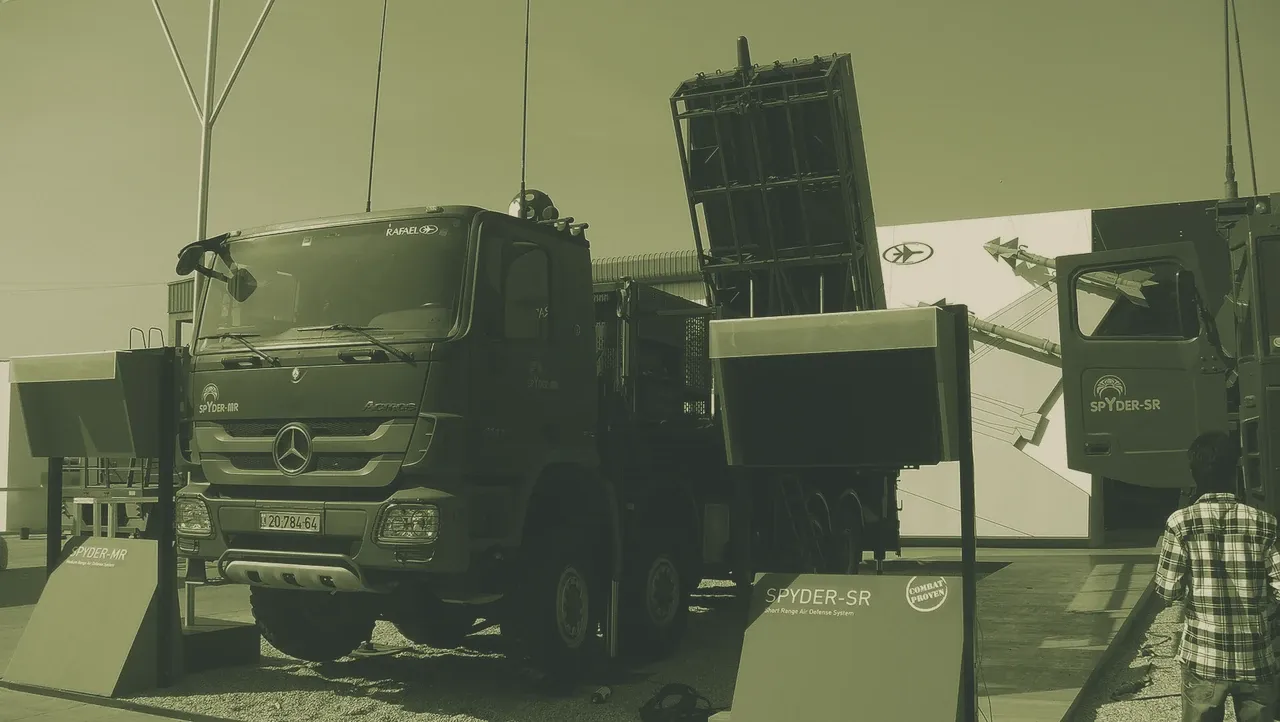
Israel's family of mobile, quick-reaction surface-to-air missile systems, combining Python-5 and Derby interceptors to defeat aircraft, drones, and cruise missiles from short to extended ranges, with a counter-tactical-ballistic-missile option added in 2023.
Overview
SPYDER — an acronym for Surface-to-air PYthon and DERby — is a mobile, quick-reaction surface-to-air missile system developed by Israel’s Rafael Advanced Defense Systems with radars from Israel Aerospace Industries’ Elta subsidiary. It repackages the combat-proven Python-5 short-range imaging-infrared missile and the Derby/I-Derby active-radar missile into ground-launched interceptors, giving one battery the ability to engage a wide threat set from low-signature drones to fast jets and, since 2023, incoming tactical ballistic missiles. The system is fielded in slant-launch (SR/ER), vertical-launch (MR/LR) and a single-vehicle All-in-One (AiO) configuration, and it has been sold to more than ten countries, becoming the first Israeli-made air-defense system integrated into a NATO air-defense array via the Czech Republic and selected by Romania. Wikipedia maintains an operator list that includes Azerbaijan, Ethiopia, Georgia, India, Kenya, the Philippines, Singapore, the UAE, Vietnam and the Czech Republic.
Development
Rafael began developing SPYDER in the early 2000s as a ground-launched application of its Python-5 and Derby air-to-air missiles, with IAI supplying the EL/M-2106 and later the EL/M-2084 radars. The milestone live-fire test occurred in 2005 at the Shdema range in Israel, scoring direct hits at both short and long range and clearing the way for the SR and MR variants to enter production in the mid-2000s. Wikipedia notes that the first export deliveries followed in the late 2000s — Georgia is widely reported to have received a battery by 2008, and India ordered its first systems in 2008–09. The family then grew with vertical-launch LR and extended-range ER configurations, and in January 2024 Rafael unveiled the All-in-One variant after demonstrating a live UAV intercept for the Israeli Ministry of Defense. A counter-tactical-ballistic-missile upgrade was announced in 2023, driven by operational experience in conflicts featuring heavy ballistic-missile use. EDR Magazine reported that the upgrade involved hardware and software changes to the Derby LR interceptor. The Czech Republic, a NATO member, selected SPYDER in 2021, making it the first time an Israeli air-defense system was integrated into the Alliance’s air-defense architecture; the first Czech battery completed factory acceptance testing in early 2025. Defence Industry Europe
Design & capabilities
The SPYDER architecture is built on a mix-and-match missile loadout: a single battery can fire Python-5 dual-waveband imaging-infrared missiles, I-Derby active-radar missiles and the extended-range I-Derby ER, each weighing about 100–150 kg and flying at Mach 4 class with a 11 kg (Python-5) or 23 kg (Derby) warhead according to Army Recognition. The short-range SR variant uses a 360° slant launcher with the EL/M-2106 ATAR 3D AESA radar, while the medium-range MR and long-range LR/ER variants employ vertical launch from an eight-round canister and rely on the EL/M-2084 MMR S-band AESA — the same radar family used by Iron Dome — which can track over 1 200 targets out to 250 km. Rafael’s own brochure and Czech officers cite engagement radii of about 15–20 km for SR, 35–50 km for MR, and up to 80 km for the extended-range configurations, with some manufacturer claims reaching 160 km for the newest extended-range setups. Radio Prague International confirmed that the Czech mix includes Python-5, I-Derby and I-Derby LR missiles, giving a layered envelope of 30–80 km. The system is highly modular: customers choose their truck chassis (Tatra, MAN, Scania, Mercedes), radar fit and missile mix, and the open architecture allows a battery to accept future interceptors. The All-in-One variant compresses a 360° phased-array radar, a day/night electro-optical/infrared sensor, the command-and-control shelter and up to eight canisterized missiles onto a single 8×8 vehicle, which can search on the move and transition from road march to ready-to-fire in about three minutes. Rafael states that the AiO can also control an additional slaved launcher and is air-transportable by C-130.
Variants
- SPYDER-SR – short-range, 360° slant launcher with EL/M-2106 ATAR radar; four ready-to-fire missiles, engagement range ~15–20 km.
- SPYDER-MR – medium-range, vertical-launch canisters, booster-equipped missiles, EL/M-2084 MMR radar; eight rounds per launcher, engagement range ~35–50 km.
- SPYDER-LR / SPYDER-ER – long/extended-range vertical-launch variants pushing the envelope to ~80 km (some manufacturer claims up to 160 km), using I-Derby ER interceptors.
- SPYDER All-in-One (AiO) – radar + EO/IR + C2 + up to 8 missiles on a single 8×8 truck; demonstrated live UAV intercept in January 2024.
- Counter-TBM SPYDER – 2023 upgrade to the Derby LR interceptor for tactical-ballistic-missile defense, adding a new engagement mode without changing the launcher hardware.
Combat record / operational use
India is the most documented combat operator. On 26 February 2019, a SPYDER battery of the Indian Air Force shot down a Pakistani surveillance drone over Gujarat, one day after the Balakot airstrikes, according to Wikipedia. The following day, the same battery mistakenly engaged an IAF Mi-17 transport helicopter near Budgam, killing all six on board and one civilian — an incident later confirmed by an Indian Air Force court of inquiry as a friendly-fire fratricide. During the May 2025 India–Pakistan crisis (Operation Sindoor), Indian media placed SPYDER in the close-in layer — cited at 8–10 km— of a multi-tiered integrated air-defense grid that India says “effectively repulsed” a large-scale Pakistani drone and missile attack on the night of 8–9 May 2025, protecting 15 military sites across 1,800 km of airspace. India Today detailed the layered grid but noted that Pakistan disputed the Indian claims.
Elsewhere, Georgia is widely reported to have used SPYDER-SR during the 2008 Russo-Georgian War, though these claims remain unverified. Army Recognition cites Hebrew-language reports that Israel itself employed SPYDER for counter-UAV missions during the 2023 “Iron Swords” war. The Philippines inducted its first SPYDER-MR batteries — locally designated SPADS — at Basa Air Base on 8 November 2022 under the 960th Air and Missile Defense Group, with a third battery arriving in November 2024. Shephard Media recorded the inaugural ceremony. In Central Europe, the Czech Republic’s first battery completed factory testing in early 2025 and was publicly exhibited at IDET 2025 in Brno on 28 May 2025; military trials were set for autumn 2025, with full operational capability expected in 2027–28. Army Recognition
Advantages
- Dual-seeker missile mix (imaging-infrared Python-5 and active-radar I-Derby/I-Derby ER) allows lock-on-before-launch and lock-on-after-launch against everything from low-RCS drones to fighters and, since 2023, tactical ballistic missiles. EDR Magazine
- Combat-proven quick reaction: 360° launch within seconds and sub-5-second reaction time in the Czech SR configuration; the missiles are fully common with the mature Python-5 and Derby air-to-air rounds, simplifying logistics. Radio Prague International
- The first Israeli-made air-defense system integrated into a NATO air-defense array, with Czech batteries on Tatra 8×8 trucks and Romania’s €1.9 billion selection in 2025, demonstrating strong alliance interoperability credentials. The Jerusalem Post
- Highly modular open architecture: customers choose chassis, radar and missile mix, and local industrial participation can exceed 30% (Retia, VTÚ and Tatra in the Czech deal). Defence Industry Europe
- The All-in-One variant compresses an entire battery’s functions onto one 8×8 vehicle, credited with counter-drone-swarm utility and a ~3-minute march-to-fire transition. Rafael
Drawbacks / limitations
- Official range and altitude figures are inconsistent: Rafael’s own brochure quotes 20 km for the SR variant while many third-party sources list 15 km, and MR ranges are given as 35 km and 50 km, complicating capability assessment. Wikipedia
- A well-documented friendly-fire incident on 27 February 2019, when an Indian SPYDER battery shot down an IAF Mi-17, demonstrates the lethal consequences of identification failures in a quick-reaction SAM.
- New operators face long induction timelines: Czech crews require roughly 18 months of training, and full operational capability for the four-battery force slips to 2027–28 even after 2025 deliveries. Radio Prague International
- In layered air-defense grids, SPYDER is typically bracketed as a short-range point-defense layer; it cannot substitute for area-defense systems against stand-off threats. India Today
- Opaque transfers, such as a reported but unacknowledged November 2025 delivery of three launchers to Georgia by An-124, cloud the system’s export record and end-use transparency. Army Recognition
Counterparts
Outlook
SPYDER is riding Europe’s post-Ukraine air-defense surge. The Czech Republic’s four-battery order (~$627 million) will replace Soviet-era 2K12 KUB systems and achieve full service in 2027–28, while Romania’s €1.9 billion selection in July 2025 — the second-largest Israeli defense deal if signed — would make it a second NATO operator, with Iron Dome elements also offered. The Jerusalem Post Kenya’s delivery in December 2025 extends the customer base into Africa. The drone-heavy threat environment plays to the system’s strengths, particularly the AiO’s counter-swarm capability and Israel’s own operational counter-UAV use in 2023. The 2023 counter-TBM upgrade simultaneously positions SPYDER against the ballistic-missile threat that the May 2025 India–Pakistan crisis and the Iran-related conflicts have made salient. The main open questions are the true performance of the LR/ER envelope and how Rafael will balance production across a rapidly expanding order book.
Key specifications
| Spec | Value |
|---|---|
| Type | Mobile short-to-medium/long-range quick-reaction SAM system |
| Engagement range | 15–160 km (SR ~15–20 km; MR ~35–50 km; LR/ER up to ~80 km, claims to 160 km) |
| Engagement altitude | ~9 km (SR, Python-5) to ~16 km (MR, boosted Derby) |
| Target set | fixed/rotary-wing aircraft, UAVs, cruise missiles, PGMs; tactical ballistic missiles (Counter-TBM) |
| Interceptor(s) | Python-5 (IIR), I-Derby (active radar), I-Derby ER (extended range) |
| Radar / fire control | EL/M-2106 ATAR 3D AESA (SR); EL/M-2084 MMR S-band AESA (MR/LR); AiO integrated 360° phased-array + EO/IR |
| Reaction time | Under 5 s (SR configuration); AiO ~3 min from road march to ready-to-fire |
| Simultaneous engagements | multi-target, saturation-capable; net-centric multi-launch architecture |
| Mobility | truck-mounted (Tatra 8×8, MAN, Scania, Mercedes); AiO single-vehicle, air-transportable |
Sources
- Rafael Advanced Defense Systems — SPYDER All-in-One. https://www.rafael.co.il/system/spyder-all-in-one/
- Wikipedia — SPYDER. https://en.wikipedia.org/wiki/SPYDER
- Army Recognition — IDET 2025: Czech Army Showcases Rafael SPYDER SR and Elta ELM-2084 MMR. https://www.armyrecognition.com/news/army-news/2025/idet-2025-czech-army-showcases-rafael-spyder-sr-and-elta-elm-2084-mmr-as-cornerstone-of-new-air-defense
- Defence Industry Europe — Czech Republic: first battery of Spyder air defence system completed and undergoing testing. https://defence-industry.eu/czech-republic-first-battery-of-spyder-air-defence-system-completed-and-undergoing-testing/
- Radio Prague International — New Czech air defense system has range of up to 80 kilometers. https://english.radio.cz/new-czech-air-defense-system-has-range-80-kilometers-8857515
- India Today — How Indian interceptors crushed Pak drones: Inside the impregnable air defence web. https://www.indiatoday.in/india/story/how-indian-interceptors-crushed-pak-drones-inside-the-impregnable-air-defence-web-2722029-2025-05-09
- EDR Magazine — Rafael’s Spyder Now Offering Counter TBM Capabilities. https://www.edrmagazine.eu/rafaels-spyder-now-offering-counter-tbm-capabilities
- The Jerusalem Post — Rafael to sell interceptors to Romania in deal worth $2.2 billion. https://www.jpost.com/business-and-innovation/article-859940
- Shephard Media — Philippines inducts first SPYDER air defence systems. https://www.shephardmedia.com/news/landwarfareintl/philippines-inducts-first-spyder-air-defence-systems/
- Army Recognition — Georgia may have received another Spyder air defense missile system from Israel. https://armyrecognition.com/news/army-news/2025/georgia-may-have-received-another-spyder-air-defense-missile-system-from-israel
- Army Recognition — Philippine Marine Corps could purchase Israeli Spyder air defense missile system. https://www.armyrecognition.com/news/army-news/2025/philippine-marine-corps-could-purchase-israeli-spyder-air-defense-missile-system-to-protect-key-military-installations
🔒 The Analyst Section on SPYDER is for BattlePolicy Pro members. Below the line: procurement and contract history, the suppliers and companies behind the system, our head-to-head analyst view of the systems it actually competes with, and the BattlePolicy assessment note. Unlock the full file with BattlePolicy Pro →