Brussels Fast-Tracks a Satellite Merger. Ukraine Lost a Network, Not a Factory.
Brussels wants to clear the Airbus-Thales-Leonardo satellite merger fast after the Starshield cap hit Ukraine's drones. The merger combines factories; Ukraine's dependency sits in the network, the terminals and the rockets.
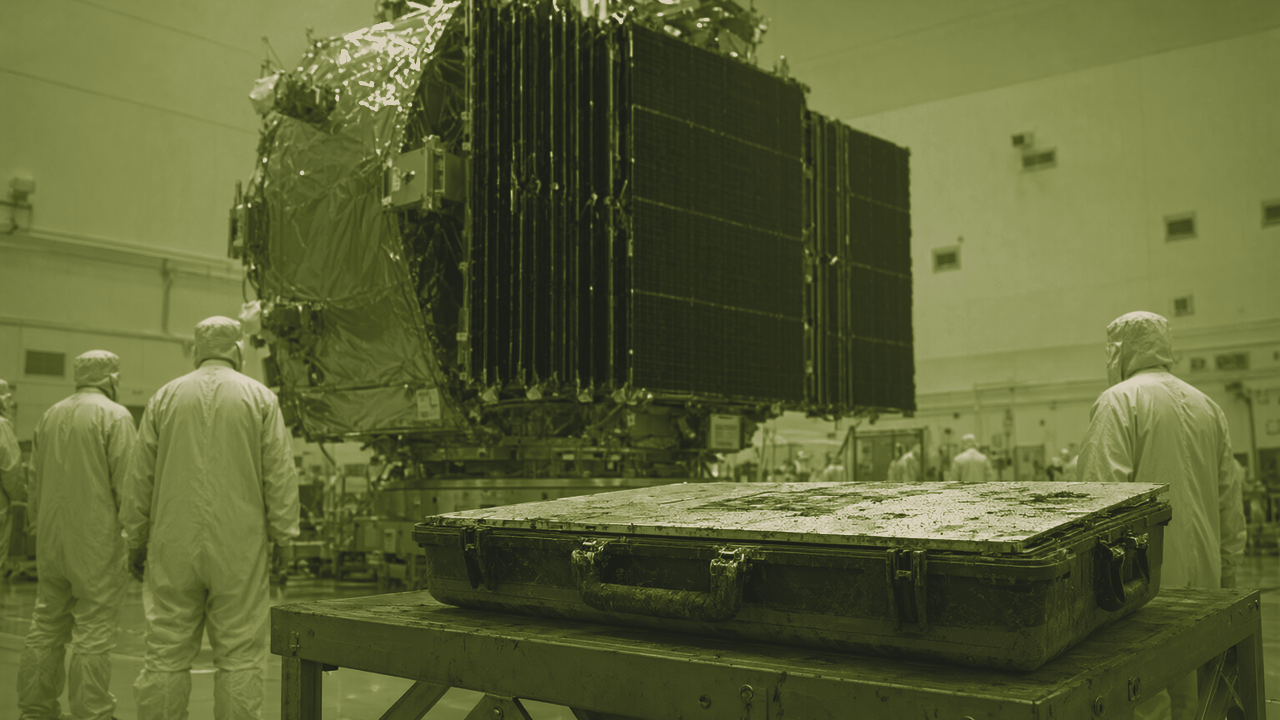
Project Bromo would combine the satellite businesses of Airbus, Thales and Leonardo. The Starshield speed cap exposed a dependence on network control, field terminals and launch that the merger does not touch.
Fast-tracking Project Bromo will not fix the 160 km/h ceiling that grounded Ukrainian interceptor drones this week. Overnight on Oct. 13-14, Starshield terminals in Ukraine began dropping their connection once they moved, with some units losing service at speeds between about 72 and 161 km/h, according to Ukrainian Defense Ministry sources. A day later, a person familiar with the matter told Bloomberg that the European Commission aims to give speedy antitrust approval to the venture combining the space businesses of Airbus, Thales and Leonardo.
Bromo would build a bigger European satellite maker. What Ukraine lost was access to a network it does not control, through proprietary terminals it cannot move to another provider, on a constellation launched by rockets Europe does not own. None of those three sit inside the merger.
The Oct. 13-14 restrictions
Who ordered the cap is still disputed. Two US officials and a Western official told Reuters the instruction to slow Starshield for the Ukrainian military came from inside the White House, without naming who gave it. A senior US official countered: "No such request was ever made by the president." Elon Musk wrote that Starshield systems are owned and controlled by the US government, so limits on speed or usage are decided "by the US military and ultimately POTUS."
Former Defense Minister Mykhailo Fedorov said connectivity was returning at up to 160 km/h and called for the limit to be removed entirely. The ceiling matters because Ukraine's Defense Intelligence puts the jet-powered Geran-4 at 300 to 400 km/h.
Europe's leaders said plainly that they have no substitute. "Starlink is really necessary for Ukraine and unfortunately in the short term Europe can't replace this capability," EU foreign policy chief Kaja Kallas told reporters on Oct. 16. Satellite consultant Christian Freiherr von der Ropp put the reason in hardware: Starlink and Starshield terminals use proprietary technology and could not simply connect to Eutelsat's OneWeb, so switching means replacing thousands of them.
Bromo runs on a different clock. The companies have not yet filed, and EU officials expect them to in the coming weeks, according to Bloomberg's source, after a year of talks to iron out competition concerns. With remedies such as asset sales, the deal could clear a phase 1 review in just over a month; unresolved concerns would mean an in-depth probe lasting several months. That timetable governs permission to combine three companies. The near-term European options for Ukraine run on a separate one, set for 2027 and 2029.
Frequently Asked Questions
What is Project Bromo?
A planned joint venture combining the space businesses of Airbus, Thales and Leonardo, agreed in a memorandum on Oct. 23, 2025. CEPA puts it at about 25,000 employees and roughly €6.5 billion in annual revenue.
How fast could the EU approve it?
The companies have not yet filed. According to Bloomberg, a deal with remedies such as asset sales could clear a phase 1 review in just over a month; unresolved concerns would trigger an in-depth probe lasting several months.
What happened to Starshield in Ukraine?
Overnight on Oct. 13-14, terminals stopped working when moving, with a cap of about 160 km/h, disrupting interceptor and strike drones. Two US officials and a Western official told Reuters the order came from inside the White House; a senior US official said the president made no such request.
Can Eutelsat's OneWeb replace Starlink for Ukraine?
Not quickly. EU foreign policy chief Kaja Kallas said Europe cannot replace the capability in the short term. Consultant Christian Freiherr von der Ropp said Starlink terminals cannot simply connect to OneWeb, so thousands would need replacing, and OneWeb's terminals are bulky and power-hungry.
When will Europe's own constellation, IRIS², be ready?
The programme schedule cited by CEPA sets first launches in 2029, services from 2030 and full capability by 2032. A Commission spokesperson said GOVSATCOM could add commercial capacity at the beginning of 2027 as a bridge.
AI-generated summary, reviewed by an editor. More on our AI guidelines.
Read next — from the Lexicon
Below this point
- A merger without a launcher
- The 160 km/h problem
- Airbus builds, SpaceX flies
- The 2027 bridge
- What to watch through early 2027
A merger without a launcher
Bromo consolidates manufacturing and services. It does not create an operated constellation. The memorandum signed on Oct. 23, 2025 covers a selective perimeter, starting with the Space Systems and Space Digital activities of Airbus Defence and Space, rather than a full merger of the three parents. CEPA, in a commentary by non-resident fellow Maciej Bukowski, puts the combined entity at about 25,000 employees and roughly €6.5 billion in annual revenue.
Bromo excludes launchers, Bukowski wrote, so it fails to recreate SpaceX's vertical integration of spacecraft, launch and network operations. Airbus remains a 50% shareholder in Ariane Group, which keeps European launch capacity outside the venture.
The Commission's case rests on scale. At the Paris space summit in September, Ursula von der Leyen called Bromo one of "the types of industrial champions we need if Europe is to lead in the space economy of tomorrow," and tied it to revised merger guidelines that recognise "European companies need scale." The venture is expected to be headquartered in Toulouse, Bloomberg reported.
Competition chief Teresa Ribera told Bloomberg TV on Sept. 22 that the endorsement "doesn't mean we are not going to apply and to enforce our own regulation." French MEP Stéphanie Yon-Courtin called von der Leyen's intervention an "abuse of power." Germany's OHB has warned the combination could weaken competition and disrupt its supply chain. All three objections concern satellite supply. None concerns who controls the link a Ukrainian drone crew relies on.
The 160 km/h problem
Ukraine's dependency is bolted to the airframes. Von der Ropp judged that OneWeb's "current constellation remains rooted in an outdated architecture and technology conceived a decade ago." Capacity limits, plus the "cost, weight, bulk and power consumption" of its user terminals, "limit its suitability for frontline applications," he said.
The speed numbers make the gap concrete. A link that drops above 160 km/h cannot follow a target flying at twice that speed or more. One Ukrainian source said terminals need to work at no less than 450 km/h, and two officials said the partial restoration still complicated interception of Russia's jet-powered drones. The disruption reached interceptor and medium-range strike drones, along with reconnaissance, logistics and communications-relay missions.
This is an air-defense problem, not a bandwidth inconvenience. Ukraine's primary counter to Russian drones has been a fleet of small, cheap, fast drones flown by ground operators over Starshield, Brynn Tannehill, a former RAND senior analyst, wrote this week. "Without access to these high-speed data links, Ukraine loses most of its defensive capability."
Paying for the terminals has not bought control of them. Poland funded a large share of Ukraine's sets, and its foreign minister, Radosław Sikorski, wrote to Musk on X: "As your European customers we are keeping a close eye on you." Bohdan Sas, co-founder of Ukrainian startup Buntar Aerospace, drew the procurement lesson: "you can't rely solely on one solution that can be switched off."
Airbus builds, SpaceX flies
Markets priced the gap within a day. Eutelsat closed at €1.370 on Oct. 13, a record closing low. The next day the shares jumped 23%, their largest one-day gain in 16 months, Reuters reported, and CNBC put the rise over five days at 25% by Oct. 16.
Deutsche Bank analysts read the rally as evidence of "the sovereign value of European Satellite networks," then undercut it. Eutelsat "lacks the scale to offer the number of terminals that Starlink can provide," they wrote, and the shares should "give up some of the gains." Scarcity creates demand. It does not create terminals.
OneWeb is growing, with a heavy bill attached. It has more than 600 satellites in orbit. Its LEO revenue rose 69.5% like-for-like to €297 million in fiscal 2025-26, a quarter of group revenue, and the company has budgeted about €1.2 billion of capital expenditure this year.
The renewal programme shows where the remaining dependency sits. On Sept. 10, Eutelsat ordered 229 more OneWeb satellites from Airbus for about €1 billion, bringing the renewal to 669 spacecraft. On Oct. 2, Airbus finished the first 32. They will launch with SpaceX, on a date not yet published. Bromo's largest partner builds Europe's only operating LEO broadband constellation, and the company Europe wants to stop depending on will put it in orbit.
The 2027 bridge
Europe's nearest real option is GOVSATCOM, the EU programme that pools governmental satellite capacity. "We are currently in talks with Ukraine to fully associate Ukraine to Govsatcom," Commission spokesperson Thomas Regnier said on Oct. 14. Commercial capabilities could be added at the beginning of 2027, he said, potentially serving military needs. Commission officials declined to compare those services with Starshield.
IRIS² sits further out, and its dates depend on who gives them. Regnier called it fully operational in 2029. The programme schedule cited by CEPA sets first launches in 2029, services from 2030 and full capability by 2032. The constellation will grow to 348 satellites, 330 in low Earth orbit and 18 in medium orbit, according to Euronews. Belgium's Aerospacelab is building 264 of the LEO satellites under an order it values at €2.4 billion; Airbus is building at least 66 for the first military layer, due in 2029; OHB holds a contract with SES worth just under €1 billion for the 18 medium-orbit spacecraft.
Launch is the binding constraint again. Ariane 6 has flown four times this year, three of them carrying satellites for Amazon Leo, and Amazon has booked at least 18 Ariane 6 launches. Germany is meanwhile planning its own SATCOMBw 4 constellation: a three-digit number of LEO satellites costing €8 billion to €10 billion, with up to 40 scheduled to be operational as early as 2029. Major General Armin Fleischmann wants "flying Fritzboxes" in orbit. No contract has been awarded.
IRIS² was never designed as a like-for-like Starlink rival; its strategic value is a European-controlled secure layer for government and defense users, as Bukowski noted. Bromo may be sound industrial policy. But the sovereignty Ukraine needed this week means owning network operations, a usable terminal fleet and assured launch. The merger supplies none of the three. Approving it quickly answers a question about Europe's satellite factories, not the one Ukrainian drone crews were asking on Oct. 14.
What to watch through early 2027
- The Bromo filing. Whether remedies keep the review in phase 1, about a month, or concerns push it into a months-long phase 2.
- Ukraine's GOVSATCOM association. Whether the agreement lands, and what commercial capacity arrives at the start of 2027.
- The speed cap. Whether Starshield service extends past 160 km/h toward the 450 km/h a Ukrainian source says interceptors need.
- OneWeb's next launch. When SpaceX flies the first 32 Airbus-built renewal satellites.
- SATCOMBw 4. Industry reports point to an award around the turn of the year, with insiders seeing early 2027 as possible; OHB Rheinmetall Space Networks is bidding.
- Eutelsat's first quarter. Revenues due Oct. 29 give the first read on whether the Starshield episode turns into OneWeb orders.

Marcus Schuler
Marcus Schuler edits BattlePolicy, a daily defense-technology brief connecting the companies and capabilities behind modern war to the contest among Europe, the US, Russia, and China.