LORA
Israel's long-range precision strike missile — a theater quasi-ballistic system launched from mobile ground launchers, ships, or fighters, delivering a 570 kg warhead with 10-meter accuracy up to 430 km.
Overview
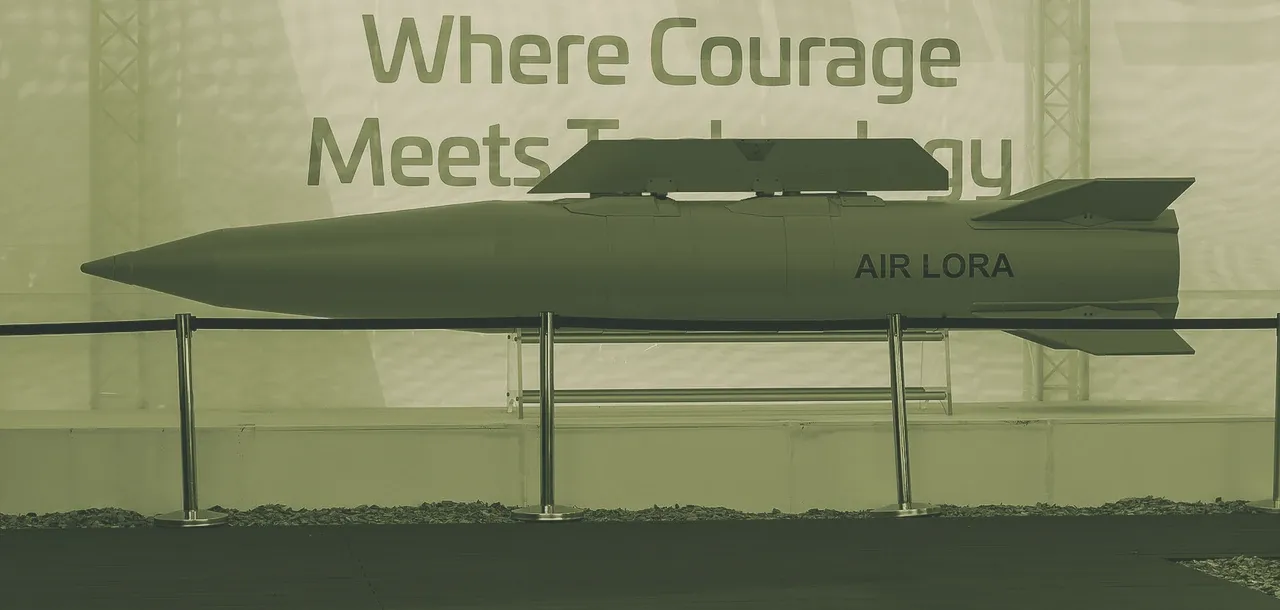
LORA — LOng Range Artillery — is an Israeli theater quasi-ballistic missile developed by Israel Aerospace Industries (IAI) for precision strikes against high-value targets at ranges of 90 to 430 kilometers, according to CSIS Missile Threat and Army Technology. The system is fielded on a mobile 6×6 truck, aboard naval vessels in containerized launchers, and since 2024, as the air-launched “Air LORA” variant. It is marketed as a competitor to the Russian Iskander and the American PrSM, offering a shoot-and-scoot ground system, ship-based deployment, and fighter carriage with claimed 10-meter circular error probable (CEP).
Development
IAI’s MALAM division began LORA development around 2002, with initial test firings in November 2003 and March 2004, as noted by Army Technology. The weapon was first displayed publicly at Eurosatory 2006 and the Paris Air Show 2007. While Israel itself has never officially acknowledged operational service, CSIS assesses the missile was introduced into Israeli use around 2007 CSIS. A June 2017 trial demonstrated launch from a sealed container on a ship’s deck, and in June 2020 a dual firing at sea validated hits at 90 and 400 km, cementing the containerized ship-launch capability CSIS. The air-launched variant, Air LORA, was unveiled at ILA Berlin in June 2024 after live firings from an F-16, with IAI marketing it to operators of heavy fighters like Su-30MKI and Rafale Breaking Defense.
Design & capabilities
LORA is a single-stage solid-fuel missile with all-electric actuation, measuring 5.2 meters long and 624 mm in diameter, and weighing approximately 1,600 kg at launch. It carries a 570 kg (up to 600 kg) warhead — available in high-explosive, blast-fragmentation, deep-penetration, and submunition configurations — over a range of 90–430 km, according to the manufacturer, though CSIS cites a more conservative 280 km envelope CSIS. Guidance relies on an anti-jam INS/GNSS suite with in-flight target-coordinate updates; terminal television guidance has been reported, enabling a claimed 10-meter CEP across the entire range envelope Army Technology. The missile’s trajectory can be shaped for a 60–90° steep terminal dive, complicating detection and interception. The ground-launched configuration uses a 6×6 truck TEL carrying four sealed canister missiles, with a shoot-and-scoot cycle of 10 minutes into action and 3 minutes out. Ship launches from standard intermodal containers were proven in 2017 and 2020, allowing covert deployment on cargo ships. Air LORA extends the concept to fighters, with IAI claiming a range of about 400–430 km and the ability to strike naval vessels in littoral waters, though the target-acquisition mechanism for moving ships remains unspecified The War Zone.
Variants
- Ground/sea-launched LORA: Baseline system with a 6×6 TEL or containerized ship launcher; sealed canisters provide a 7-year maintenance-free shelf life.
- Air LORA: Air-launched ballistic missile introduced in 2024, test-fired from an F-16 and marketed for the Su-30MKI, Rafale, and P-8, carrying blast-fragmentation or deep-penetration warheads with the same claimed 10 m CEP.
Combat record / operational use
The only documented combat use of LORA occurred during the 2020 Nagorno-Karabakh war, when Azerbaijan — the first confirmed export customer — employed the system against the Lachin corridor bridge in an attempt to sever Armenia’s ground link to Stepanakert. Azerbaijan’s purchase had been revealed in June 2018 when President Aliyev inspected a new Missile Troops unit displaying LORA alongside Belarusian Polonez launchers, and CSIS assessed the missiles were deployed in Nakhchivan from May 2018 Israel Defense. The strikes on the bridge, however, were less effective than anticipated: post-strike imagery showed limited damage rather than destruction, and a detailed analysis in Military Strategy Magazine notes that several rounds were fired, with at least one landing inside Armenian territory. The episode demonstrated the system’s coercive potential but cast doubt on its ability to deliver a knockout blow against hardened infrastructure.
No Israeli combat use of LORA has ever been confirmed. The Air LORA variant gained attention when wreckage of a missile visually resembling it appeared after Israel’s April 2024 strike on an Iranian S-300 battery near Isfahan, though the identity was never officially attributed to LORA The War Zone. India, meanwhile, emerged as the most significant prospective operator: Indian media reported in early 2026 that Air LORA was included in a large Israeli-origin weapons package worth approximately $8.7 billion, and that the IAF aimed to integrate it on its Su-30MKI fleet by 2026–27, with the missile already described as “in use by India” in a 2026 report The Week The Economic Times.
Advantages
- Advertised 10 m CEP across 90–430 km, with trajectory shaping and steep terminal dive that complicate missile defenses.
- Truly multi-domain: road-mobile TEL, containerized ship launch, and fighter-carried Air LORA.
- Combat-proven in a real-world conflict (Nagorno-Karabakh), demonstrating its strategic intimidation value even if the physical damage was limited.
- Quick deployment and high readiness: 48-missile battalion can be fired within two minutes, with a 10-minute emplacement and 3-minute displacement cycle, and missiles sustain a 7-year shelf life in sealed canisters.
- Anti-jam INS/GNSS navigation without an active seeker reduces unit cost and electronic vulnerability — a key selling point in the Indian market, where sources estimate an Air LORA round at $1–5 million Raksha Anirveda.
Drawbacks / limitations
- Actual combat performance against a bridge target was underwhelming, with limited damage and off-target rounds.
- No terminal seeker in the baseline weapon renders moving targets untargetable; the claimed anti-ship capability for Air LORA remains unproven and unexplained.
- Range figures are inconsistent: IAI’s 430 km against CSIS’s 280 km, and independent verification of accuracy and speed is lacking.
- Heavy weight (~1,600 kg) restricts air carriage to large fighters (Su-30MKI class), reducing salvo size per sortie compared to lighter missiles like Rampage.
- Israeli operational status is itself unconfirmed, with no documented Israeli combat use — the program relies on export sales for credibility.
Counterparts
- Iskander-M (Russia)
- ATACMS (USA)
Outlook
LORA’s future is tied to the Indian air force and the Air LORA variant. The reported Indian acquisition package, alongside a 2023 MoU with Bharat Electronics for licensed production, positions India as the anchor customer, with IAF squadrons expected to field the missile by 2026–27. Greece’s December 2025 ground-system order extends the export base into NATO. As a political alternative to Russian Iskander systems and American ATACMS/PrSM, LORA’s containerized launch option and lack of tight export restrictions make it attractive to mid-sized powers, though its credibility will ultimately rest on whether the 10 m CEP claim is borne out in future combat.
Key specifications
| Spec | Value |
|---|---|
| Type | Theater quasi-ballistic missile (SRBM class) |
| Range | 90–430 km (manufacturer); ~280 km (CSIS est.) |
| Speed (Mach / km·s⁻¹) | Up to Mach 5 (reported) |
| Warhead (type & weight) | ~570 kg (up to 600 kg) — HE, blast-frag, deep-penetration, submunition |
| Guidance | INS/GNSS anti-jam, TV terminal (reported), in-flight update, trajectory shaping |
| Accuracy (CEP) | 10 m (manufacturer claim) |
| Launch platform(s) | 6×6 truck TEL, ship (containerized), aircraft (F-16, Su-30MKI, Rafale) |
| Propulsion | Single-stage solid rocket motor |
| Length / diameter / launch weight | 5.2 m / 624 mm / ~1,600 kg |
Sources
- CSIS Missile Threat — LORA — https://missilethreat.csis.org/missile/lora/
- Army Technology — LORA Precision Strike Tactical Missile, Israel — https://www.army-technology.com/projects/lora-precision-strike-tactical-missile/
- Israel Defense — Azerbaijan Buys LORA Weapon System from IAI — https://www.israeldefense.co.il/en/node/34578
- Breaking Defense — Israel's IAI rolls out Air Lora, a new air-launched ballistic missile — https://breakingdefense.com/2024/06/israels-iai-rolls-out-air-lora-a-new-air-launched-ballistic-missile/
- The War Zone — Air LORA, Israel's Biggest Air-Launched Ballistic Missile, Emerges From The Shadows — https://www.twz.com/air/air-lora-israels-biggest-air-launched-ballistic-missile-emerges-from-the-shadows
- Military Strategy Magazine — Endgame in Karabakh: Azerbaijan, Armenia and the Utility of Land Power in the 2020s — https://www.militarystrategymagazine.com/exclusives/endgame-in-karabakh-azerbaijan-armenia-and-the-utility-of-land-power-in-the-2020s/
- The Economic Times — New teeth for the Su-30MKI: Israeli LORA could be India's next big strike weapon — https://economictimes.indiatimes.com/news/defence/new-teeth-for-the-su-30mki-israeli-lora-could-be-indias-next-big-strike-weapon/articleshow/122365429.cms
- The Week — India to buy Israel's Rampage, Air LORA, and Ice Breaker missiles for IAF? — https://www.theweek.in/news/defence/2026/01/03/india-to-buy-israel-s-rampage-air-lora-and-ice-breaker-cruise-missiles-for-the-iaf-here-s-why-they-matter-10-facts.html
- Raksha Anirveda — India Considering Acquisition of Air Launched Ballistic Missile Air LORA — https://raksha-anirveda.com/india-considering-acquistion-of-air-launched-ballistic-missile-air-lora/
🔒 The Analyst Section on LORA is for BattlePolicy Pro members. Below the line: procurement and contract history, the suppliers and companies behind the system, our head-to-head analyst view of the systems it actually competes with, and the BattlePolicy assessment note. Unlock the full file with BattlePolicy Pro →