Patria AMV
The most successful modern 8×8 — Finland's Patria AMV is a modular wheeled armoured vehicle adopted by a dozen nations and licence-built across Europe, Africa and Asia (as Poland's Rosomak, South Africa's Badger and more). One chassis, many roles, combat-tested from Afghanistan onward.
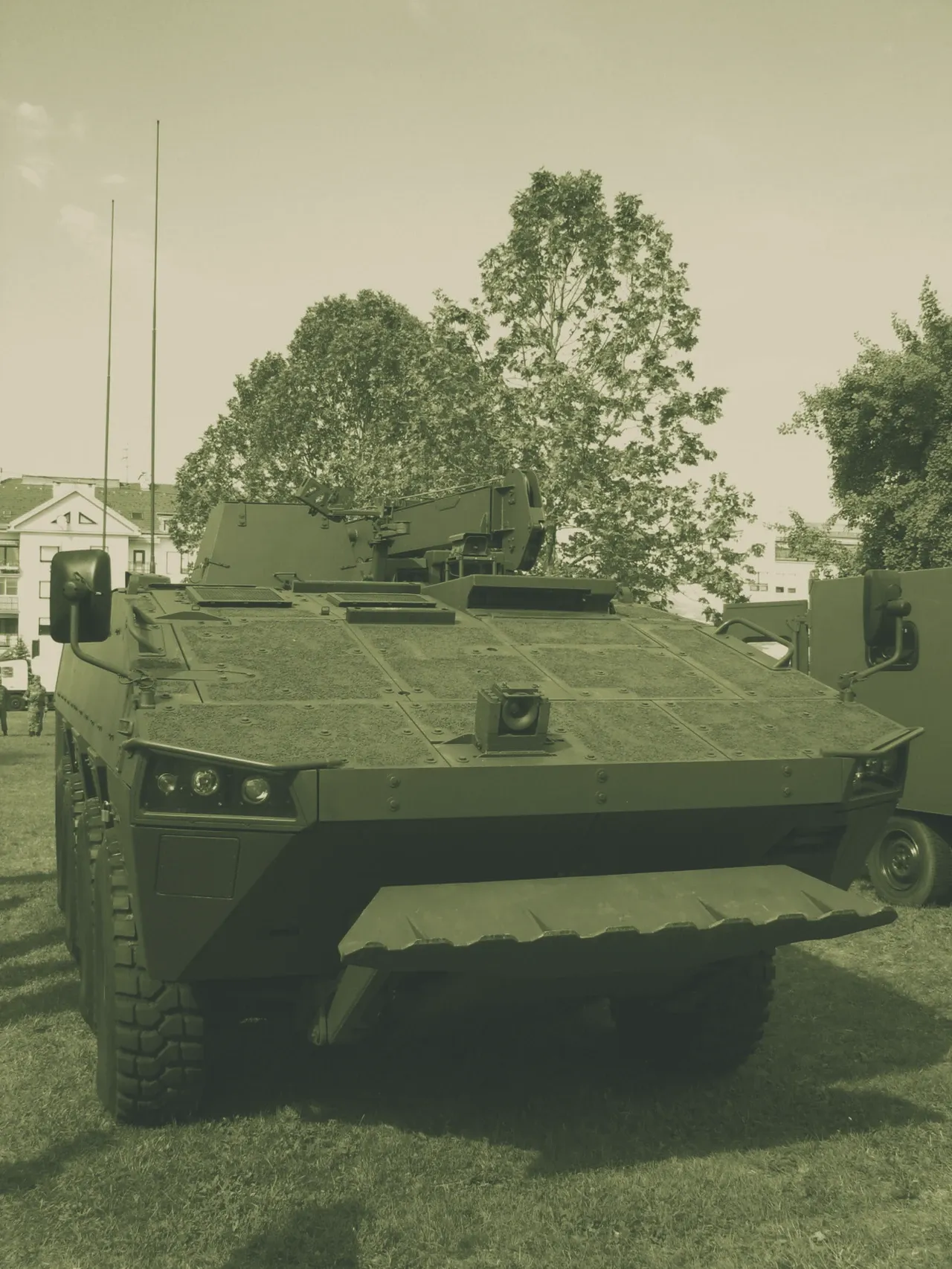
The most successful modern 8×8 — Finland's Patria AMV (Armoured Modular Vehicle) is a wheeled armoured vehicle built around modularity: one mine-protected chassis that accepts whatever turret, weapon, sensor or mission module a customer needs. That flexibility, plus strong protection and mobility, made it a global best-seller — adopted by around a dozen nations and licence-produced across Europe, Africa and Asia (as Poland's Rosomak, South Africa's Badger and others) — and one of the few Western 8×8s with a real combat record.
Overview
The Patria AMV is an 8×8 multi-role armoured vehicle produced by Finland's Patria, whose defining feature is its modular design: a common drivetrain and hull onto which different turrets (from remote weapon stations to 30mm cannon turrets to the AMOS twin 120mm mortar), weapons, sensors and communications fits can be integrated, and from which a family of variants — APC, IFV, command, mortar carrier, ambulance, recovery and more — is built. It combines that flexibility with high cross-country and road mobility, strong mine and ballistic protection, and (in many configurations) amphibious capability. Designed in the early 2000s, it became the benchmark modern wheeled armoured vehicle, winning a string of national competitions and being licence-built in several countries — a commercial success matched by few Western combat vehicles.
Development
Patria developed the AMV in the early 2000s as a modular, exportable 8×8, and it quickly accumulated customers and licence-production deals, per Wikipedia and Military Factory. Finland fields it, but the AMV's reach is defined by its licensees and operators: Poland licence-builds it as the KTO Rosomak (its standard wheeled APC/IFV, combat-deployed in Afghanistan), South Africa as the Badger, with production and operation also in Croatia, Slovenia, Sweden (Patgb 360), the UAE, Japan and others. The latest version, the AMVXP, adds a more powerful engine (around 450 kW), greater payload and protection, and an integrated terrain-control system, keeping the design competitive into the 2020s. The AMV has won numerous international tenders against rival 8×8s, and its modular concept has been validated across very different national requirements.
Design & capabilities
The Patria AMV is an 8×8 with independent suspension for high cross-country mobility, a powerful diesel powerpack (the AMVXP rated around 450 kW / ~600 hp), and good road speed and range. Protection is scalable — mine and IED protection (a key design emphasis), ballistic armour and add-on packages — and many variants are amphibious. The modular architecture is the core: the same hull mounts remote weapon stations, manned or unmanned 30mm cannon turrets (Poland's ZSSW-30, used on both Rosomak and the new Borsuk, is one example), the AMOS/NEMO 120mm mortar systems, or anti-tank, air-defence, command and support fits — letting one vehicle family cover the mechanized-infantry, fire-support and combat-support roles. It carries a crew plus a section of dismounts in IFV/APC configurations. The trade-offs are the general wheeled ones — somewhat less extreme cross-country capability than tracks, and armour tuned to defeat autocannon and mines rather than tank rounds — but the AMV's blend of protection, mobility, modularity and proven exportability is exactly what made it the dominant modern 8×8.
Variants
- Patria AMV (baseline): the original 8×8 in APC/IFV and many mission configurations.
- AMVXP: the latest, more powerful and better-protected version with terrain-control system.
- KTO Rosomak (Poland): licence-built standard Polish 8×8 (combat-used in Afghanistan).
- Badger (South Africa): licence-built family for the South African Army.
- AMOS/NEMO mortar carriers; command, ambulance, recovery and other role variants.
- National variants in Croatia, Slovenia, Sweden (Patgb 360), the UAE, Japan and others.
Combat record / operational use
The Patria AMV has a genuine combat record, principally through Poland's Rosomak, which Polish forces deployed extensively in Afghanistan (earning a strong reputation for protection and reliability, and the nickname "green devils" from local forces) and in other missions, and through other operators' deployments. As the standard wheeled armoured vehicle of multiple armies, it is used for mechanized infantry transport, fire support (via cannon and mortar variants), reconnaissance and combat-support roles. Its widespread adoption and licence production mean it is fielded across NATO and partner forces in large numbers, and its modular variants (like the ZSSW-30-turreted versions) keep it current. Its operational significance is breadth and proven service rather than a single campaign: the AMV is one of the most battle-tested and widely-relied-upon Western wheeled combat vehicles of the modern era.
Advantages
- Modular — one chassis, many turrets, weapons and mission roles.
- Strong protection — mine/IED and ballistic protection a core design emphasis.
- Mobile and amphibious — high cross-country and road mobility; many variants swim.
- Combat-proven — Polish Rosomak service in Afghanistan and beyond.
- Globally adopted — ~a dozen operators, licence-built across Europe, Africa and Asia.
Drawbacks / limitations
- Wheeled limits — less extreme cross-country capability than tracked IFVs in mud/broken terrain.
- Armour ceiling — protects against autocannon and mines, not tank rounds.
- Configuration sprawl — broad modularity and many national variants complicate logistics/training.
- Drone/mine exposure — like all armour, vulnerable to top-attack munitions and FPV drones once located.
- Weight growth — heavier protected/AMVXP fits stress the wheeled chassis and reduce margins.
Counterparts
The Patria AMV is the most successful entry in the crowded modern 8×8 market, competing with Germany's Boxer, the US Stryker, the Italian Freccia/Centauro family and others. As a modular, mission-flexible platform it parallels the design ethos of newer vehicles like the tracked Lynx. Its cannon-turreted IFV variants overlap with dedicated IFVs, and its licensees' national versions (Rosomak, Badger) are effectively members of the same family. The AMV's distinction is commercial and proven: where many 8×8s are national or limited-export designs, the Patria AMV became a genuine global standard — adopted, licence-built and combat-tested across continents — making it arguably the benchmark modern wheeled armoured vehicle.
Outlook
The Patria AMV's trajectory is continued production (the AMVXP keeping it competitive) and the steady evolution of its many national fleets, including new turret and mission modules. The variables to watch are how the wheeled-8×8 concept fares against the drone-and-mine threat that has reshaped armoured warfare, further exports and licence deals, and the integration of more capable turrets (like the ZSSW-30) and protection systems. As one of the foundational vehicles of the modern mechanized-infantry force across many armies, the AMV will remain a workhorse for years; its long-term relevance, like all medium armour, depends on adapting protection and tactics to a battlefield where cheap drones and mines threaten even well-protected vehicles. For Finland, the AMV is a flagship export and proof that a small nation's defence industry can set a global standard.
Key specifications
| Spec | Value |
|---|---|
| Type | 8×8 wheeled armoured modular vehicle |
| Origin | Finland — Patria |
| In service | Mid-2000s; AMVXP current |
| Powerpack | Diesel; ~450 kW (~600 hp) on AMVXP |
| Drive | 8×8, independent suspension; many variants amphibious |
| Protection | Scalable mine/IED + ballistic armour |
| Armament | Modular — RWS, 30mm cannon turrets (e.g. ZSSW-30), AMOS/NEMO 120mm mortar, ATGM, etc. |
| Roles | APC, IFV, command, mortar, recovery, ambulance, more |
| Licence variants | KTO Rosomak (Poland), Badger (South Africa), others |
| Operators | Finland, Poland, Sweden, Croatia, Slovenia, UAE, South Africa, Japan, others |
| Status | In service / production |
Sources
- Patria AMV — Wikipedia
- Patria Armoured Modular Vehicle — Army Technology
- Patria AMV: Specs & Operators — Global Military
- Patria AMVXP — Army Technology
- KTO Rosomak 8×8 — Army Recognition
- Patria AMV — Military Factory
🔒 The Analyst Section on Patria AMV is for BattlePolicy Pro members. Below the line: procurement and contract history, the suppliers and companies behind the system, our head-to-head analyst view of the systems it actually competes with, and the BattlePolicy assessment note. Unlock the full file with BattlePolicy Pro →