Putin Is Bombing Ukraine's Civilians. Kyiv's Bridges Are Next, and Engines Decide Who Wins
A glide bomb killed 33 people at a Kramatorsk bus stop. Drones hit Kyiv's bridges seven times in four days. Putin's target is civilian life, and the defense comes down to interceptor engines.
A glide bomb killed 33 people at a Kramatorsk bus stop. Drones hit Kyiv's bridges seven times in four days. Putin's target is civilian life, and the defense comes down to interceptor engines.
Vladimir Putin is losing ground at the front, so he is making war on the people behind it. The Institute for the Study of War assessed that Russian forces suffered a net loss of 80.81 square kilometers in September. At 10 a.m. on October 8, a Russian glide bomb hit two passenger buses at a stop in Kramatorsk, in Donetsk region. Ukraine's emergency service put the dead at 33; regional prosecutors counted 18 wounded. "For them, a bus with passengers is an attractive target precisely because one hit can kill as many people as possible," said Donetsk governor Vadym Filashkin.
That was the day after a Russian missile brought down a five-storey apartment block in Pryluky, east of Kyiv, killing 22 people, five of them children aged one to eight. The United Nations counted more Ukrainian civilians killed by August this year than in all of 2025. This is not collateral damage. It is the strategy.
The battlefield and the defense-tech story, sourced and fused. Free in your inbox.
Subscribe Free →The bridges are the same strategy
Kyiv's bridges are where that strategy is now aimed. Between October 1 and 4, Russia struck the Pivdennyi (South) Bridge five times and the Pivnichnyi (North) Bridge twice, according to a count by OSW. The strikes tore up road surface, damaged a support structure and the overhead power lines, and forced traffic restrictions. On October 6, a bridge in Zaporizhzhia was hit too.
Russia's Defence Ministry claims the Northern Bridge carried troops and military cargo. The South Bridge carries six traffic lanes and Kyiv's green metro line.
A column in The Telegraph by Hamish de Bretton-Gordon has put a face on the campaign: he wrote that Putin "has just brought in" Sergei Surovikin, the "General Armageddon" of Aleppo, to do the same to Kyiv. The claim rests on that one column and is unconfirmed. Whoever signs the target lists, Putin owns them, and the weapon is the jet-powered drone. Russia launched 594 of them in a single week, and Ukraine shoots down far fewer of those than of the older propeller models. Kyiv's crossings will stay open only if Ukraine builds interceptors and point-defense guns faster than Russia builds jets, and the interceptors are short of one part above all: small jet engines.
594 jets in a week
Jet-powered Gerans have changed the arithmetic of Ukraine's air defense. The Ukrainian Air Force estimated that between the evening of September 29 and the morning of October 6, Russia launched 1,434 attack drones, 594 of them jet-powered, or 41.4%. Defenses downed or neutralized 1,221, an 85.1% rate, but the blended figure hides the gap. Zelensky put interception at about 57% for jet drones against 85% to 90% for conventional ones in an interview with the Financial Times.
The volume is climbing. The Air Force counted a record 3,500 jet drones in September, ten times June's figure. Fredrik Wesslau, a senior policy fellow at the European Council on Foreign Relations, wrote that the jet variants fly at up to 375 mph, more than three times the original Iranian design, and use mesh radio networks to slip past Ukrainian electronic warfare. Presidential adviser Serhiy "Flash" Beskrestnov reported that Russian operators used mesh repeaters to steer drones in real time during the bridge attacks.
Death by small cuts
The bridges will not fall to drones, and Putin does not need them to. Major Artem Bilyk, a member of the General Staff's expert group on engineering protection for critical infrastructure, told Kyiv Post that single strikes cannot significantly damage massive bridge structures. Russia is instead using "small cuts": repeated hits that force closures for inspection and repair. His concern is precision. "Bridges have sensitive parts – nodes, joints and tensioned elements," he said, and guided drones can hit them.
The geometry favors drones over missiles. Kyiv architect and infrastructure researcher Oleg Grechukh noted that the bridges are no more than 15 to 20 meters wide, so a ballistic missile with 10-meter accuracy can miss into the Dnipro and do nothing.
The target is daily life. The river runs 600 to 1,000 meters wide through a city of almost 3 million, close to 4 million with suburbs, split roughly 55:45 between the banks. Earlier strikes on petrol stations were quickly repaired, and hit internet providers were back within hours. The bridge strikes produced hours-long jams and kept people from going to work. Russian milblogger Ilya Tumanov, known as Fighterbomber, said the goal was to "scatter brains from those who try to cross these bridges."
The Institute for the Study of War assessed that Russia struck the Southern Bridge to degrade its structural stability, but found it unclear whether Russia can sustain the tempo needed to make it unrepairable. ISW ties the campaign to a shift in Putin's theory of victory: with battlefield gains slowing, he is betting on a winter strike campaign to force Ukraine to give in. De Bretton-Gordon reads it the same way: Putin is moving the war onto ground where he thinks Russia has the advantage, a test of civilian endurance.
Twelve turrets, one job
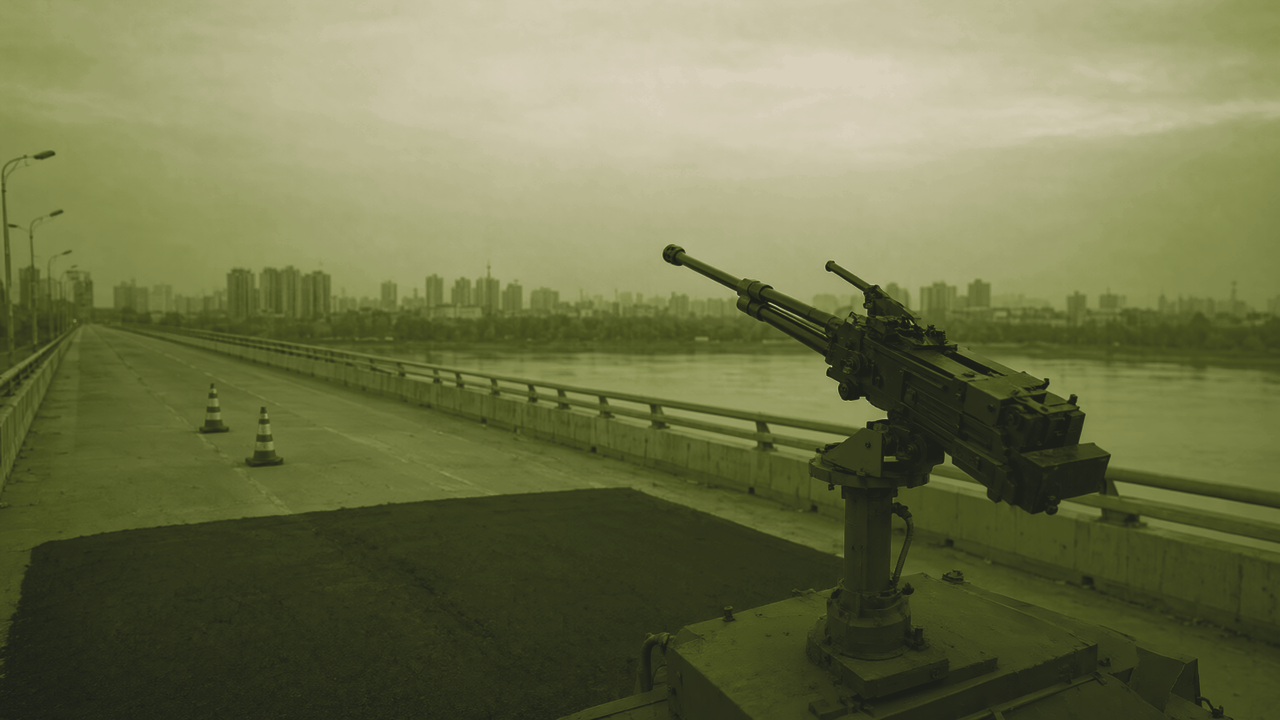
Ukraine's newest answer defends a site, not a city. Twelve automated .50-caliber machine-gun turrets are now in place around Kyiv, with eight more planned for the surrounding oblast, all aimed at jet drones, Zelensky said. Air Force spokesperson Yurii Ihnat said on October 5 that the turrets had already downed jet drones, "even 'Geran-5'," using machine vision to aim.
Beskrestnov set the limits plainly. A turret is "not a 'city-level' defense, but a 'site-level' defense," he wrote, naming "a warehouse, a production facility, a bridge, an electrical substation." "The turret is the last level of defense when the drone has overcome all others."
Against a campaign aimed at fixed crossings, that is the right weapon. A gun line at each bridge is a bounded procurement problem, and twenty guns are announced. What is missing is the layer in front of them.
400 interceptors, too few engines
That layer is the interceptor drone, and it is starved of engines. Zelensky told the FT that Ukraine is testing five high-speed models and that one could reach about 400 units by the end of October. The best performer, the Bars, developed jointly with Germany, intercepts at around 30%, he said separately. "Engines are key," he told the FT. "We really import a lot of engines." Domestic output falls short, and he cited a lack of budget money for development and mass production.
Colonel Yuriy Cherevashchenko, deputy commander of the Air Force, expects the necessary number of interceptors no earlier than the end of November. The military is working with about 20 companies; 14 are flight-testing and six have destroyed aerial targets. Output is still limited to dozens of units.
Four hundred airframes of one model, with the best design hitting about 30% of the time, do not answer a threat running at 3,500 jets a month. The Kyiv Independent assessed that producing jet interceptors at the needed scale is likely impossible for now, because the West has no supply chain for cheap jet engines. Ukraine has decided to build several types of jet engines at home, Zelensky said, with no output date given.
That makes the small jet engine the chokepoint of this war on civilians. Whoever supplies them at volume, a Ukrainian line or a European partner, decides how fast interceptor designs leave testing. The turrets need no engine at all.
Patriots cannot carry it
High-end missiles cannot carry this load. Zelensky said on October 4 that Russia has stockpiled up to 700 ballistic missiles and produces 130 to 140 a month, amid an ongoing Patriot shortage. Wesslau, working from an earlier figure of about 100 missiles a month, estimated that the US builds roughly half that many Patriot interceptors. Every PAC-3 spent on a drone over a bridge is one missing when a ballistic missile comes for an apartment block.
ISW warns that Russia may shift to more ballistic missiles once Ukraine's jet-drone interception improves. Closing the drone gap pushes Putin toward the other door. That is the case for cheap layers at the crossings: they save scarce interceptors for the missiles nothing else can catch.
Europe's choice is simple. Engines, interceptor money and gun turrets are cheap next to the cost of letting Putin learn that bombing bus stops and bridges works. He will keep doing it until it stops working.
What to watch
- The October batch. Whether production of one interceptor model actually reaches about 400 units by month's end.
- The November line. The Air Force's end-November target, and a start date for domestic jet-engine production.
- Turret count. Expansion beyond the 20 announced for Kyiv city and oblast, and whether the guns cover the crossings.
- Damage type. A confirmed hit on a joint, node or tensioned element, the weak points Bilyk named, would mark a shift from disruption to structural attack.
- Partner packages. Whether allies answer Zelensky's call for "concrete action through new defence packages" with engines and interceptor funding, not just statements.
Get BattlePolicy’s weekly read on the war, the weapons and the companies behind them. Free.
Subscribe Free →Frequently Asked Questions
What happened in Kramatorsk on October 8?
A Russian glide bomb hit two passenger buses at a stop at about 10 a.m. Ukraine's emergency service put the dead at 33; regional prosecutors counted 18 wounded.
Has Putin put General Surovikin in charge of strikes on Kyiv's bridges?
Unconfirmed. The claim's only source is an October 8 Telegraph opinion column by Hamish de Bretton-Gordon.
How many times have Kyiv's bridges been hit?
Seven times between October 1 and 4: five strikes on the South Bridge and two on the North Bridge, according to OSW. A bridge in Zaporizhzhia was also targeted on October 6.
Can drones destroy Kyiv's bridges?
Engineers told Kyiv Post it is practically impossible. Major Artem Bilyk warned, however, that repeated precise hits on joints, nodes and tensioned elements could disable a bridge without collapsing it.
What are the AI turrets around Kyiv?
Automated .50-caliber machine-gun turrets aimed by machine vision: 12 around Kyiv and eight more planned in the oblast, per Zelensky. The Air Force says they have downed Geran-5 jet drones. Adviser Serhiy Beskrestnov calls them site-level, last-layer defense.
Why can't Ukraine just use Patriot missiles?
Patriot interceptors are scarce and needed against ballistic missiles. Zelensky says Russia produces 130 to 140 ballistic missiles a month and has stockpiled up to 700.
AI-generated summary, reviewed by an editor. More on our AI guidelines.
Read next — from the Lexicon

Marcus Schuler
Marcus Schuler edits BattlePolicy, a daily defense-technology brief connecting the companies and capabilities behind modern war to the contest among Europe, the US, Russia, and China.