The Last Imported Part in Ukraine's Bars Drone Is Its Engine
Ukraine's Bars strike drone is now more than 74% domestically made, and the one part it still buys abroad is the turbojet. A Ukrainian engine has passed final tests. The engine, not the airframe, is what caps output on both sides of the drone war.
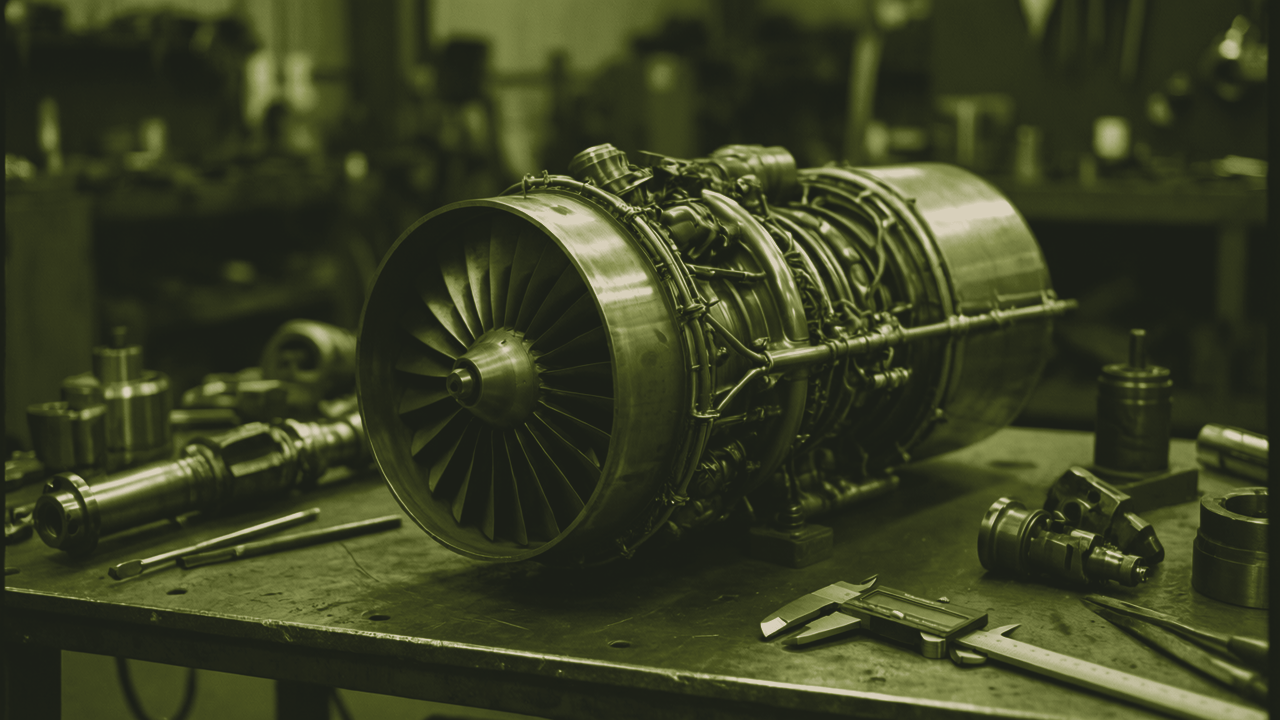
Ukraine is building an engine, Russia is importing one from China, and Europe is financing American interceptors. Each answer runs on a different production clock.
Bars at 74%
The only critical imported component left in Ukraine's Bars jet strike drone is its turbojet, and a Ukrainian-built replacement has now passed final tests. That single fact marks where the drone war's binding constraint has moved. Airframes get redesigned, guidance software gets revised, assembly gets spread across workshops. Small turbojets need precision manufacturing and a supply chain that takes years to stand up. Engine supply is the input that neither money nor fast iteration fixes on a war clock.
The Bars developer, unnamed for security reasons, told RBC-Ukraine on Sept. 7 that localization now exceeds 74% and that the turbojet remains the sole critical imported part. "Without exaggeration, we source them from all over the world," the developer said of the engines. An engine of the company's own production has completed final tests. No serial-production rate or start date was given.
The rest of the system has moved a long way. Development began in 2023 around a 22.5-kilogram warhead and a 700-kilometer range. The current vehicle carries up to 60 kilograms, reaches 1,000 kilometers and exceeds 700 km/h, after more than 40 engineering iterations. Its modular platform supports what the developer called DeepStrike, mid-strike and front-strike configurations. Ukraine codified it as an unmanned aerial vehicle, though the developer put it more bluntly: "legally a UAV, but factually a missile."
Frequently Asked Questions
What is the Bars missile-drone?
A Ukrainian jet-powered strike drone in service since development began in 2023. Its developer told RBC-Ukraine it carries a warhead of up to 60 kilograms, reaches 1,000 kilometers and flies at more than 700 km/h, across DeepStrike, mid-strike and front-strike configurations. Ukraine codified it as a UAV, though the developer called it "legally a UAV, but factually a missile."
Why does the turbojet engine matter so much?
It is the one part Ukraine still imports for Bars, and the developer said the limit on scaling production is not volume but engine delivery times. On the Russian side, analyst Michael Bohnert prices the Chinese microturbojet in Geran-4 and Geran-5 wreckage at $35,000 to $40,000 against a roughly $60,000 drone, making the engine most of the unit cost.
How much worse are Ukraine's intercept rates against jet drones?
An air-defense officer identified as Marko said interceptor drones costing $1,000 to $3,000 used to down 40% to 50% of ordinary Shaheds but manage about 15% against jet-powered ones, per bne IntelliNews. Ukraine had been intercepting about 95% of piston Shaheds by May.
How many jet drones is Russia building?
Ukrainian military intelligence assesses roughly 3,000 Geran-4 and Geran-5 airframes a month, and August was the first month jet models outnumbered piston-engined ones in production, per the Kyiv Independent.
What did the EU approve on Sept. 8?
Member states agreed to let Ukraine use 3.2 billion euros from the 90 billion-euro Ukraine Support Loan to buy American Patriot interceptors, an exception to rules restricting purchases to the EU, Ukraine or Norway. EU and national diplomats told the Kyiv Independent the Commission must still publish the communication, expected Sept. 11.
When will those Patriot missiles actually arrive?
Defense Minister Yevhen Khmara said Kyiv is contracting for about 1,000 Patriot missiles and that most will arrive only in the coming years, which is why Ukraine is asking partners for rounds from their own stockpiles. Germany is transferring PAC-2 missiles from its stocks in the interim.
AI-generated summary, reviewed by an editor. More on our AI guidelines.
Below this point
- The Oct. 10 Delivery Date
- Telefly's 200-Kilogram-Force Turbojet
- The $35,000 Component
- Marko's 15%
- Bohnert's Cost Per Hit
- Europe's 3.2 Billion Euros
- Alabuga and the Engine Line
- Sept. 11, Oct. 10, and Winter
The Oct. 10 Delivery Date
The developer named the constraint himself. "As of today, the only limitation to scaling up the production of 'Bars' is the so-called 'bottleneck,' and it is not so much the volumes as the delivery times of turbojet engines." That distinction carries the whole argument. Ukraine can build more airframes than it can buy engines to hang on them. What binds is lead time.
A joint-venture plant on European territory was due to start work in early September, with its first Bars output going to Ukraine's Defense Forces from Oct. 10. Foreign Minister Andrii Sybiha announced on July 8 that Ukraine and Germany had signed a Bars co-production agreement, with Germany financing the first stage and every unit built during it transferred to Ukraine's armed forces. That adds capital and European floor space. It does not yet prove the Ukrainian engine has reached serial output, which is the step that removes the imported part from the equation.
Telefly's 200-Kilogram-Force Turbojet
Russia solved the same propulsion problem by buying it. Ukraine's Defense Intelligence Directorate assessed that Russia developed the Geran-4 specifically as a countermeasure to Ukrainian interceptor drones. The design swaps the Shahed's propeller for a Chinese Telefly TF-TJ2000A turbojet rated at roughly 200 kilogram-force of thrust. The result maneuvers at 300 to 400 km/h, accelerates to 500 km/h, flies to 5,000 meters and carries a 50-kilogram warhead over 450 kilometers. The Geran-5 stretches that to 600 km/h, 6,000 meters and beyond 950 kilometers.
The older Geran-2 cruises at about 185 km/h. Russia bought enough speed to break the pursuit geometry that Ukraine's cheapest defenses depend on. Ukrainian military intelligence assesses Russia now builds around 3,000 Geran-4 and Geran-5 airframes a month, and August was the first month jet models outnumbered piston-engined ones in production. This is no longer a variant at the edge of a salvo. It is the center of the mix.
The $35,000 Component
The turbojet also absorbs most of the weapon's cost. Defense analyst Michael Bohnert notes the Chinese microturbojet recovered from Geran-4 and Geran-5 wreckage has been priced closer to $35,000 to $40,000 on its own, against a complete Geran-4 he puts at roughly $60,000. Serhiy "Flash" Beskrestnov, a presidential adviser on defense technology, arrives near the same number from the other direction: jet propulsion adds $30,000 to $40,000 per drone and cuts its range.
Two independent routes to one conclusion. The engine is not a component of these weapons so much as the majority of them. Bohnert cautions that his $50,000 to $70,000 band for the Geran-4 rests on a single air-defense source and should be read as directional rather than as a bill of materials. Estimates collected by The Irish Times put jet drones anywhere from 17,000 to 43,000 euros apiece, which shows how loose the public figures still are. The caveat narrows the precision and leaves the structure standing.
Marko's 15%
The engine decides which defensive layer can even engage. An air-defense officer identified only as Marko, in a thread posted by former economy minister Tymofiy Mylovanov and reported by bne IntelliNews, said interceptor drones costing $1,000 to $3,000 used to destroy 40% to 50% of ordinary Shaheds. Against jet-powered targets they manage about 15%. A propeller interceptor chasing from behind cannot catch something moving twice as fast.
"We'd spent a year building our system around target speeds and routes, and suddenly a third of the targets got 1.5 times faster," Marko said. Ukraine had been intercepting roughly 95% of piston Shaheds by May.
Colonel Yurii Ihnat of Air Force Command described the mechanics: machine-gun teams get far less time to open fire, a typical interceptor drone lacks the speed to catch a jet target, and at high altitude the target sits beyond mobile teams entirely. Many of the cheaper systems that became the backbone against conventional Shaheds either fail against jet models or work less well, he said, which pushes Ukraine onto electronic warfare, fighters and surface-to-air missiles. Those missiles are expensive and, in his words, "we have a lack of supplies." Vienna-based analyst Franz-Stefan Gady calls the jet drones "effectively cheap cruise missiles."
Bohnert's Cost Per Hit
Paying more per launch has bought Russia a better exchange rate. Bohnert prices a Geran-2 at about $35,000, which at a 10% leak rate costs roughly $350,000 in drones for every target actually struck. He puts the Geran-4 at about $60,000, which at a 50% leak rate costs about $120,000 a hit, and about $200,000 even at 30%. On those assumptions the jet drone is two to three times more cost-effective than the piston one, and Ukraine would have to hold Geran-4 leakage below 20% before the two weapons looked comparable.
Russia is spending more per launch to spend less per result. The engine is what makes the trade work.
Europe's 3.2 Billion Euros
Europe's answer runs through the interceptor market instead. On Sept. 8 EU member states agreed to let Ukraine draw 3.2 billion euros, about $3.7 billion, from the 90 billion-euro Ukraine Support Loan to buy American Patriot interceptors, a derogation from terms that otherwise restrict purchases to products from the EU, Ukraine or Norway. Commission President Ursula von der Leyen said the disbursement comes on top of 8.4 billion euros already paid out. EU and national diplomats told the Kyiv Independent the Commission still has to write up and publish the communication, expected Sept. 11. Britain committed 100 million pounds the same day for an air-defense package including Patriot missiles through NATO's Prioritized Ukraine Requirements List.
Authorization is not delivery. Defense Minister Yevhen Khmara said at the Ramstein meeting that Kyiv is signing contracts for about 1,000 Patriot missiles, and that most will arrive only in the coming years, which is why Ukraine is asking partners for missiles from their own stocks. Germany is transferring PAC-2 rounds from its stockpile to cover part of the interval. An engine line starting work in September and a check for interceptors do not run on the same clock, and only one of them changes what Ukraine can build for itself.
The demand is not waiting. Ukraine reported intercepting 175 aerial targets on the night of Sept. 8, with President Volodymyr Zelensky calling results against cruise missiles good and ballistics still especially hard. Across August the Defense Ministry counted more than 4,600 aerial targets and claimed 45 ballistic and cruise missile intercepts, of which eight were Iskander-M or KN-23 ballistic weapons.
Alabuga and the Engine Line
If the engine is the chokepoint, it is also the target and the lever. Bohnert argues that if the exchange rate holds, the Alabuga plant and the jet-engine line should move up Ukraine's target list above ballistic-missile final assembly, above oil except where oil funds the same plants, and well above the consumer-logistics strikes that have filled the ledger for a month.
The logic runs the other way too. A domestic engine through final tests, a European joint venture with an Oct. 10 date and a German-financed line all attack the same imported constraint. Their value depends less on announcing another airframe than on turning one tested engine into repeatable monthly output. Ukraine is running combat tests on at least four jet interceptors, and Khmara has described the task as bringing them to standard and scaling to thousands of units, which remains on the drawing board. Those interceptors will meet the same propulsion economics as the targets they chase.
Sept. 11, Oct. 10, and Winter
Five things now signal which way this goes: whether Ukraine's engine moves from final tests to serial output, and at what monthly rate; whether the European joint venture makes its Oct. 10 delivery; whether Russia's Chinese turbojet supply gets disrupted or sanctioned; whether the Commission publishes the 3.2 billion-euro decision on Sept. 11; and whether Ukraine's jet interceptors reach volume before winter.
The nearest policy date is Sept. 11. The nearest production date is Oct. 10. Neither answers the question that now governs the rest: how many engines Ukraine can build in a month.

Marcus Schuler
Marcus Schuler edits BattlePolicy, a daily defense-technology brief connecting the companies and capabilities behind modern war to the contest among Europe, the US, Russia, and China.