Germany Funds Tens of Thousands of Interceptors. Ukraine's Best Drone Stops 30% of Jet Gerans
Berlin is paying Quantum Systems to scale interceptor production inside Ukraine before any interceptor drone has shown it can reliably kill Russia's jet-powered Gerans.
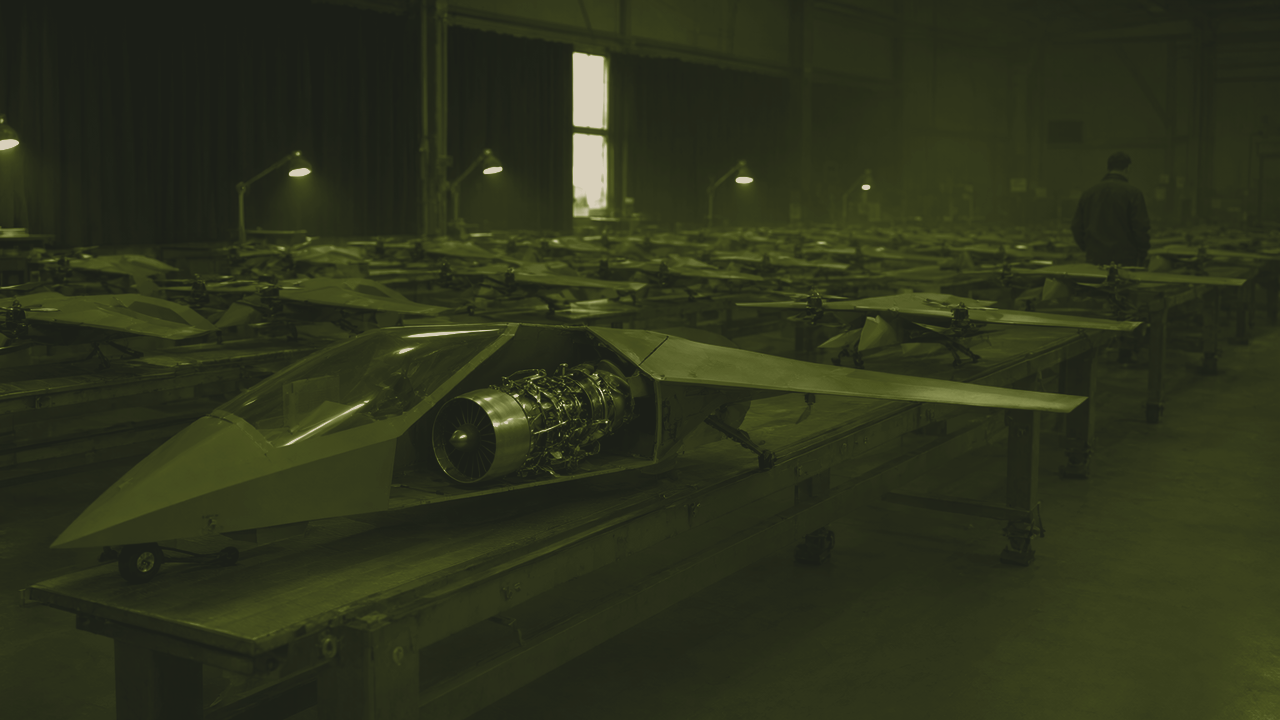
Berlin is paying Quantum Systems to scale interceptor production inside Ukraine before any interceptor drone has shown it can reliably kill Russia's jet-powered Gerans.
Chancellor Friedrich Merz's Oct. 4 package buys interceptor production in Ukraine before any interceptor drone has shown it can reliably kill a jet-powered Geran. Quantum Systems said "several tens of thousands" of its interceptors would be built in the country. The same day, President Volodymyr Zelensky put the best Ukrainian interceptor drone, Bars, at about 30% against jet targets. Berlin is betting that a factory inside Ukraine can absorb design changes faster than Russia changes the target.
Merz's Oct. 4 package
Merz announced about €1 billion ($1.1 billion) in military aid during a surprise Sunday visit to Kyiv with Economy Minister Katherina Reiche and executives from Diehl Defence, Hensoldt, Siemens Energy and Quantum Systems. The military package covers turbojet-powered drone interceptors, standoff weapons and space-based technology. Another €350 million goes to energy repairs, taking the total above €1.3 billion.
"Significant technical breakthroughs have already been achieved in recent weeks" on the interceptors, Merz said, "and these are now accelerating production." He added: "This will strengthen Ukrainian air defenses quickly and noticeably."
Zelensky counted 15 agreements and documents worth more than €8.5 billion. German officials gave a narrower tally of 14 company agreements worth about €6.6 billion. Ukraine's Defense Ministry signed with Quantum Systems on testing and procuring interceptors for jet-powered drones, signed three memoranda with Diehl covering IRIS-T systems, thousands of missiles and ammunition, and agreed a surveillance-radar deal with Hensoldt.
The need is measurable. Ukraine downs 85% to 92% of conventional Shahed-type drones and 50% to 60% of the jet-powered ones, Zelensky said on Oct. 4, and most of that jet figure belongs to combat aircraft. On Oct. 5, Air Force spokesperson Yurii Ihnat said automated gun turrets using machine vision had downed their first jet-powered drones, including a Geran-5. Kyiv now has a first point-defense kill and a German-funded production order. It does not yet have an interceptor drone that wins most of its engagements.
Frequently Asked Questions
What did Germany announce in Kyiv on Oct. 4?
Chancellor Friedrich Merz announced a package worth more than €1.3 billion: about €1 billion ($1.1 billion) in military aid, including funding for interceptor drone production, and €350 million for energy repairs.
How many interceptors will Quantum Systems build?
The company said "several tens of thousands" will be produced in Ukraine. It has not named the model, a unit price or a delivery schedule.
How well does Ukraine intercept jet-powered Gerans today?
President Volodymyr Zelensky said on Oct. 4 that Ukraine downs 50% to 60% of jet-powered drones, mostly with aircraft, against 85% to 92% of conventional Shaheds. The best interceptor drone, Bars, downs about 30%.
What is SPYS?
A propeller-driven interceptor from Quantum WIY Industries with a 0.3-kilogram warhead and roughly 15 kilometers of range. Its stated maximum speed is up to 480 km/h, according to UNN, and it remains in testing.
What are the AI gun turrets?
Automated .50-caliber machine-gun turrets aimed by machine vision. More than 12 are installed in Kyiv, and Air Force spokesperson Yurii Ihnat said on Oct. 5 they had downed their first jet-powered drones, including a Geran-5.
Why are jet engines a constraint?
Ukraine does not produce small jet engines itself, according to Fabian Hoffmann of the Norwegian Institute for Defence Studies, so scaling jet-powered interceptors depends on imports or licensed production.
AI-generated summary, reviewed by an editor. More on our AI guidelines.
Read next — from the Lexicon
Below this point
- Quantum WIY's STRILA, SPYS and SPICE
- Zelensky's 800-plus jet drones
- HUR's autumn Geran-4 findings
- Kyiv's 12-plus gun turrets
- Quantum Systems, Diehl and Hensoldt
- Kruck's four-to-eight-week window
Quantum WIY's STRILA, SPYS and SPICE
Quantum Systems has not said which interceptor Germany is financing. Its statement credits the Ukrainian team at Quantum WIY Industries, the joint venture with WIY Drones launched in April after Quantum invested in WIY in March, and says the drones plug into its MOSAIC UXS software. The company's press service said the order scales interception systems already in use in Ukraine. It gave no model, no unit price and no delivery schedule. German officials told Euronews that thousands of interceptors would reach Ukrainian forces in the coming months.
Three product lines are candidates, and they face different problems.
- STRILA. Militarnyi reported a September order of 25,000 for Ukraine's National Guard; DroneXL put a Berlin-funded March order at 15,000. STRILA was designed for Shahed-136 and Shahed-131 class targets. A rocket-boosted STRILA-2 was reported in development in March.
- SPYS. A propeller-driven interceptor with a 0.3-kilogram warhead, roughly 15 kilometers of range and a 4-kilometer ceiling, cued by radar with terminal guidance. A company representative earlier described sprints to 600 km/h; the stated maximum is now up to 480 km/h, according to UNN. WIY unveiled it in July and it remains in testing. Zelensky called its latest test successful on Oct. 4.
- SPICE. A jet-powered counter-drone design that Quantum co-CEO Sven Kruck described to the Kyiv Independent.
The announcements do not line up. Merz's package is described as turbojet-powered interceptors, which points to SPICE. The company's language about systems already in use points to the propeller lines. "Several tens of thousands" cannot be turned into a monthly defensive capacity until one of them is named.
Kruck framed the purpose as industrial. "Ukraine needs interceptor drones at industrial scale," he said in the company statement. "By expanding production in Ukraine, we can respond faster to the immediate threat while building an industrial capability that will also strengthen Germany and its allies." Quantum lists several hundred employees in Ukraine and three joint ventures there: Quantum Frontline Industries, Quantum WIY Industries and Quantum Tencore Industries.
Zelensky's 800-plus jet drones
Demand already exceeds what a successful test can answer. Russia sent more than 1,900 attack drones at Ukraine between Sept. 27 and Oct. 4, more than 800 of them jet-powered, alongside 1,700 aerial bombs and 25 missiles, by Zelensky's count. Ukrainian intelligence estimates Russia can build 3,000 jet Gerans a month.
The 30% Bars figure is the number that matters for Quantum. It measures an interceptor drone against a jet target, and it is roughly half the rate Ukraine's aircraft achieve. "Others are catching up as well," Zelensky said.
Serhiy Sternenko, drone warfare adviser to former Defense Minister Mykhailo Fedorov, was blunter. "There is currently no mass produced effective product among interceptors," he said, and taking a prototype to a large series is sometimes "even impossible due to limited access to certain components."
Speed explains the gap. The Geran-5 flies 150 km/h faster than the Geran-4, a senior engineer at a defense contractor told the Kyiv Independent, "so the goal is to intercept from the front rather than the rear - a much harder problem to solve." Kyiv Post lists the Geran-5 at a 450 to 600 km/h cruise, a range of about 950 kilometers and a 6-kilometer ceiling, against a 350 km/h maximum for the Geran-4. A SPYS at 480 km/h cannot run down a Geran-5 at the top of that band. It has to meet it.
Russia pays for that speed. The Geran-5 is estimated at about $115,000, including a $40,000 Chinese turbojet, against as little as $30,000 for piston models, the Kyiv Independent reported. With no interceptor price disclosed, the cost per kill on the defending side cannot be calculated.
HUR's autumn Geran-4 findings
A production order placed in October is aimed at a target that changed in September. Ukraine's military intelligence agency, HUR, found that Geran-4s used this autumn carry an optical navigation system called Susanin, which compares camera imagery of the ground with stored images. A similar system flies on the Geran-5. Both cut the drone's dependence on satellite signals, which shrinks what jamming can do and pushes more of the work onto physical interception.
HUR also identified a new shaped-charge warhead built to cut bridge structures and the supports that carry high-voltage lines. Russian forces struck Kyiv's Northern and Southern bridges seven times between Oct. 1 and 4, the Institute for the Study of War counted.
Zelensky expects the mix to shift further. Russia will move "toward quality rather than quantity," he said, with "maximum utilization of jet variants." He also put Russia's ballistic stockpile at up to 700 missiles, with 130 to 140 built each month. Interceptor drones answer none of those.
Kyiv's 12-plus gun turrets
The turrets are a stopgap for single structures. Zelensky described more than 12 installed in Kyiv and eight more planned for the surrounding region, each built around a .50-caliber machine gun. Ihnat credited machine vision for the jet kills; the guns have limited range, he told a national telethon, according to Ukrainian media. Business Insider reported that some will sit on Kyiv's bridges.
A .50-caliber gun can defend a bridge span. It cannot defend a district, and Ukraine has published no interception rate for the turrets. Zelensky separately promised domestically produced small missiles in the second half of October and said a new small missile, Nika, will be tested.
Quantum Systems, Diehl and Hensoldt
Germany is financing output inside Ukraine through a German company that owns the joint venture, instead of shipping finished weapons from German plants. That makes Quantum Systems the channel for Berlin's counter-drone money. The company also signed a memorandum with Fire Point, maker of the FP-1 long-range drone, on unmanned systems and countering advanced aerial threats. A concept image circulated by the outlet Drone Wars shows eight SPYS under the wings of an aircraft resembling Fire Point's FP-1 or FP-2.
Diehl and Hensoldt take the conventional share. The IRIS-T order will draw on the second tranche of the European loan, Zelensky said.
Money does not buy the jet interceptor's scarcest part. Ukraine does not produce small jet engines, said Fabian Hoffmann of the Norwegian Institute for Defence Studies, so scaling "will require steady and growing supply from abroad, or establishing licensed production facilities." The Kyiv Independent assessed that building jet interceptors at the required scale is likely impossible without Western supply chains for cheap engines. If Germany's money is for SPICE, the engine is the bottleneck. If it is for SPYS, the bottleneck is a head-on intercept at 480 km/h.
Kruck's four-to-eight-week window
- The funded model and a monthly rate. Neither Quantum Systems nor Kyiv has named the interceptor or said how fast tens of thousands will reach units.
- Kruck's own clock. Speaking of the several companies working on faster interceptors, he told the Kyiv Independent in an article published Oct. 1 that "maybe in four to eight weeks, we should see we are more controlling the air again." Counted from publication, that window closes between late October and late November.
- The interception rate. The baseline is 50% to 60% for jet drones overall and about 30% for the best interceptor drone.
- Small missiles and Nika. Zelensky's deadline for the first small-missile deployments is the second half of October.

Marcus Schuler
Marcus Schuler edits BattlePolicy, a daily defense-technology brief connecting the companies and capabilities behind modern war to the contest among Europe, the US, Russia, and China.