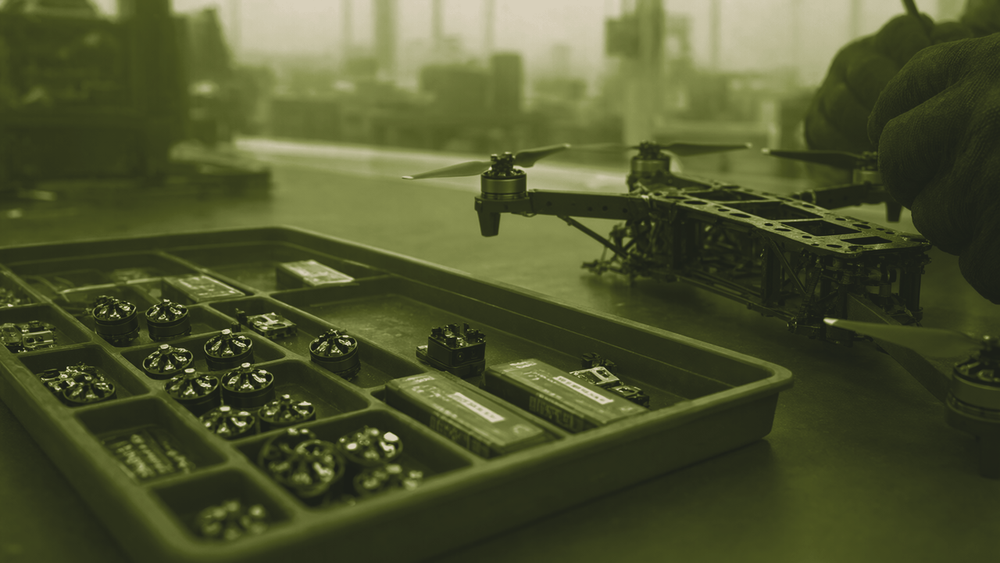
Unusual Machines says Powerus placed a $16.9 million order for U.S.-made motors, batteries, cameras and video transmitters. The supplier also holds a $30 million stake in the counter-drone maker.
The production award pairs a fused bridge picture for watchstanders on five Arleigh Burke destroyers with the plumbing to collect shipboard data, retrain AI models ashore and update ships at sea.
A Sequoia-led seed round values a company with no dogs yet at $1.2 billion, betting that cloned, gene-edited working dogs wired into Anduril's kit can replace the Pentagon's European supply.
Interceptor startup Singularity says a solid rocket motor co-developed with the Navy's China Lake weapons center completed a static fire about three months after the two signed a research agreement. No contract has been announced.
After Ukraine lost Starshield service without warning, Palantir says neither it nor Washington can switch off the Maven AI system running at NATO's top military headquarters.
The Army's enterprise deal for Striveworks' Chariot AI, which sorts sensor and drone data into potential targets, now runs to $700 million over five years as NGC2 moves to I Corps.
AFRL's Oct. 20 test put military supplies inside a one-ton-class commercial reentry capsule, the vehicle class the Air and Space Forces now favor over the 30-ton rocket deliveries Rocket Cargo began with.
Russia's first diesel tanker for the US sails Thursday with 40,000 tonnes. How many follow depends on refinery units and export terminals that Ukraine's drones keep hitting.
The office meant to keep Pentagon AI trustworthy is 70 percent unstaffed and its coordinating council has no charter, while the department pushes AI into target recognition and agentic systems on a wartime footing.
Canberra declassified payloads that take its autonomous submarine from surveillance into mining and strike, and is offering them to the US and UK under AUKUS.
Epirus announced an Oct. 13 research agreement with the Army's Ground Vehicle Systems Center to put Leonidas on vehicles. The Army told Congress it plans no more fixed-site buys.
The Army's cyber command wants offensive AI agents that 'must operate with minimal human oversight,' while its commander says the agents it runs today stay under human supervision.
The Fury's onboard autonomy carried out a Raptor pilot's orders, the first in-flight test of the command link the Air Force's drone-wingman plan depends on.
Emil Michael, who handles the White House AI task force's dealings with the labs, said export controls are an appropriate stick for AI companies that do not cooperate with the government.
Beijing's Nov. 18 licence list draws its motor lines above FPV hardware. The customs queries and spec declarations that come with it reach the third-country routes Ukrainian drone makers use to buy Chinese parts.
The Pentagon has given BAE a seven-year demand signal for its cheap laser-guided drone interceptor, but the buy still awaits congressional authorization and appropriations.
Ukraine's main defense against Russian ballistic missiles now waits on a Pentagon signature, with interceptors its allies already paid for held up in Washington.
The shipbuilder-plus-software team put its uncrewed vessel autonomy in front of US Navy observers as Anduril chases the Navy's medium USV program with commercial yards.
Orqa U.S., formed by Croatia's Orqa and By Light, won a $38 million Drone Dominance contract for 8-inch MRM2 indoor drones that By Light will build in Port Orange, Florida. The program leaderboard lists 7,000 drones; no delivery schedule is public.
Brussels wants to clear the Airbus-Thales-Leonardo satellite merger fast after the Starshield cap hit Ukraine's drones. The merger combines factories; Ukraine's dependency sits in the network, the terminals and the rockets.
On Newsmax, Trump said the U.S. is keeping its new munitions and will let allies buy again once it is "really stocked." Kyiv, out of Patriot interceptors, cannot wait that long.
Hadrian will bring a 24-machine automated machining cell into Lockheed Martin's Grand Prairie missile parts plant in early 2027 under a seven-year agreement. Work starts on PAC-3 and PrSM parts; neither company disclosed the value or the added output.
A reported Patriot run-out, missing launch warnings and a 160 km/h cap on drone links arrived in the same week. The refinery campaign Kyiv resumed depends on none of them.
Lockheed is reserving capacity at Avio USA's new Virginia plant to loosen a two-supplier solid rocket motor market, but the motors still have to qualify and the plant is not scheduled to build any until 2029.
Ukrainian drone makers have replaced many Chinese parts with their own. Magnets, battery cells, chips and thermal sensors still come from China, and magnets are the first of those parts US sourcing rules police, from Jan. 1.
The radar and interceptor at the center of the U.S. Army's LIDS counter-drone system go to Qatar and Jordan as Raytheon tests a faster, rocket-powered Coyote.
Riyadh is investigating why its air defenses failed after Houthi missiles killed at least 13 at King Khalid airport. Officials say the kingdom is short of interceptors, and the American stocks that would resupply it are depleted.
Project Griffin would let software respond to intrusions the Army can now only detect. Officials said the agents will not start work on Army networks right away.
Vector and Nammo Defense Systems expanded their teaming agreement on Oct. 12 to put Nammo munitions on Vector's small drones. Vector says it was selected for up to 5,000 Drone Dominance systems; the agreement names no value or quantity.
Lockheed showed a Patriot successor due in 2031 on the day Poland said its own PAC-3 deliveries will slip. Ukraine's ballistic defense this winter rests on missiles allies already hold.
Powerus says it is automating the final kill because the U.S. lacks Ukraine's drone-pilot brigades, while the Congressional Budget Office counts U.S. missile interceptor stocks down by up to two-thirds.
Anduril's two-stage missile design is built to push interceptor output into the thousands and cut the cost of each engagement, with flight tests set for 2027.
Shield AI is matching a $150 million Navy award that pays to make its AI-piloted, runway-free fighter exportable, lifting X-BAT commitments to $400 million before its first flight test.
The MQ-4C Triton is Northrop Grumman's unarmed, high-altitude maritime surveillance aircraft, operated by the U.S. Navy and Australia alongside crewed P-8A Poseidon aircraft.
The ADM-160 MALD is an expendable air-launched decoy that imitates aircraft radar signatures. The MALD-J variant adds radar jamming; Ukraine uses the baseline decoy alongside strike weapons.
The GBU-53/B StormBreaker is a US precision glide bomb combining radar, infrared and laser guidance with in-flight updates to attack moving targets in poor weather.
EchoGuard is Echodyne's compact, electronically steered radar for short-range drone and ground-target tracking, used as a sensing and cueing component in surveillance and counter-drone systems.
LOCUST is AeroVironment's high-energy laser counter-drone weapon family, developed by BlueHalo and deployed by the US Army in palletized and vehicle-mounted configurations.
The Space-Based Interceptor program develops orbital kinetic interceptors for Golden Dome, with a planned constellation intended to engage missiles during boost, midcourse and glide phases.
FireAnt is Swarmbotics AI's small autonomous ground vehicle for networked reconnaissance, electronic warfare and mission payloads, undergoing US Army experimentation with the 1st Cavalry Division.
The Glide Phase Interceptor is a US-Japan missile-development program intended to give Aegis ships and Aegis Ashore a hit-to-kill defense against hypersonic glide vehicles during atmospheric glide.
The award backs interceptor replenishment after combat use against Iran, but the missile count is undisclosed and industry warns funding gaps could delay investment.
Two awards in three days give the Navy two companies developing a motor for the medium-range variant of its planned Standard Missile successor, a four-per-cell interceptor.
The company-funded YFQ-48A cut parts and weight to get Northrop back into an Air Force drone-wingman plan that already has two airframes in production.
The Army awarded Anduril a five-year contract worth up to $1.8 billion to field NGC2's common data layer, starting with I Corps, the company said Oct. 5.
The five-year order backs a production target above 500 SM-6s a year, but the Pentagon has not said how many missiles it buys and Congress has not yet funded it.
The G7 will release up to 100 million barrels as Ukraine's drones keep hitting Russian refineries. Putin put the campaign's cost at 1% of GDP and said a strike pause would not return Russian diesel while sanctions stand.
Blackstone has combined TSC and ASEI into Falcata, a company built to expand output of the seekers, guidance electronics and navigation systems inside the cheaper interceptors needed against mass drone and missile threats.
Lockheed Martin led Fortem's $50 million Series B to expand DroneHunter production in Utah and tie Fortem's radars and interceptors into its Sanctum counter-drone software. The Army's new counter-drone IDIQ does not name Fortem.
Shield AI has fixed the factory and flight-test sites for its runway-independent AI-piloted fighter, which has yet to fly and whose production dates do not yet line up.
The Pentagon wants a 12th combatant command for drones and robotics by Oct. 1, 2027, and until Congress agrees, the work runs through the office already buying them.
The Army's $4.15 billion Domestic Shield counter-drone vehicle fits the small drone over a U.S. base. Only $50 million is funded, and its one Ukraine-tested interceptor flies at about half the speed of Russia's Geran-4.
The Trump administration's hand-picked NATO working group leaves out Europe's two nuclear powers and the three allies that spend the largest share of GDP on defense.
Aeon says it will license-build Destinus' Hornet Block 2 interceptor in Texas from 2027, and the pair's joint proposal is a Topic 1 finalist in the Army's xTech|Apex Intercept competition.
A Navy buying model that made vendors fund their own sea trials has produced its first production orders, and the service is already loosening the rules to bring in more builders.
The Pentagon's up-to-$20.7 billion AMRAAM contract refills U.S. and allied magazines through 2033. Ukraine, where F-16s and NASAMS fire the missile at Russian cruise missiles and jet drones, is not a named buyer.
The Navy is buying the autonomy startup as a second-source shipbuilder, and Saronic has to deliver crewed landing craft from its new Texas yard before its autonomous fleet arrives.
The likely PAC-2 route avoids PAC-3's seeker constraint, but offers weaker ballistic defense from a European production base Germany hosts and Poland wants.
The deleted clause would have required a person to check an AI-generated target before a strike, weeks before states decide whether to open treaty talks.
Fury and Vengeance have moved from company demonstrations to Air Force operator-led testing, while both manufacturers build production jets ahead of new federal funding.
At Scarlet Dragon 26-3 the XVIII Airborne Corps found no single sensor can stop a 100-drone swarm, while the Pentagon is already ordering attack swarms by the thousand.
Finland has signed and a US framework is ready. The Iran war showed why Ukrainian interceptors have to travel with Ukrainian components, software and operators.
The Army picked Vulcan Elements to supply rare-earth magnets for the brushless drone motors it builds at Tobyhanna Army Depot. The award notice shows $1.2 million; no order quantity or delivery date is public.
A Gray Flag 2026 test sent a human-built mission plan to an autonomous MQ-20 Avenger, giving the Navy a platform-agnostic planning layer for combat drones it has not yet bought.
At least 20 counter-drone vendors at NORTHCOM's border-focused Falcon Peak 26.2 had to feed their tracks into Anduril's Lattice, including interceptors Ukraine already flies against Russian drones.
The EA-37B Compass Call is a US Air Force airborne electronic-attack aircraft that transfers the Compass Call mission from the EC-130H to a modified Gulfstream G550.
The Army Applications Laboratory gave Rune Technologies $4.1 million to take TyrOS across the 1st Cavalry Division and let it task drones and ground robots with resupply. The only disclosed live mission so far was one August drone run.
A new seeker turns existing HIMARS units into land-based anti-ship forces, but the open-quantity $1.2 billion award arrives with baseline PrSM stocks still depleted.
Kyiv's strike ledger overstates the Russian refining capacity offline at one time. The harder metric is whether repeat strikes keep plants broken faster than Moscow can repair them, and that is the leverage Trump wants frozen.
An AI-assisted report falsely tied a Chinese ship's cargo to a nuclear program during the Iran war. Senators now want inspectors general to examine how the Pentagon checks machine-made intelligence.
Hanwha Defense USA and Magnet Defense start building the 38-meter H38 unmanned vessel in October and test it in January. The Navy's first MUSV trial round is running without them.
The next funding phase moves Avalon Holographics toward an OLED flat panel, the cost cut that decides whether its mission-planning display ever leaves the operations center.
The Gauntlet II leaderboard picks the vendors in line for a 60,000-drone Pentagon order, but the program still calls them finalists and says awards are not guaranteed.
Pratt & Whitney licensed Hermeus on Sept. 15 to build F100-PW-229 fighter engines. Hermeus must first get its builds accepted by Pratt, and no rate or delivery date was disclosed.
The Pentagon inspector general made the munitions shortfall official and named industrial bottlenecks as the constraint. Ukraine's winter air defense now rests on allied stock swaps and its own cheap interceptors.
Fire Point makes 300 to 400 long-range attack drones a day. Washington is asking Kyiv to curb their refinery mission while the Gulf drives the larger diesel shock.
The MQ-1C Gray Eagle is the US Army's armed medium-altitude, long-endurance uncrewed aircraft, combining persistent surveillance, targeting, electronic warfare and Hellfire strike capabilities.
The V-22 Osprey is a twin-engine military tiltrotor combining helicopter-like vertical takeoff and landing with the speed and range of a turboprop transport.
A compact US-German ship-defense missile that combines passive radio-frequency and infrared homing to intercept anti-ship missiles and other close-range threats.
The M113 is a lightweight American tracked armored personnel carrier whose simple construction, extensive variant family and large surviving inventory have sustained its use from Vietnam to Ukraine.
The BGM-71 TOW is a long-serving American heavy anti-tank guided missile family, launched from tripods, vehicles and helicopters and fielded in wire-guided and radio-frequency variants.
Paveway is a US-origin family of guidance kits that converts general-purpose and penetrator bombs into laser-guided or dual-mode laser/GPS precision weapons.
The AGM-65 Maverick is a modular US air-to-surface missile family combining television, imaging-infrared or laser guidance with anti-armour and penetrating warheads.
The A-10 Thunderbolt II is an armored US close-air-support aircraft built around a 30 mm cannon, valued for persistence and low operating cost but vulnerable in contested airspace.
Anduril Dive-LD is a US large autonomous underwater vehicle designed for long-endurance undersea surveillance, mine countermeasures, seabed mapping and modular payload delivery.
LUCAS is a US long-range one-way attack drone derived from the Iranian Shahed-136 and designed to deliver affordable mass through coordinated, expendable strike formations.
The RGM-84 Harpoon is a US surface-launched, sea-skimming anti-ship cruise missile used from warships and coastal batteries, including Ukraine's Black Sea defenses.
The LGM-30G Minuteman III is the United States' three-stage, solid-propellant, silo-based intercontinental ballistic missile and the sole land-based component of the US nuclear triad.
The UGM-133A Trident II D5 is the submarine-launched ballistic missile at the core of the United States and United Kingdom sea-based nuclear deterrents.