IranPro
Misagh-2
Misagh-2 is an Iranian infrared-guided, man-portable surface-to-air missile associated with Chinese QW designs and documented transfers to armed groups.
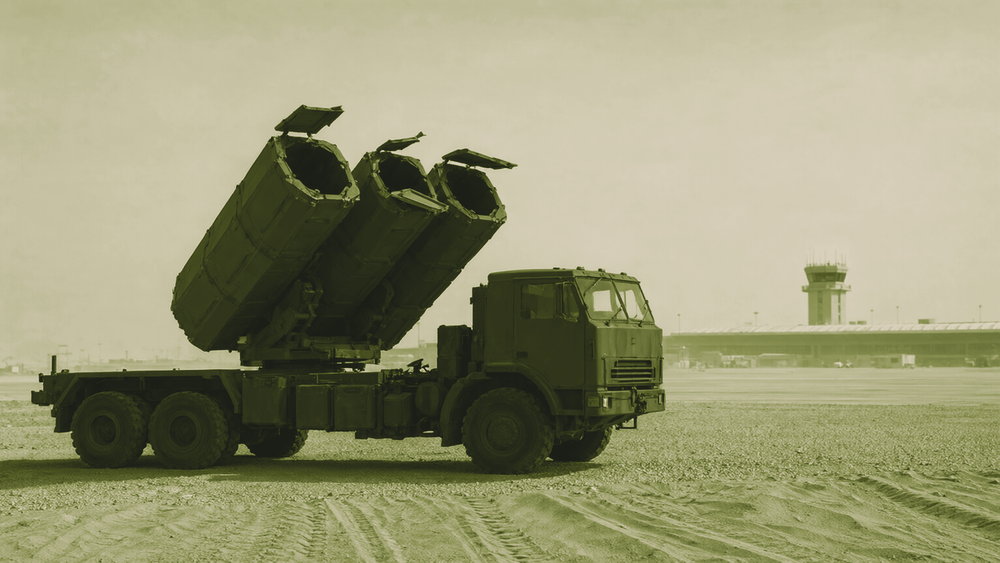
Riyadh is investigating why its air defenses failed after Houthi missiles killed at least 13 at King Khalid airport. Officials say the kingdom is short of interceptors, and the American stocks that would resupply it are depleted.
Misagh-2 is an Iranian infrared-guided, man-portable surface-to-air missile associated with Chinese QW designs and documented transfers to armed groups.
Hormuz-2 is an Iranian Fateh-110-derived anti-ship ballistic missile with a reported range of about 300 km, an unresolved terminal-seeker configuration and no confirmed combat use.
Russia's Geran-5 has reached Kyiv and drawn Iranian interest. Its marquee capabilities are unproven, its range is contested and its output depends on one Chinese turbojet.
The HQ-7 is a Chinese short-range surface-to-air missile system derived from the French Crotale, with the improved FM-90 serving as its principal export version.
Zoubin is an Iranian short-range, low-altitude air-defence system combining a 360-degree radar with vertically launched missiles to counter drones, cruise missiles and low-flying aircraft.
An Iranian class of four aluminium catamaran missile corvettes built for the IRGC Navy, combining vertical-launch cells, anti-ship missiles, fast boats and a helicopter deck on a 600-tonne hull.
Iran's Qaem family comprises TOW-derived short-range surface-to-air missiles, UAV-carried glide bombs and the longer-range Qaem-118 counter-air interceptor.
Iran's Moudge class is a family of domestically built light frigates, officially designated as destroyers by Tehran, that combined anti-ship missiles, short-range air defense and helicopter facilities on a roughly 1,500-tonne hull.
China's independent global positioning, navigation and timing constellation, combining open and restricted signals with a distinctive satellite short-message service.
The Ababil is a long-running Iranian family of tactical drones spanning reusable reconnaissance, target and armed aircraft, as well as the one-way Qasef derivatives supplied to Yemen's Houthis.
The Pentagon inspector general made the munitions shortfall official and named industrial bottlenecks as the constraint. Ukraine's winter air defense now rests on allied stock swaps and its own cheap interceptors.
The Samad-3 is a long-range Houthi one-way attack drone with an external fuel tank, an estimated reach beyond 1,800 km and an Iranian-linked commercial-component supply chain.
The Palestine-2 is an Iranian-derived, two-stage solid-propellant ballistic missile fielded by Yemen's Houthi movement for long-range strikes against Israel.
China's widely exported family of subsonic, turbojet-powered anti-ship cruise missiles, fielded from ships, aircraft and coastal launchers and reproduced in Iran as the Noor, Qader and Ghadir.
Toufan is the Houthi designation for an Iranian Ghadr-derived, liquid-propellant medium-range ballistic missile with sufficient claimed range to reach Israel from Yemen.
Majid is an Iranian short-range air-defense system combining electro-optical tracking with passive imaging-infrared missiles for low-altitude defense against drones, cruise missiles, helicopters and aircraft.
Iran's road-mobile medium-to-long-range surface-to-air missile system, combining a phased-array engagement radar with Sayyad-family interceptors for defense against aircraft and uncrewed aerial vehicles.
Iran's first dedicated drone carrier — a converted Panamax container ship fitted with an angled flight deck, aviation facilities and missile armament for forward operations by the IRGC Navy.
Iran's road-mobile, solid-fuel Zolfaghar ballistic missile extends the Fateh-110 family to a claimed 700 km and has been used in cross-border strikes since 2017.
The vehicle Iran recovered near the Strait of Hormuz cost about as much as one Tomahawk. Its intact, mass-produced hull may be worth more to an adversary than the secrets it was not carrying.
European financing and Ukrainian arms production constrain Washington’s ability to impose a bargain, while US weapons, intelligence and commercial services preserve US leverage.
The small Shahed. About two-thirds the weight of a Shahed-136 with roughly a third of the warhead and a rotary engine, it entered Russian service as the Geran-1 in 2022 and is still a separately planned production line four years later.
Russia's second Shahed line — built not at Alabuga but by Almaz-Antey subsidiary Kupol in Izhevsk, with Chinese engineering help. Heavier warhead than a Geran-2, now sold abroad by Rosoboronexport and fielded in Mali.
The largest and fastest member of Russia's Geran family — a 6.5-metre, cruise-missile-shaped "missile-drone" flying at up to 600 km/h with a 90 kg warhead, air-launchable from a Su-25 and reportedly able to carry an air-to-air missile of its own.
The Navy's $22.9 billion, seven-year Tomahawk award gives Raytheon the certainty to build toward 1,000 missiles a year. It does not buy back the 1,000-plus fired at Iran: rocket-motor lead times set the clock, while Ukraine's Fire Point builds 100 cheaper cruise missiles a month.
Two Pentagon moves would deepen Palantir's hold on military software after Maven accelerated AI-assisted targeting during the Iran campaign.
Iran's reusable medium-altitude, long-endurance ISR and strike drone, designed for persistent surveillance and guided-weapon employment from a runway-based platform.
The Fateh-110 is an Iranian road-mobile, solid-propellant short-range ballistic missile developed for conventional theater strikes at ranges of approximately 200 to 300 km.
Adversaries are winning with recontextualized real footage and propaganda aimed at the AI answer layer. Western money is still buying deepfake detectors whose accuracy collapses on exactly that content.
Tehran's answer to losing its fixed SAM sites is a $60 million buy of man-portable launchers, routed through a Hong Kong intermediary and, reportedly, Pakistan.
Ukraine's July 25 Caspian strikes hit the Port Olya 2 and the Begey, two hulls already designated by OFAC and OFSI, on a sea where a 2018 convention bars foreign warships from enforcing anything.
Task Force Talon Synapse puts about 20 US and Emirati AI specialists in Abu Dhabi, giving CENTCOM a forward model-development cell in the theater where it is already running a strike campaign.
The Houthi strike on two Saudi tankers turned the Red Sea into a second front alongside the Strait of Hormuz and pushed Brent past $100. The drones and missiles doing it cost a fraction of what it takes to stop them, and that gap is the story.
CENTCOM named the platform behind the first combat strike by American sea drones: three Saronic-built Corsairs hit Iran's Bandar Abbas naval port on July 12.
Iran answered a second night of US strikes by firing on bases in four countries, aiming, by its own account, at a Patriot battery in Kuwait and an early-warning radar in Qatar.
CENTCOM's largest strike wave since June hit anti-ship missile sites and more than 60 IRGC fast boats after attacks on three tankers; Tehran answered at US bases in Bahrain and Kuwait, and the June ceasefire looks dead.
Iran's largest Shahed-family reconnaissance-strike UCAV, presented as a turboprop answer to the MQ-9 Reaper with long-endurance ISR and precision-strike roles, but with performance and production claims still dependent on Iranian and trade-press reporting.
Iran's HESA Karrar is a jet-powered target drone adapted into claimed strike and air-defense interceptor roles, with performance and weapons claims still thinly verified outside Iranian sources.
The Shahed-101 is Iran's small one-way-attack drone — the quiet, catapult-launched progenitor of the Shahed-107, used by Hezbollah and Iraqi militias since 2021, confirmed in Ukraine from late 2025 (all-Iranian parts), and refielded in an electric, near-silent variant for Iran's 2026 Gulf strikes.
The Shahed-107 is Iran's mid-range strike drone reportedly built for Russia's war — announced as a 1,500 km HIMARS hunter, revealed by Ukrainian teardown as a ~300 km, 15 kg-warhead X-tail drone hitting the near rear. The gap between those two descriptions is the story.
The Emad is Iran's first precision-guided ballistic missile — a Ghadr airframe with a maneuvering reentry vehicle, ~1,700 km range. It has flown in every True Promise salvo against Israel since April 2024, and the 2026 war gutted the launcher force and factories that field it.
The Paveh is Iran's 1,650 km-claimed cruise missile — the IRGC's Project 351, identical to the Houthis' Quds that hit Saudi Aramco in 2019. Used against Israel in April 2024 (0 of ~30 got through), exported to three proxy arsenals, and absent from the missile-dominated 2025–26 wars.
An Iran war that burned through American missile-defense stockpiles is reshaping Pentagon procurement, starting with a contract to quadruple THAAD interceptor production.
The "bigger brother" of the Shahed-136 — Iran's large, long-range kamikaze drone, unveiled with the boast that it was built to hit Tel Aviv and Haifa. Claimed to fly ~2,000 km with an anti-radar seeker, it's real and fielded — and US forces have already blown one up.
Iran's solid-fuel medium-range ballistic missile — quick to launch, road-mobile, and tipped with a maneuvering warhead that jinks in its final seconds to dodge interceptors. It flew in Iran's 2024 barrages on Israel, and its booster later seeded the Fattah-1.
Iran's mobile medium-to-long-range SAM — a self-contained launcher-radar vehicle from the indigenous Raad family, Iran's rough Buk equivalent. It shot down a US RQ-4 Global Hawk over the Strait of Hormuz in 2019, the country's most famous air-defence kill.
Iran's hypersonic-glide evolution of the Fattah-1 — a missile pairing a solid-fuel booster with a maneuvering liquid-fuel glide vehicle, claimed to reach Mach 15 over ~1,500 km. Topical after the Israel–Iran exchanges, but its real performance is heavily disputed.
Iran's would-be answer to the MQ-9 Reaper — a large reconnaissance-strike drone unveiled in 2023 with bold claims of 2,000 km range, 24-hour endurance and a 300 kg payload. The catch: almost none of it has been independently verified, and a piston engine caps the ambition.
Iran's flagship indigenous long-range SAM — an S-300/S-400-class system built to defend Tehran and its nuclear sites after sanctions delayed Russia's S-300. Iran claims it rivals the S-400; the 2025–26 air wars tested those claims hard.
Ofek satellites generated the targets and AI electronic warfare "opened" Iran's skies for an 18,000-bomb campaign, and both just won Israel's 2026 Defense Prize as the primes behind them sell the next generation.
Hours after threatening to seize Kharg Island, the White House paused its air campaign for a memorandum that Iran's foreign ministry calls speculative and unfinished.
Iran's jet-turbine loitering munition — a faster, costlier successor to the Shahed-136, fielded by Russia as the Geran-3 and by Iran itself in the Gulf.
Forty-nine Tomahawks in one night, eight tankers disabled and oil above $93: the April ceasefire survives mostly as a phrase both sides keep citing.
Iran's twin-boom multirole ISTAR/strike UAV — a runway-operated, 12-hour endurance platform armed with precision glide bombs and Almas missiles, exported to Russia, Venezuela, Sudan and others, and seeing combat from Ukraine to the Caribbean.
Iran's first solid-fuel medium-range ballistic missile — a two-stage, road-mobile MRBM fielded by the IRGC, with a ~2,000 km range and a short-notice launch capability that marks a step beyond liquid-propellant Shahab derivatives.
Iran's heaviest liquid-fuel medium-range ballistic missile family, derived from the North Korean Musudan, carrying large conventional warheads or submunitions out to ~2,000 km and assessed capable of 3,000 km with a lighter payload — a centrepiece of IRGC strategic strike and the subject of.
Russia's first jet-powered Shahed — a turbojet bolted onto a Geran-2 airframe to outrun cheap interceptors. It worked well enough to prove the concept and badly enough to be cancelled: Moscow halted production in August 2026 in favour of the purpose-built Geran-4 and Geran-5.
Iran's most advanced operational ballistic missile — a solid-propellant MRBM with a powered maneuvering re-entry vehicle, marketed by Tehran as "hypersonic" and combat-tested against Israeli defenses in 2024 and 2025.
A Task Force 59 Corsair recovered two Army aviators after Iran downed their Apache near the Strait of Hormuz, the first rescue of personnel at sea by an uncrewed vessel.
Iran's first ballistic strike since April aimed at two of Israel's main air bases; the IDF claims a clean intercept, and the exchange now sits on top of the US-Iran talks.
The State Department's $1.98 billion approval puts Anduril's electronic and kinetic drone defenses in the Gulf days after an Iranian drone hit Kuwait's main airport.
Iran-origin, Russia-built long-range one-way attack drone — the saturation-strike icon of the Ukraine war, fired in mass nightly salvos to exhaust air defenses and strike infrastructure at a cost-exchange ratio that has rewritten the economics of strategic bombardment.