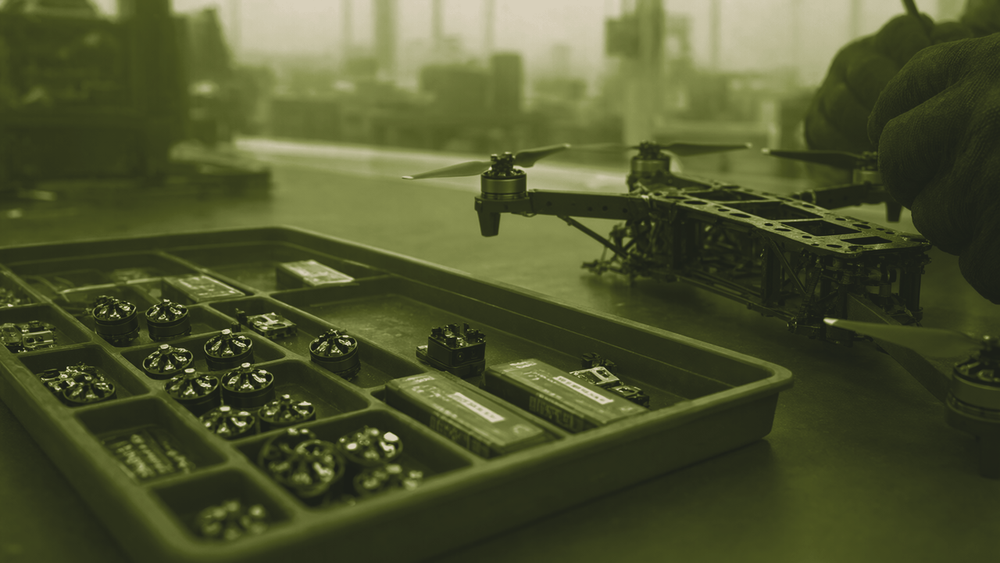
Unusual Machines says Powerus placed a $16.9 million order for U.S.-made motors, batteries, cameras and video transmitters. The supplier also holds a $30 million stake in the counter-drone maker.
Russia's new Filin cruise missile pairs avionics from a Shahed-type drone supplier with a drone-class turbojet and US chips made as late as October 2025, and its claimed 800 km/h doubles the speed of Ukraine's multirotor interceptors.
Russia's first diesel tanker for the US sails Thursday with 40,000 tonnes. How many follow depends on refinery units and export terminals that Ukraine's drones keep hitting.
Lithuania's RSI Europe and Estonia's Odin Defence won €29.5 million from the EU to make loitering-munition warheads. RSI's new plant is due to break ground in early 2027.
Beijing's Nov. 18 licence list draws its motor lines above FPV hardware. The customs queries and spec declarations that come with it reach the third-country routes Ukrainian drone makers use to buy Chinese parts.
Orqa U.S., formed by Croatia's Orqa and By Light, won a $38 million Drone Dominance contract for 8-inch MRM2 indoor drones that By Light will build in Port Orange, Florida. The program leaderboard lists 7,000 drones; no delivery schedule is public.
Kyiv says money, not factory space, caps its drone output, and EU loan money already pays for Ukrainian drones. The extra €70 billion it wants for 2027 has no source yet.
France's DGA ordered a new batch of MX-10 Damocles loitering munitions from KNDS and Delair on Oct. 13. The companies say German auto supplier Schaeffler will assemble it, with Delair's CEO claiming capacity rises from 10 to 100 a day from November.
Ukrainian drone makers have replaced many Chinese parts with their own. Magnets, battery cells, chips and thermal sensors still come from China, and magnets are the first of those parts US sourcing rules police, from Jan. 1.
Taiwan's defense ministry will require teardown inspections even on unit orders of two or four drones, after a court ordered two executives of supplier Jiin Ming Industry detained.
Vector and Nammo Defense Systems expanded their teaming agreement on Oct. 12 to put Nammo munitions on Vector's small drones. Vector says it was selected for up to 5,000 Drone Dominance systems; the agreement names no value or quantity.
Ukraine says it left Russian refineries alone on the ceasefire's first night while Russia struck a Kharkiv power plant and a Kyiv power station, then launched 121 drones, 76 of them jet-powered.
The MQ-4C Triton is Northrop Grumman's unarmed, high-altitude maritime surveillance aircraft, operated by the U.S. Navy and Australia alongside crewed P-8A Poseidon aircraft.
Sharp Claw 1 and Sharp Claw 2 are NORINCO ground robots pairing a small tracked reconnaissance vehicle with a larger 6×6 carrier. Sharp Claw 1 entered Chinese army service in 2020; combat use is not publicly established.
FireAnt is Swarmbotics AI's small autonomous ground vehicle for networked reconnaissance, electronic warfare and mission payloads, undergoing US Army experimentation with the 1st Cavalry Division.
The first confirmed strike on Russian data infrastructure took a Yandex Cloud zone offline, weeks after Russia began knocking out data centres in Kyiv.
Astra reports a fire at a Moscow-region dispatch station that feeds three airports, after a 650-drone raid and days after Kyiv claimed 51% of Russian refining was disabled.
The G7 will release up to 100 million barrels as Ukraine's drones keep hitting Russian refineries. Putin put the campaign's cost at 1% of GDP and said a strike pause would not return Russian diesel while sanctions stand.
Russia's drone campaign has reached the bridges that join Kyiv's two banks, and ISW assesses that repeated, precise hits with shaped-charge warheads could eventually do serious damage.
France and Italy deny receiving the warning. Russia has already demonstrated the aircraft, ship launch and disruption model that make the scenario credible.
Fire Point can now damage Moscow's oil economy, but Russia brings more weapons, industrial capacity and societal slack to a winter campaign that is already spilling into NATO airspace.
Finland has signed and a US framework is ready. The Iran war showed why Ukrainian interceptors have to travel with Ukrainian components, software and operators.
The Army picked Vulcan Elements to supply rare-earth magnets for the brushless drone motors it builds at Tobyhanna Army Depot. The award notice shows $1.2 million; no order quantity or delivery date is public.
The D-21-12R is a Ukrainian remotely operated armed ground robot combining FRDM Group's D-21 wheeled platform with a D-12 weapon module carrying a 12.7 mm machine gun.
Kyiv's strike ledger overstates the Russian refining capacity offline at one time. The harder metric is whether repeat strikes keep plants broken faster than Moscow can repair them, and that is the leverage Trump wants frozen.
Zelensky listed a weapon called Pelican in the largest strike on Moscow Oblast. It may be Fire Point's FP-7 ballistic missile or a fixed-wing drone, and the FP-7's published range rules out a direct hit on Moscow.
Russia's Geran-5 has reached Kyiv and drawn Iranian interest. Its marquee capabilities are unproven, its range is contested and its output depends on one Chinese turbojet.
The Gnom is a Ukrainian family of compact, remotely controlled unmanned ground vehicles developed by Temerland for reconnaissance, fire support, logistics, evacuation, remote mining and drone carriage.
China's large twin-turbofan reconnaissance and strike UAV, designed as a faster, higher-end complement to the propeller-driven Rainbow export family but not confirmed in service.
The Ababil is a long-running Iranian family of tactical drones spanning reusable reconnaissance, target and armed aircraft, as well as the one-way Qasef derivatives supplied to Yemen's Houthis.
The Gauntlet II leaderboard picks the vendors in line for a 60,000-drone Pentagon order, but the program still calls them finalists and says awards are not guaranteed.
One overnight Ukrainian drone raid went after Russian airlift at a Rostov airbase and the fuel output of a top-five refinery in Yaroslavl. The aircraft losses remain Ukraine's claim.
CORVUS replaces Watchkeeper's 54-aircraft buy with up to 24 AR5s, a contract built for service-life updates and a Swindon line. Another 1,025 small drones hedge the question of whether the larger aircraft can survive.
The Orlan-30 is a Russian fixed-wing reconnaissance UAV that adds laser target designation to the Orlan family, linking aerial surveillance directly to guided artillery and air-launched weapons.
The MQ-1C Gray Eagle is the US Army's armed medium-altitude, long-endurance uncrewed aircraft, combining persistent surveillance, targeting, electronic warfare and Hellfire strike capabilities.
Ukraine's small, petrol-powered long-endurance tactical UAS, combining 24-hour-class endurance with modular ISR payloads, autonomous flight and an increasingly international production base.
Ukraine's battery-powered fixed-wing tactical reconnaissance UAV, used at brigade level to locate targets, adjust artillery fire and maintain surveillance under electronic-warfare pressure.
Ukraine's SHARK is an electric fixed-wing reconnaissance UAV used for target acquisition and fire correction, with the SHARK-M extending endurance, datalink range and support for networked strike drones.
The Hermes 450 is an Israeli tactical long-endurance uncrewed aircraft used for intelligence, surveillance, reconnaissance and strike missions, with service across several continents.
Anduril Dive-LD is a US large autonomous underwater vehicle designed for long-endurance undersea surveillance, mine countermeasures, seabed mapping and modular payload delivery.
The Ukrainian manufacturer tied two deep strikes inside Russia to the mass-produced weapons it says fund its FP-7 ballistic missile, now weeks from combat use.
Russia has pushed Ukraine past cheap FPV interceptors and through its air-to-air missile reserves. The next air-defense contest turns on who can manufacture an affordable round by the thousand.
Ukraine's Special Operations Forces struck two gas condensate plants in Yamalo-Nenets on Sept. 9, a record 3,200 km out. The campaign has moved past oil refining into Gazprom's Arctic production core, 600 km from the LNG project Europe still buys from.
Arkeus and Tanglewood Group will build and sustain the Warden hyperspectral sensor in Malvern, England. The Melbourne startup already sells to the Australian Army and the US Department of War, and flew Warden in Europe last November. It still has no British customer.
Howa Machinery took equity in Prodrone and handed it a factory site, giving the Nagoya drone maker the production line it has never had and a route into a Defense Ministry it does not yet sell to.
Ukraine's Bars strike drone is now more than 74% domestically made, and the one part it still buys abroad is the turbojet. A Ukrainian engine has passed final tests. The engine, not the airframe, is what caps output on both sides of the drone war.
GARC is a compact American uncrewed surface vessel developed by BlackSea Technologies for modular reconnaissance, sensing and strike missions, and first used in a US Navy live-fire exercise at RIMPAC 2026.
Anduril Omen is a runway-independent Group 3 autonomous aircraft co-developed with EDGE Group, combining vertical launch and recovery with wing-borne cruise and a hybrid-electric powertrain.
Anduril Copperhead is a family of compact autonomous underwater vehicles and expendable armed variants designed to extend uncrewed sensing and strike networks into the undersea domain.
The WINFLY Spider is a reusable Ukrainian interceptor UAV that catches hostile drones with a replaceable net, offering a low-cost alternative to expendable ramming interceptors.
Saab's A3-001 is a proposed stealthy, supersonic collaborative combat aircraft intended to accompany the Gripen E/F, with a first demonstrator flight planned for 2027.
The AJX-002 is a Chinese extra-large uncrewed underwater vehicle revealed in 2025, potentially intended for persistent surveillance, mining or blockade missions, but with no official specifications or confirmed operational status.
Ukraine's first domestically built jet-powered interceptor drone, codified in August 2026 to close the speed gap that Russia's turbojet Geran-4 and Geran-5 opened over the cheap propeller interceptors that had been beating the Shahed.
Ukraine's long-range drone volume is forcing Russia to halt its own flights, and that is changing the risk calculation for the foreign carriers that still profit from shorter routes across the country.
Ukraine's refinery campaign is converting drone volume into lost Russian fuel, exports and revenue. Moscow's warehouse strikes on Kyiv impose severe civilian costs, but the confirmed damage has yet to expose a comparable economic bottleneck.
The American order has fixed quantities and deliveries running to 2033, while Taiwan's far larger domestic drone program was handed an annual ceiling already below what the defense ministry planned to spend next year.
Both sides now aim at the commercial infrastructure that moves the other's goods, and both say so openly: Moscow claimed strikes on three Odesa ports, and drone damage shut Ozon's Ufa warehouse for inspections.
Ukraine's FP-1 drones finished a Tambov warehouse they first struck in July, turning repair for Russian owners from a one-time expense into a recurring cost.
Ukraine can put a Behemoth one-way attack drone over a Russian logistics hub for an estimated $35,000 to $50,000. Europe's newest €6.1 billion buys the costly systems that stop the return fire.
Taipei has cleared 3 percent of GDP, but the uncrewed mass that could decide a fight in the Strait remains trapped in a separate dispute over how money becomes orders.
Kyiv wants to strike the launchers behind Russia's ballistic attacks, but SpaceX controls whether its drones can cross the border with satellite guidance.
The Army stood up a 600-soldier battalion in January to turn Ukraine's drone lessons into US tactics. Eight months later it is taking the drone mission away and has not said what replaces it.
Ukrainian drones reached Dzerzhinsk overnight and OSINT traced the smoke to the Sverdlov plant, which fills Russian artillery shells and aerial bombs. It is the third reported strike on the site since October.
Ukraine is sustaining its deep-strike tempo against the capital while targeting the civilian logistics network it says supplies Russian drone units at the front.
Ukrainian operators dismantled a US armored brigade in a German exercise. The Army's FY2027 answer shifts drone selection toward soldiers and tests whether industry can keep pace.
The Aug. 7 strike extended a three-week campaign that has disabled more than 20% of Russia's largest online retailer's warehouse capacity and prompted Moscow to weigh financial support.
An explosive-laden drone came within metres of Ukraine's heavy airlift fleet at Leipzig/Halle Airport, exposing a counter-drone gap over a NATO logistics hub.
Tokyo's 598-page annual defense paper names drones and AI as the warfare Japan must adapt to, and routes the buildup through startups and dual-use suppliers rather than its incumbent primes.
Ukraine's long-range drones are now hitting the inputs to Russia's drone war, while Kyiv intercepted just one of 27 Russian ballistic missiles for lack of Patriot rounds.
Iran's reusable medium-altitude, long-endurance ISR and strike drone, designed for persistent surveillance and guided-weapon employment from a runway-based platform.
Ukraine's July 25 Caspian strikes hit the Port Olya 2 and the Begey, two hulls already designated by OFAC and OFSI, on a sea where a 2018 convention bars foreign warships from enforcing anything.
Overnight strikes on Yaroslavl and Udmurtia landed hours after Zelensky and Ukraine's new command team updated the priority list for a campaign that has flown more than 1,000 missions into Russia this year.
Ukraine's long-range drone campaign has moved from refineries into e-commerce logistics, and Wildberries, Ozon and Yandex Market have all rewritten seller contracts to push the loss onto merchants.
Ukraine's signature one-way attack drone appeared at Farnborough as a standoff missile carrier, a configuration that so far exists as a display model rather than a fielded weapon.
A Russian security-service base ringed by checkpoints, guards and underground shelters was hit by 13 drones, the SBU said, showing what rear-area hardening now buys against Ukraine's mid-range strike fleet.
The CIA director's figure lands as Washington weighs new money for Ukraine's drone programs, and its trail runs back to Russian Telegram channels rather than to independent US collection.
A reported fire at the home base of Russia's Tu-95 and Tu-160 fleets, and attack footage showing an unfamiliar V-tail airframe, put Ukraine's deep-strike campaign back on its highest-value target set.
Teledyne FLIR's Black Recon is a vehicle-launched autonomous micro-drone system that lets a crew launch, operate, recover and recharge up to three UAVs without leaving the vehicle, delivering near-continuous GNSS-denied reconnaissance. Market-launched at Eurosatory 2026.
AVILUS's Wespe is a German uncrewed coaxial-rotor helicopter built to carry about 200 kg of cargo or casualties some 300 km with no crew aboard; the first-generation prototype flew on 1 June 2026, pitched at the Bundeswehr's contested-resupply and medevac needs.
The Airbus U145 is an uncrewed, AI-flown conversion of the best-selling H145 light-twin helicopter, unveiled at ILA Berlin 2026 and pitched for high-volume cargo resupply in contested zones where putting aircrew at risk is no longer acceptable.
Airbus's U760 Ravenstorm is an uncrewed collaborative combat aircraft concept — a stealthy loyal wingman for air-to-air combat, strike and jamming unveiled at ILA Berlin 2026 and aimed at Germany's post-FCAS combat-drone race. So far it is a model, not an aircraft.
The Yartura Dancer 4.5.0 is a Ukrainian fixed-wing interceptor drone that reaches 450 km/h and uses an AI homing system to re-attack a target drone until it is destroyed — built against the fast jet-powered variants of Russia's Shahed/Geran family.
The Victor U250 is a German hybrid-electric heavy-lift cargo drone from ERC System, an IABG subsidiary, built to carry up to 250 kg over 300 km for battlefield resupply — targeting the gap between small cargo drones and crewed helicopters, with Rheinmetall backing production.
Vepr is a Ukrainian tracked ground robot for frontline logistics and casualty evacuation — 350 kg of cargo or two wounded, ~40 km per charge, plus remote demining, recovery and one-way strike roles. Codified by Ukraine's MoD in June 2026 after two years on the front.
Mach Industries' Atlas is a hybrid-electric, runway-independent strike drone being developed under DIU's RIMES program to carry 1,000-pound munitions 1,400 nautical miles from destroyer decks and austere sites — and come back to rearm.
The AeroVironment P550 is a runway-independent, battery-electric eVTOL reconnaissance drone built for the US Army's Long-Range Reconnaissance program, giving battalion commanders up to five hours of modular ISR, relay, electronic-warfare and strike capability.