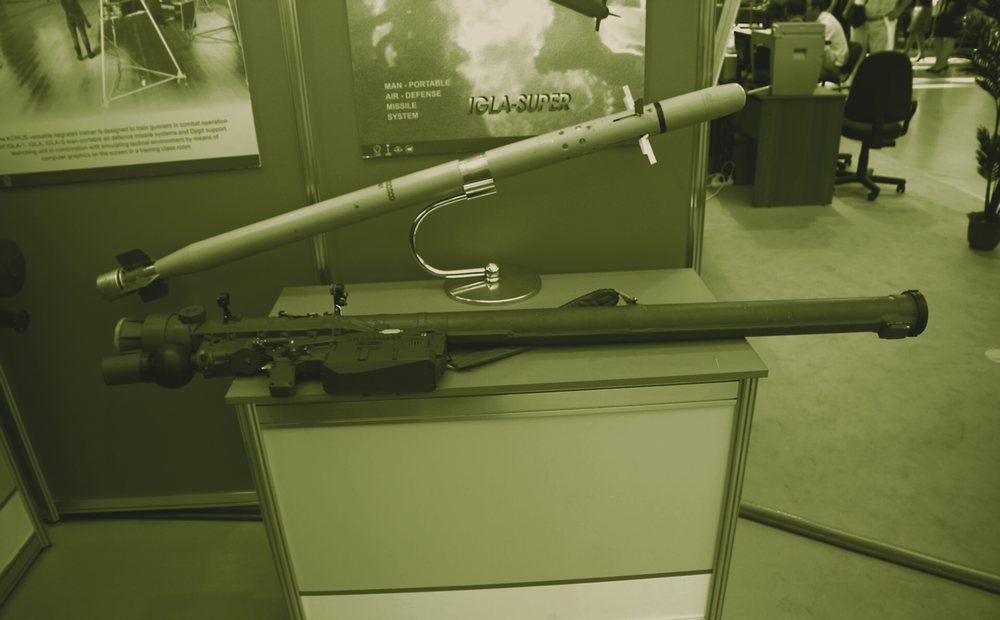
A shoulder-fired infrared missile that Russia now launches from helicopters to hunt Ukrainian drones — and bolts to Shahed airframes so the drone can shoot back at the aircraft sent to intercept it.
A 1976 Soviet missile system built to shoot down low-flying jets, now hunting Lancets and Hornets. Its infrared seeker was never designed to find something the size of a quadcopter — which is why Ukraine bolted an electro-optical sight to nine of them.
A 1965 Soviet anti-aircraft gun built to shoot down jets, now one of the cheapest ways Ukraine kills Shahed drones. Sixteen modernised Shilkas funded by a charity recorded their first Shahed shootdowns in December 2025.
A wire-guided missile that requires its operator to hold the crosshair on a tank for the whole flight — up to four kilometres, several seconds, motionless. In a battlefield watched continuously by drones, that is the hardest thing a soldier can be asked to do.
A 1961 shoulder-fired launcher that found a second career nobody designed: its PG-7 shaped-charge grenade is one of the most common warheads bolted onto FPV attack drones, so much of the armour destroyed in this war is hit by RPG ammunition.
The 152 mm half of the Soviet self-propelled artillery pair still fighting on both sides. It outranges and outweighs the Gvozdika, it trails only the Msta-S in Russian self-propelled artillery losses, and drones now kill it before it fires.
The amphibious 122 mm howitzer that both armies still fire daily, and that both are losing faster than they can replace. Oryx has documented about 400 Ukrainian losses of the type — and Russia is reported to be stripping barrels off its own.
A tank designed in 1961, pulled from Siberian storage yards and sent to Ukraine because Russia has run out of newer ones. At least 334 have been destroyed, and the T-62's real significance is as a measure of how far the Russian tank reserve has been drained.
A Kharkiv-built Soviet tank from 1966 that is still the backbone of Ukraine's armoured force in 2026 — kept alive by depot reactivation, Oplot transmissions and anti-drone cages, because Western donations could never replace it at scale.
A ramjet missile that homes on the radar trying to detect it. The Kh-31P is why Ukrainian Patriot crews cannot leave their radars radiating, and why the air-defence problem in Ukraine is as much about emissions discipline as about interceptor stocks.
A 1960s anti-ship missile carrying nearly a tonne of explosive at Mach 4.6, fired at cities it was never designed to hit. Its error is measured in hundreds of metres, which is why its record in Ukraine is a record of civilian casualties.
The precision half of Russia's air-launched arsenal. Where the Kh-22 lands within half a kilometre of where it was aimed, the Kh-59MK2 is credited with metres — and it is the missile Ukrainian air defence reports intercepting one at a time.
Russia's radar-cued hard-kill tank shield, and the first serial Russian active protection system credited with shooting down FPV drones. In its combat debut one tank killed seven drones, then ran out of ammunition and died.
Russia's answer to Starlink is not a jammer. Kalinka listens for the uplink a terminal sends to the satellite and works out where the operator is sitting — turning a communications link into a targeting cue.
North Korea's heavyweight Hwasong-11 — a solid-fuel ballistic missile more than ten metres long, claimed to carry a 2.5-tonne warhead roughly five times an Iskander's, transferred to Russia in 2026 and deployed within range of Ukraine.
A plywood aircraft with no warhead and a metal-coated sphere in the fuselage. The Luneburg lens makes it read on radar as a Shahed, so Ukrainian air defence must treat every one as lethal — which is the entire weapon.
Britain took ASRAAM missiles awaiting disposal, bolted them to launch rails cut from retired Tornado, Hawk and Jaguar jets, and welded the result to a Supacat truck. The improvisation has claimed over 400 aerial targets in Ukraine.
The US Air Force went to two firms almost nobody had heard of, asked for a cruise missile cheap enough to run out of without regret, and got flight tests in four months. ERAM is the West's answer to the cost-exchange crisis Shahed created.
A British air-defence system inside a shipping container that fires Ukraine's own Soviet-era R-73 air-to-air missiles from salvaged fighter launch rails — built because Ukraine had missiles it could not launch and targets it could not reach.
Ukraine's first domestically built jet-powered interceptor drone, codified in August 2026 to close the speed gap that Russia's turbojet Geran-4 and Geran-5 opened over the cheap propeller interceptors that had been beating the Shahed.
The largest and fastest member of Russia's Geran family — a 6.5-metre, cruise-missile-shaped "missile-drone" flying at up to 600 km/h with a 90 kg warhead, air-launchable from a Su-25 and reportedly able to carry an air-to-air missile of its own.
Vepr is a Ukrainian tracked ground robot for frontline logistics and casualty evacuation — 350 kg of cargo or two wounded, ~40 km per charge, plus remote demining, recovery and one-way strike roles. Codified by Ukraine's MoD in June 2026 after two years on the front.
Slovakia's autoloading wheeled gun — the Zuzana 2 puts a 360°-traversing 155mm howitzer with an automatic loader on an 8×8 truck, firing to 40 km. The DANA's modern NATO-caliber heir, donated and sold to Ukraine, where it has duelled Russian artillery across the front.
Poland's international mash-up howitzer — the Krab marries a Korean K9 chassis, a British AS-90 turret, a French-pattern 155mm gun and Polish fire control into one 40-km self-propelled gun. Donated and then sold to Ukraine, it has become one of Kyiv's most prized Western artillery pieces.
The shoulder-fired missile that became a star of the Ukraine war — Poland's Piorun is a modernized, sharper-eyed heir to the Soviet Igla that has knocked down Russian jets, helicopters, cruise missiles and drones, and won orders from the US Army. A cheap, mobile answer to the air threat.
Rheinmetall's modular tracked IFV — a clean-sheet fighting vehicle with a digital Lance turret (30 or 35mm cannon + Spike missiles) and a reconfigurable hull. Bought by Hungary, picked by Ukraine as its standard IFV, and headed for Italian co-production.
Ukraine's "Fury" — a cheap combat ground robot that turns a remote-controlled machine gun into a mobile turret, built from commercial-drone parts and fielded by special forces. One has led an assault through a minefield; it is the emblem of Ukraine's armed-UGV surge.
Ukraine's $12,000 robot mule — a small tracked ground drone that hauls 300 kg of ammo and supplies to the trench, evacuates the wounded, or mounts a machine gun, made by the thousands. The workhorse of Ukraine's 2025 ground-robot surge, now heading into German co-production.
The West's benchmark battlefield robot — an Estonian tracked "tankette" that swaps payloads to haul cargo, evacuate wounded, scout, defuse bombs or carry a machine gun. The first ground robot in the Lexicon, and the platform that proved the UGV concept across NATO and in Ukraine.
France's 6×6 "gun on wheels" — a fast, 105mm-armed reconnaissance vehicle the press dubbed a light tank when France sent it to Ukraine. Hard-hitting and quick on roads, but thinly armored: a mobile cavalry scout pressed, controversially, toward front-line assault work.
A clever bolt-together weapon — a small glide bomb strapped to a surplus rocket motor to give HIMARS a 150 km punch that can curve around defenses and even strike behind the launcher. On paper a bargain deep-strike round; in Ukraine, blunted badly by Russian jamming.
The cruise missile that killed the INF Treaty — a ground-launched, nuclear-capable weapon the US says flies far past the 500 km the treaty banned, and Russia insists stays just under it. The arms-control dispute became its legacy; its reported 2025 combat use in Ukraine is its grim sequel.
The biggest self-propelled gun in the world — a Soviet 203mm monster firing a 110 kg shell up to 47 km, nuclear-capable, and dragged out of Cold War storage by both Russia and Ukraine for long-range counter-battery duels. Slow and exposed, but it hits like nothing else on the front.
Russia's Mach-2.5 ramjet cruise missile and the Bastion-P coastal batteries that fire it — designed to kill ships, but used relentlessly against Ukrainian land targets because its speed makes it brutally hard to intercept. The parent design of India's BrahMos.
The Soviet swing-wing bomber Ukraine turned into its hardest punch — a 1970s tactical strike jet improbably re-armed with British Storm Shadow and French SCALP cruise missiles, which it has used to gut Russia's Black Sea Fleet. The most obsolete airframe became the most potent strike system.
The big Soviet air-superiority fighter built to out-range the F-15 — and the parent of the entire Flanker dynasty. Ukraine's pre-war top fighter, now an outclassed but still-fighting workhorse that flew night intercepts in the war's first hours and later flexed into a Western-bomb truck.
The Soviet lightweight fighter both sides fly — and the one Ukraine famously hot-rodded, bolting American HARM and JDAM and French Hammer onto a 1970s airframe with an iPad in the cockpit. Agile, short-legged, and attrition-heavy, it became an improvised SEAD jet over Ukraine.
Ukraine's home-grown drone-killer EW — a Proximus-built system that passively detects UAVs out to ~100 km, then jams their control links and satellite navigation (GPS/GLONASS/Galileo/BeiDou) inside ~20 km. Built specifically to counter Russia's Orlan-10, and now a Ukrainian export.
Russia's flying cell-tower attacker — a command truck plus Orlan-10 drones carrying a payload that mimics a GSM base station to locate phones, jam cellular networks and blast fake SMS at enemy troops and civilians. Electronic warfare and psychological warfare in one airborne package.
Russia's tracked tactical jamming complex — nine MT-LB vehicles that fuse four jamming-station types under one console to detect, locate and suppress enemy radio, GSM, satellite comms and GPS. A constant Ukraine-front presence, and a prized target: captured in 2022, hunted by FPV drones since.
Russia's soldier-portable "find" half of the reconnaissance-fire loop — the KRUS Strelets links scouts, drone operators and artillery spotters to the guns. Capable on paper and improved in Syria, but Ukrainian accounts say its centralised, EW-fragile design lags Ukraine's apps.
"Nettle" — the volunteer-built Ukrainian app that turns a $150 Android tablet into an artillery fire-control computer, replacing 15-minute Soviet hand-calculation with a coordinate, a tap and rounds on target in seconds. Built by the NGO Army SOS.
Ukraine's "Uber for artillery" — software that matches a target to the best available gun and cuts the call-to-trigger time from ~20 minutes to one or two, letting a smaller, dispersed force out-shoot a numerically superior one.
Ukraine's "Hell" — a jet-powered missile-drone, the faster sibling of Palianytsia. Built in under a year and already in serial production, it flies a mini-cruise-missile profile to hit Russian refineries, depots and airfields, and was used in the June 2026 Moscow oil-refinery strike.
Russia's stealthy precision cruise missile — a low-flying, low-radar-signature weapon shaped to fit inside the Su-57's bays. Launched from tactical jets with little warning, it destroyed the Trypilska power plant near Kyiv in 2024 and now spearheads the campaign against Ukraine's grid.
One of Russia's two workhorse spotter drones in Ukraine, alongside the Orlan-10. A small catapult-launched aircraft full of off-the-shelf civilian electronics, the Supercam is the eye that cues Russian artillery and Lancet strikes — slow, jammable, and shot down by the hundred.
A Russian counter-battery system that finds enemy guns without a radar — it just listens and watches. Fusing sound, ground vibration and thermal flash, it fixes a firing position in seconds while emitting nothing, so it can't be detected or jammed like the radars it replaces.
Ukraine's home-built tank-killer — a tripod ATGM with one defining trick: the crew fires it by cable from up to 50 m away, in cover, while the launcher sits exposed. Cheaper than a Javelin, it became famous for killing tanks and, on video, shooting down Russian helicopters.
Ukraine's "buzz bomb" — a deliberately crude, dirt-cheap pulsejet missile built by volunteers to be fired in salvos and mixed with decoys, forcing Russia to spend million-dollar interceptors on a $3,000 target. The loudness is the point.
Ukraine's home-built jet "missile-drone" — a cruise-missile/drone hybrid named after a hearth-bread that doubles as a wartime shibboleth. Built in 18 months to hit the Russian airfields that bomb Ukrainian cities, it sidesteps the range limits on Western weapons.
Russia's heavy stealth flying-wing combat drone, built as a Su-57 "loyal wingman." Its defining moment was a humiliation: in October 2024 a Russian fighter shot down its own out-of-control Okhotnik over Ukraine — handing Kyiv the wreckage, Western chips inside and all.
A secretive Russian ground system built to switch off communications satellites — jamming the relay birds that armies (and Ukraine) depend on. It is the counter to the transparent battlefield: if sensing is the new deterrent, this is the attempt to blind it. Ukraine drone-killed one in January 2026.
The world's largest radar-satellite constellation — Finnish microsatellites that see through cloud, darkness and camouflage. It is Ukraine's crowdfunded "People's Satellite," feeding nearly 6,000 radar images to Ukrainian targeting cells — and now shadowed in orbit by Russia.
Ukraine's first home-built guided glide bomb — a clamp-on wing-and-guidance kit that turns a dumb 250-kg bomb into a stand-off precision weapon, the Ukrainian answer to Russia's devastating FAB-UMPK. Declared combat-ready in May 2026; no confirmed strike yet.
Ukraine's first heavy underwater drone — a ~10-tonne autonomous submarine pitched for strike, cargo and the unusual role of hunting other underwater drones. Unveiled at Eurosatory 2026, every figure is vendor-declared and unproven.
Ukraine's "Google for the military" — a cloud battlefield-awareness and command system that fuses drone, satellite, sensor and intelligence feeds into one shared map and, the military says, compresses the find-to-strike cycle from days to minutes. The first software entry in the Lexicon.
Ukraine's ~$1,000 answer to the Shahed: a partly-3D-printed interceptor drone that rams or proximity-detonates against incoming attack drones — the cheap, kinetic, deterrence-by-denial weapon now gaining an onboard AI eye that spots a Shahed faster than a human pilot.
Russia's jet-powered Shahed, built to outfly the cheap interceptor drones that were knocking propeller Shaheds down. Early figures said the speed cost it range. A year of upgrades says otherwise: 850 km declared, 960 km flown, 96% of Ukraine in reach.
The jam-proof attack drone reshaping the front: a standard FPV flown down a hair-thin glass fiber instead of a radio link — immune to every electronic-warfare countermeasure, and the weapon that pushed the "kill zone" from 10–20 km out to 50.