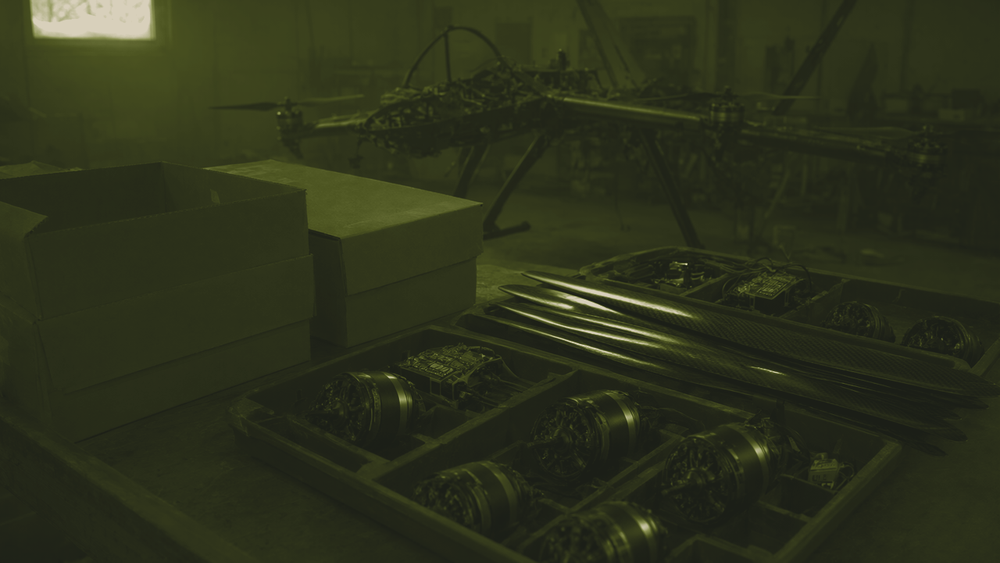
Beijing's Nov. 18 licence list draws its motor lines above FPV hardware. The customs queries and spec declarations that come with it reach the third-country routes Ukrainian drone makers use to buy Chinese parts.
Ukrainian drone makers have replaced many Chinese parts with their own. Magnets, battery cells, chips and thermal sensors still come from China, and magnets are the first of those parts US sourcing rules police, from Jan. 1.
Taiwan's defense ministry will require teardown inspections even on unit orders of two or four drones, after a court ordered two executives of supplier Jiin Ming Industry detained.
Sharp Claw 1 and Sharp Claw 2 are NORINCO ground robots pairing a small tracked reconnaissance vehicle with a larger 6×6 carrier. Sharp Claw 1 entered Chinese army service in 2020; combat use is not publicly established.
Silent Hunter is a Chinese ground-based fibre-laser counter-drone system marketed by Poly Technologies, with documented Saudi deployment and a claimed engagement range of up to 4 km.
Type 095 is the unofficial designation for China's next-generation nuclear-powered attack submarine, identified at Bohai in 2026 with a pumpjet and X-tail.
Type 004 is the analysts' designation for China's fourth aircraft carrier, under construction at Dalian. Satellite imagery suggests a hull comparable in length to the US Ford class and possible nuclear propulsion.
LY-1, also called Liaoyuan-1, is a Chinese laser directed-energy weapon intended for close-range naval air defense. Public reporting documents its unveiling and apparent shipboard evaluation, while interception performance and operational service remain unestablished.
An unmarked shoulder-fired missile in a Rostov air-defense team resembles China's QW series. Its origin is unconfirmed, but Ukraine's drone campaign explains why Russia wants it.
An AI-assisted report falsely tied a Chinese ship's cargo to a nuclear program during the Iran war. Senators now want inspectors general to examine how the Pentagon checks machine-made intelligence.
Russia's Geran-5 has reached Kyiv and drawn Iranian interest. Its marquee capabilities are unproven, its range is contested and its output depends on one Chinese turbojet.
China's short-range naval point-defense missile system, fielded across warships from Type 056 corvettes to Type 055 destroyers and aircraft carriers as the fleet's final missile layer against incoming threats.
China's HQ-11 is a mobile terminal air-defence system combining vertical-launch missiles, a Type 1130-derived close-in gun and networked command elements to protect units and key sites.
The HQ-12, developed from the export-oriented KS-1 family, is a Chinese road-mobile medium-range surface-to-air missile system built around phased-array fire control and exported across Asia.
The HQ-7 is a Chinese short-range surface-to-air missile system derived from the French Crotale, with the improved FM-90 serving as its principal export version.
China's Type 100 is a medium-weight main battle tank built around an unmanned turret, active protection, hybrid propulsion and networked sensors rather than progressively heavier passive armor.
China's Type 022 Houbei is a fast, waterjet-driven catamaran missile boat built to launch coordinated YJ-83 salvoes in coastal and near-littoral waters.
China's SC-19 is a ground-launched, hit-to-kill anti-satellite weapon associated with the wider DN-series of exo-atmospheric interceptors and the destructive 2007 Fengyun-1C test.
China's large twin-turbofan reconnaissance and strike UAV, designed as a faster, higher-end complement to the propeller-driven Rainbow export family but not confirmed in service.
China's independent global positioning, navigation and timing constellation, combining open and restricted signals with a distinctive satellite short-message service.
China's first area-air-defence destroyer class, combining a four-face Type 346 AESA radar with 48 vertically launched HHQ-9 missiles and serving as the technological bridge to the Type 052D.
China's widely exported family of subsonic, turbojet-powered anti-ship cruise missiles, fielded from ships, aircraft and coastal launchers and reproduced in Iran as the Noor, Qader and Ghadir.
China's DF-16 is a road-mobile, two-stage ballistic missile designed for conventional precision strikes against Taiwan and other targets across the western Pacific's first island chain.
The Type 056 Jiangdao is China's mass-produced light corvette, built for coastal patrol, escort and anti-submarine warfare and adapted for coast-guard and export service.
China's 25,000-tonne amphibious transport dock, combining marine, vehicle, landing-craft and helicopter lift for regional assault, logistics and far-seas operations.
China's PL-17 is a very-long-range air-to-air missile designed to threaten tankers, airborne early-warning aircraft and other high-value support assets at distances approaching 400 km.
The DF-5C is China's newest heavy, liquid-fuelled, silo-based intercontinental ballistic missile, presented as a globally ranged strategic weapon and assessed by the Pentagon to carry a multi-megaton warhead.
China's YJ-12 is a ramjet-powered supersonic anti-ship cruise missile fielded from H-6 bombers, surface ships and coastal launchers, with the CM-302 offered for export.
China's YJ-18 is a ship- and submarine-launched cruise-missile family combining subsonic cruise with a supersonic terminal sprint, with reported anti-ship and land-attack variants.
Liaoning and Shandong are China's first two operational aircraft carriers: conventionally powered, ski-jump ships derived from the Soviet Kuznetsov design and used to build the PLA Navy's carrier-aviation capability.
China's twin-engine carrier fighter family, derived from the Su-33 and developed from ski-jump operations into catapult-launched strike, air-defense and electronic-warfare variants.
Howa Machinery took equity in Prodrone and handed it a factory site, giving the Nagoya drone maker the production line it has never had and a route into a Defense Ministry it does not yet sell to.
Chinese military procurement has moved from buying humanoid robots to buying the perception and training data that would make them work, and that shift is the real signal.
China's new-generation general-purpose frigate, enlarging and modernising the Type 054A formula with improved stealth shaping, sensors and combat-system integration while retaining a 32-cell vertical-launch battery.
China's YJ-19 is a submarine-launched, air-breathing hypersonic anti-ship missile sized for standard 533 mm torpedo tubes and accepted for service aboard Type 039B Yuan-class submarines.
The CJ-1000 is a Chinese road-mobile, scramjet-powered hypersonic cruise missile presented for long-range land attack and anti-ship missions, although its deployment status and performance remain unverified.
China's road-mobile exo-atmospheric ballistic-missile interceptor, presented as a follow-on to the HQ-19 but still defined more by its September 2025 parade appearance than by verified performance data.
China's road-mobile exo-atmospheric interceptor, designed to defeat medium-range ballistic missiles through direct impact and provide an upper tier for the country's layered missile defenses.
Taiwan's indigenous high-altitude anti-ballistic missile system, designed to provide the upper interception tier of the planned T-Dome air and missile defense network.
The AJX-002 is a Chinese extra-large uncrewed underwater vehicle revealed in 2025, potentially intended for persistent surveillance, mining or blockade missions, but with no official specifications or confirmed operational status.
A ramjet missile that homes on the radar trying to detect it. The Kh-31P is why Ukrainian Patriot crews cannot leave their radars radiating, and why the air-defence problem in Ukraine is as much about emissions discipline as about interceptor stocks.
North Korea's heavyweight Hwasong-11 — a solid-fuel ballistic missile more than ten metres long, claimed to carry a 2.5-tonne warhead roughly five times an Iskander's, transferred to Russia in 2026 and deployed within range of Ukraine.
Tokyo's record 8.9 trillion yen request buys AI command-and-control, underwater attack drones and government-owned weapons factories, but the domestic drone industry it assumes does not exist yet.
The American order has fixed quantities and deliveries running to 2033, while Taiwan's far larger domestic drone program was handed an annual ceiling already below what the defense ministry planned to spend next year.
Taipei has cleared 3 percent of GDP, but the uncrewed mass that could decide a fight in the Strait remains trapped in a separate dispute over how money becomes orders.
An expanded contract gives NCSIST the ability to build AI pilots locally for drones that can keep operating when electronic warfare breaks the operator link.
Tokyo's 598-page annual defense paper names drones and AI as the warfare Japan must adapt to, and routes the buildup through startups and dual-use suppliers rather than its incumbent primes.
American autonomy software already drives Taiwanese sea drones. The NT$210 billion that would buy the fleet is stuck in cross-party talks, and the opposition's fallback caps spending at NT$40 billion a year.
A Reuters review of more than 80 Chinese papers and patents found PLA-linked researchers training domestic defense AI on outputs from OpenAI and Anthropic models, a transfer route Washington's chip export controls do not cover.
China's Type 15, or ZTQ-15, is a light tank optimized for mountains, plateaus, forests, weak roads, and other terrain where heavier main battle tanks face mobility constraints.
Tehran's answer to losing its fixed SAM sites is a $60 million buy of man-portable launchers, routed through a Hong Kong intermediary and, reportedly, Pakistan.
China's Shijian-21 is a geostationary on-orbit servicing demonstrator that docked with and towed a defunct BeiDou satellite in 2022, making it a prominent dual-use space-debris and counter-space reference system.
China's TB-001 Scorpion is a twin-boom, long-endurance MALE UCAV from Sichuan Tengden, used for PLA ISR and pressure flights around Taiwan and Japan's southwestern approaches.
China's WZ-8 is a rocket-powered, air-launched reconnaissance UAV built for short, high-speed, high-altitude sensor runs from an H-6 bomber mothership rather than persistent loiter.
The WZ-9 Divine Eagle is China's giant twin-fuselage stealth-hunting drone — a high-altitude uncrewed radar aircraft built to spot F-22s and F-35s and cue missiles at them. Almost everything known about it comes from satellite imagery; almost nothing is officially confirmed.
The KJ-600 is China's carrier Hawkeye — the first fixed-wing airborne early-warning aircraft to fly from a Chinese carrier, catapult-launched off the Fujian's electromagnetic system. It finally gives PLAN carriers the organic radar picture US carriers have had for decades.
The KJ-3000 is China's next-generation flying radar — a Y-20B-based heavyweight AEW&C in flight test since December 2024, which the Pentagon says will probably be the world's first with a digital radar. Beijing has never acknowledged it; every number is OSINT or state-media claim.
The JL-3 is China's third-generation submarine-launched ballistic missile — a ~10,000 km-class, likely MIRV-capable weapon now fielded on Jin-class submarines, which the Pentagon says ranges most of the continental US. First shown publicly at the September 2025 parade.
The DF-27 is China's ICBM-range hypersonic glide missile — per the Pentagon a fielded conventional ICBM with the world's longest-range anti-ship variant, reaching Hawaii, Alaska and much of the Pacific. Never shown or acknowledged by Beijing; nearly all data traces to one leaked US document.
The Shenyang J-50 (J-XDS) is China's second sixth-generation fighter prototype — a tailless, twin-engine lambda-wing jet with swiveling wingtips, first observed 26 December 2024, the same day as the Chengdu J-36. Beijing has never acknowledged it; everything known is OSINT.
Beijing doubled its export-control blacklist of Japanese defense and dual-use firms to 80 entities on June 29, weaponizing the rare-earth and component supply chain the drone age runs on, with Tokyo's own unmanned-systems makers among the first cut off.
China's long-promised stealth bomber — a flying-wing strategic aircraft meant to give Beijing a survivable nuclear-triad air leg and the reach to threaten Guam. Announced in 2016, it has yet to make a confirmed flight; by 2026 it looks less imminent than "frozen."
China's 40,000-ton amphibious "light carrier" — a helicopter assault ship that lands troops, vehicles and air assault forces over the horizon, built in numbers as the maritime spearhead of any future move on Taiwan. The PLAN's amphibious apex.
Satellite imagery shows the PLA built a full-scale replica of a US Navy Arleigh Burke destroyer at a desert missile range, with the backbone of US surface power as the target.
Divergent says a fleet of in-house metal printers can turn out tens of thousands of missile airframes a year, and Breaking Defense reports it is already a second source for the Tomahawk. Whether that reaches the fleet depends on numbers the company has not shown.
Beijing's new export-control list answers the Pentagon's China blacklist and pointedly names the two US rare-earth miners Washington is funding to break China's grip on the minerals.
Ukrainian drone makers are pitching Japan and Taiwan their combat-proven systems, turning four years of war with Russia into an export-and-deterrence play aimed at China.
China's stealth flying-wing UCAV — the CASC CH-7 (Rainbow-7), a tailless, low-observable high-altitude drone for deep-penetration ISR and strike. Debuted as a mockup in 2018; it finally flew in late 2025. The export-line peer to the GJ-11 and Russia's Okhotnik.
China's ship-and-air-launched anti-ship hypersonic ballistic missile — a "carrier killer" with a maneuvering glide vehicle fired from Type 055 destroyers and H-6N bombers. The core of the A2/AD picture meant to hold US carriers at risk deep in the Pacific.
The Pentagon's main launch and spy-satellite contractor took foreign, military-linked capital while private, a national-security and ownership question now surfacing through court records.
China's biggest hunter-killer drone — a long-range MALE UAV with a claimed 10,000 km reach, 40-hour endurance and 16 weapons a sortie, and the first Wing Loong that can shoot back at other aircraft. It is the spearhead of China's cut-price, no-strings drone exports.
China's answer to the loyal-wingman race — the FH-97A, a stealthy jet-powered drone meant to fly alongside the J-20 as sensor, shooter, decoy and "missile truck." It looks much like America's XQ-58 Valkyrie; how far past the mockup stage it has flown is the open question.
China's "flying aircraft carrier" — a 16-tonne jet drone built to disgorge a swarm of 100-plus small drones from a honeycomb belly bay. The air-launched face of China industrializing drone mass; it first flew in December 2025, and the swarm part has never been shown working.
A Chinese firm sells radar-stealth "by the kilogram" — Star-Navi's XRAM-C spray-on radar-absorbing coating, off-the-shelf in 1/5/10 kg tubs. The claimed ~3 dB cut is modest, but commoditizing even a small signature reduction for cheap mass drones is the story.
Anduril's CEO is pressing Washington to let allies build US weapons, not just buy them. The same week, the Pentagon walled 65 more Chinese firms out of its defense base. The drone war's real front is now the control list.
The Pentagon's expanded 1260H roster reaches past Alibaba and BYD to the dual-use suppliers, drone maker Autel and robot maker Unitree among them, that feed China's defense base.
Russia has launched roughly 1,400 jet-powered Geran drones at Ukraine this year, fast enough to slip past the cheap interceptors Kyiv built its air defense around.
China's tailless, trijet sixth-generation heavy stealth fighter prototype — a program accelerating faster than expected, challenging US NGAD timelines and upending assumptions about the future of air combat.
The PLAN's next-generation amphibious assault ship and the world's first purpose-built drone carrier — combining a full-length flight deck, electromagnetic catapult, arresting gear, and a floodable well deck for a hybrid amphibious/UCAV strike capability.
China's first operational stealth flying-wing unmanned combat aerial vehicle — a penetrating strike and ISR platform that demonstrated manned-unmanned teaming with J-20 fighters and is evolving into a carrier-capable naval derivative.
China's road-mobile, solid-fuel intercontinental ballistic missile — capable of carrying multiple independently targetable re-entry vehicles and reaching the continental United States from dispersed launch points inside China.
China's pioneering land-based anti-ship ballistic missile — the "carrier killer" that forced the U.S. Navy to rethink its force structure, holding aircraft carriers at risk out to 1,500 km.
China's second fifth-generation stealth fighter — the land-based J-35A "Cloud Dragon" — complements the J-20, brings cross-service carrier capability, and marks Beijing's push to break the Western monopoly on fifth-generation airpower exports.
Beijing fielded the HQ-16F, a Patriot-class mobile air-defense missile, opposite Taiwan in the same weeks the US burned through the interceptors it would need to defend the island. The contest is magazine depth, not exquisite platforms.
Taiwan plans to mass-produce up to 1,376 Hai Chien II naval air-defense missiles, stockpiling indigenous weapons to survive a Chinese saturation strike.
China's semi-automatic precision grenade launcher, fielded in 35mm for the PLA and 40mm for export — delivering airburst rounds through a window at 600 m.
China's first indigenous automatic grenade launcher — a gas-operated 35mm weapon that delivers squad-level suppressive fire and has proliferated across conflict zones from Sudan to Iraqi Kurdistan.
China’s standard under-barrel grenade launcher — a muzzle-loaded single-shot 35×32mm caseless system that arms the QBZ-95-1 and QBZ-191 rifle families with HE-frag, airburst and dual-purpose grenade effects.
China's Type 86P fragmentation hand grenade — an ovoid plastic-bodied design packing ~1,600 steel balls that replaced the stick-grenade lineage and remains the PLA's standard-issue close-combat frag.
The QJY-88 is the People's Liberation Army's 5.8mm general-purpose machine gun, chambered for China's indigenous intermediate cartridge and intended to replace older 7.62mm GPMGs — a lightweight design that drew criticism for its limited range and penetration.
China’s bullpup squad light support weapon, chambered in 5.8×42mm and fed from a 75-round drum — the standard PLA squad-automatic of the Type 95 family.
China's lightweight crew-served heavy machine gun — a 12.7×108mm belt-fed weapon that is among the lightest in its class, fielded by the PLA for infantry and vehicle roles.
The QSZ-92 is China's standard-issue PLA/PAP sidearm — a polymer-frame, rotating-barrel pistol chambered in two distinct cartridge families, including a unique 5.8×21mm armor-defeating round, and now being supplemented by the newer QSZ-193.
The QBZ-03 is China’s conventional-layout, folding-stock assault rifle developed alongside the bullpup Type 95 — issued to border, airborne and reserve troops, and exported to Myanmar.
China's new-generation standard assault rifle — a conventional-layout, short-stroke piston platform with modular rail interface, firing the proprietary 5.8×42mm DBP-191 round, replacing the bullpup QBZ-95 family across the PLA.