Asia-PacificPro
Kawasaki EC-2
The Kawasaki EC-2 is Japan's C-2-derived stand-off electronic warfare aircraft, developed to disrupt hostile radar and communications and replace the EC-1.
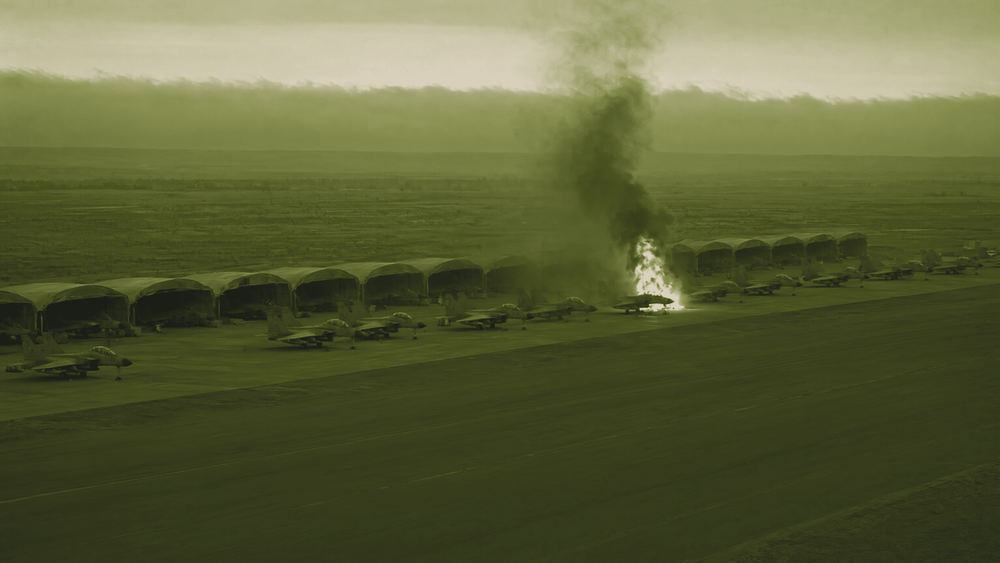
Six bombers hit in one night would exceed every Su-34 delivery Russia has publicly announced this year, by Defense Express's count.
The Kawasaki EC-2 is Japan's C-2-derived stand-off electronic warfare aircraft, developed to disrupt hostile radar and communications and replace the EC-1.
The Saab 340 ASC 890 combines the PS-890 Erieye radar with onboard combat-control stations. Sweden donated its two aircraft to Ukraine, which confirmed combat operations beginning in March 2026.
The EA-37B Compass Call is a US Air Force airborne electronic-attack aircraft that transfers the Compass Call mission from the EC-130H to a modified Gulfstream G550.
Pratt & Whitney licensed Hermeus on Sept. 15 to build F100-PW-229 fighter engines. Hermeus must first get its builds accepted by Pratt, and no rate or delivery date was disclosed.
The V-22 Osprey is a twin-engine military tiltrotor combining helicopter-like vertical takeoff and landing with the speed and range of a turboprop transport.
Europe's four-engine military transport aircraft, combining strategic payload-range performance with tactical access to short or unprepared runways and optional tanker, aeromedical and special-mission roles.
The A-10 Thunderbolt II is an armored US close-air-support aircraft built around a 30 mm cannon, valued for persistence and low operating cost but vulnerable in contested airspace.
China's twin-engine carrier fighter family, derived from the Su-33 and developed from ski-jump operations into catapult-launched strike, air-defense and electronic-warfare variants.
GCAP, informally known as Tempest, is the UK-Italian-Japanese program developing a sixth-generation stealth fighter to replace the Typhoon and Mitsubishi F-2 from 2035.
FCAS / SCAF was the Franco-German-Spanish sixth-generation air-combat project built around a crewed fighter, remote carriers and a combat cloud; its joint fighter collapsed in 2026, while parts of the wider system continue.
The C-130J Super Hercules is the current-production version of the long-running Hercules family, combining four turboprop engines, short-field tactical airlift performance and a global support base.
The Boeing P-8 Poseidon is a 737-derived maritime patrol aircraft combining anti-submarine warfare, anti-surface strike and long-range intelligence collection for the US Navy and allied fleets.
The EA-18G Growler is a carrier-based airborne electronic-attack aircraft that detects, locates and jams hostile emitters while supporting strike aircraft with anti-radiation missiles and air-to-air weapons.
Russia's long-delayed next-generation airborne early warning and control aircraft, combining an Il-76MD-90A airframe with Vega's rotating Premier phased-array radar.
Hermeus Quarterhorse is an American series of uncrewed high-Mach demonstrator aircraft intended to validate propulsion, inlet, airframe and mission-autonomy technologies for the planned Darkhorse military aircraft.
India's indigenous light attack helicopter, designed for armed reconnaissance, escort and anti-armor missions from demanding high-altitude bases.
One Kirov factory supplies K-36DM escape seats for Russia's fighter fleet and feeds the Tor missile line. Ukraine reached it with a domestic cruise missile at roughly 1,200 kilometers.
The E-3 Sentry is the original AWACS — the Boeing 707 with the rotating dome that has been NATO's eyes in the sky since 1977. It quarterbacked the Gulf War, and is now an aging, shrinking fleet in a retirement crisis, its E-7 replacement in turmoil — a gap laid bare when Iran destroyed one in 2026.
The WZ-9 Divine Eagle is China's giant twin-fuselage stealth-hunting drone — a high-altitude uncrewed radar aircraft built to spot F-22s and F-35s and cue missiles at them. Almost everything known about it comes from satellite imagery; almost nothing is officially confirmed.
The E-2 Hawkeye is the US Navy's carrier-based radar aircraft — the twin-turboprop rotodome plane China's KJ-600 copies. Six decades of iteration, an AESA-radar E-2D that quarterbacks the fleet and cues SM-6 missiles over the horizon, and the airborne command node over the Red Sea and Iran.
The AT-6 Wolverine is the A-29 Super Tucano's perennial bridesmaid — Textron's armed version of the T-6 Texan II trainer, faster and with ejection seats, sharing thousands of trainers' logistics. Yet it lost every big competition to the A-29 and to the OA-1K, and only Thailand ever bought it.
The OA-1K Skyraider II is the armed crop-duster that beat the A-29 Super Tucano for the US Armed Overwatch contract — an Air Tractor AT-802 turned into an L3Harris gunship with 10 hardpoints, Hellfires and a WESCAM sensor ball. It won the US buy the A-29 dominates the world without.
The KJ-600 is China's carrier Hawkeye — the first fixed-wing airborne early-warning aircraft to fly from a Chinese carrier, catapult-launched off the Fujian's electromagnetic system. It finally gives PLAN carriers the organic radar picture US carriers have had for decades.
The Embraer A-29 Super Tucano is the world's default light-attack aircraft — a $1,000-per-hour turboprop with 60,000 combat hours from Colombia's FARC strikes to Afghanistan and Nigeria, 290+ ordered by 20+ air forces, and a counter-drone role added in 2025.
The Embraer C-390 Millennium is the fastest-selling Western tactical airlifter — a Brazilian twin-jet eating the C-130 replacement market with ~57 firm orders across ten customers from Portugal to South Korea to the UAE, and an Indian tender worth up to 80 more in play.
The KJ-3000 is China's next-generation flying radar — a Y-20B-based heavyweight AEW&C in flight test since December 2024, which the Pentagon says will probably be the world's first with a digital radar. Beijing has never acknowledged it; every number is OSINT or state-media claim.
The TAI T929 ATAK-2 is Turkey's Apache-class heavy attack helicopter — flown in prototype form in April 2023 on Ukrainian engines, then paused in 2025 for a utility-helicopter priority. Its future hangs on an indigenous engine that doesn't yet exist as hardware.
The TAI KAAN is Turkey's indigenous fifth-generation fighter — flown in prototype form in February 2024, contracted for its first 20 production jets in May 2026, and already exported: Indonesia signed for 48. Its schedule still hinges on US-supplied F110 engines.
The Shenyang J-50 (J-XDS) is China's second sixth-generation fighter prototype — a tailless, twin-engine lambda-wing jet with swiveling wingtips, first observed 26 December 2024, the same day as the Chengdu J-36. Beijing has never acknowledged it; everything known is OSINT.
The Boeing F-47 is the US Air Force's sixth-generation NGAD fighter — the planned F-22 successor, awarded March 2025, with a claimed 1,000+ nautical mile combat radius and Mach 2+ speed. The first airframe is in build in St. Louis; first flight is targeted for 2028.
Sweden's letter of intent becomes a binding order for 16 Gripen E, but the first new jets reach Ukraine only in 2029, with donated older Gripens filling the gap.
India's home-built fighter — four decades in the making — the Tejas is a light, agile single-engine delta jet that finally gave India an indigenous combat aircraft. The Mk1A adds AESA radar and beyond-visual-range missiles; the bigger Mk2 is coming. The flagship of India's defence self-reliance.
The affordable fighter conquering the export market — KAI's FA-50 is a light, supersonic combat jet (born from the T-50 trainer) that delivers much of an F-16's mission at a fraction of the cost. Poland, the Philippines and Malaysia are buying it; Block 20 jets add AESA radar and aerial refuelling.
The "eye in the sky" that broke Boeing's monopoly — Saab's GlobalEye puts a long-range AESA radar on a business jet to watch air, sea and land at once, out past 550 km. Flown by the UAE, Sweden and France, it was picked in 2026 to replace NATO's ageing AWACS fleet.
The turboprop that flies like a jet — Switzerland's Pilatus PC-21 trains fast-jet pilots at a fraction of a jet's cost by mimicking jet-like performance and cockpits, "downloading" expensive jet training onto a cheap propeller plane. The most successful Western advanced trainer of its generation.
China's long-promised stealth bomber — a flying-wing strategic aircraft meant to give Beijing a survivable nuclear-triad air leg and the reach to threaten Guam. Announced in 2016, it has yet to make a confirmed flight; by 2026 it looks less imminent than "frozen."
The Soviet swing-wing bomber Ukraine turned into its hardest punch — a 1970s tactical strike jet improbably re-armed with British Storm Shadow and French SCALP cruise missiles, which it has used to gut Russia's Black Sea Fleet. The most obsolete airframe became the most potent strike system.
The big Soviet air-superiority fighter built to out-range the F-15 — and the parent of the entire Flanker dynasty. Ukraine's pre-war top fighter, now an outclassed but still-fighting workhorse that flew night intercepts in the war's first hours and later flexed into a Western-bomb truck.
The Soviet lightweight fighter both sides fly — and the one Ukraine famously hot-rodded, bolting American HARM and JDAM and French Hammer onto a 1970s airframe with an iPad in the cockpit. Agile, short-legged, and attrition-heavy, it became an improvised SEAD jet over Ukraine.
Russia's "PowerPoint fighter" — a single-engine stealth jet pitched at export buyers as cheap fifth-gen without US strings. Unveiled as a mockup in 2021 with Putin watching, it has still never flown, lost its UAE funding, and has no customer. The story is non-delivery.
Ukraine's first domestic guided glide bomb, the Vyrivniuvach, debuted at Eurosatory-2026 in Paris, a homemade answer to the JDAM-ER kits Kyiv has to import.
China's tailless, trijet sixth-generation heavy stealth fighter prototype — a program accelerating faster than expected, challenging US NGAD timelines and upending assumptions about the future of air combat.
South Korea's indigenous 4.5-generation twin-engine fighter—a semi-stealth, AESA-equipped multirole platform designed to replace legacy ROKAF jets and compete for export orders among nations that cannot obtain the F-35.
Israel's uniquely modified F-35A Adir — the world's most combat-tested fifth-generation fighter, spearheading long-range strikes against Iran with sovereign C4/EW capabilities and zero airframe losses.
France's delta-wing, fly-by-wire multirole fighter — 601 built, flown by nine air forces, and now intercepting Russian cruise missiles and pounding frontline targets over Ukraine.
Russia's supersonic variable-geometry long-range bomber — a stand-off launch platform for the near-unstoppable Kh-22/Kh-32 heavy missile, now contracting under the weight of attrition, precision-strike inadequacy, and a stalled modernization program.
Russia's Cold-War-era intercontinental turboprop bomber — the primary launch platform for Kh-101 cruise missiles and the air leg of its nuclear triad, now irreplaceable and facing historic attrition.
The U.S. Air Force's flying-wing stealth bomber — the world's only operational stealth bomber, sole carrier of the 30,000-lb GBU-57/B bunker buster, and the tip of the conventional and nuclear penetrating-strike spear.
The MiG-31 Foxhound is Russia’s Mach 2.83 interceptor and sole airborne carrier of the Kh-47M2 Kinzhal ballistic missile — an irreplaceable Cold War asset that dominates high-altitude combat and triggers nationwide alerts with every sortie, yet cannot be built anew.
The Su-25 Frogfoot is a heavily armored Soviet-era close air support jet, now flying for both Russia and Ukraine. Rugged, simple, and armed with a massive 30mm cannon and up to 4,000 kg of ordnance, it has become the most attrition-heavy fixed-wing type of the Russia–Ukraine war, adapting from.
China's second fifth-generation stealth fighter — the land-based J-35A "Cloud Dragon" — complements the J-20, brings cross-service carrier capability, and marks Beijing's push to break the Western monopoly on fifth-generation airpower exports.
The B-21 Raider is the U.S. Air Force's next-generation penetrating long-range strike stealth bomber — nuclear and conventional capable, designed for the most contested environments, and set to replace the B-1B and B-2 fleets alongside upgraded B-52s.
The world's first operational fifth-generation fighter — an all-aspect stealth, supercruise, thrust-vectoring air-dominance jet that remains the US Air Force's premier air-superiority asset, from the 2014 ISIS debut to the 2023 spy-balloon kill and the 2025–26 Iran crisis.
Russia’s heavy strike fighter-bomber — a side-by-side two-seat Su-27 derivative that became the principal launch platform for UMPK glide bombs over Ukraine and the most heavily contested Russian combat jet.
The Boeing B-52 Stratofortress is the United States Air Force's longest-serving strategic heavy bomber — a subsonic, eight-engine platform that has carried both nuclear and conventional payloads on every major American air campaign since Vietnam and is now slated to fly into the 2050s via the.
China's most numerous modern AEW&C platform — a Y-9-based turboprop carrying a fixed three-array AESA radar for 360° coverage, in service with both the PLAAF and PLANAF and reportedly sought by Pakistan.
Russia's 1980s-era AEW&C aircraft on the Il-76 airframe, known for its rotating Shmel radome—a fleet severely diminished by two combat losses in early 2024.
The E-7 Wedgetail is Australia's and the US's next-generation AEW&C aircraft, built on a Boeing 737-700 airframe and equipped with a fixed MESA AESA radar — the chosen successor to the E-3 Sentry across NATO and a growing allied fleet.
China's first indigenous strategic airlifter — a four-engine heavy transport known as the Kunpeng that bridges the PLA's force-projection gap, and the basis for a fast-growing aerial tanker fleet that extends Chinese airpower far beyond the first island chain.
Russia's heavy four-engine strategic airlifter, in service since 1974 and now modernised as the Il-76MD-90A with PS-90A engines, serving as the backbone of operational lift and the platform for the A-50 AWACS and Il-78 tanker.
The Boeing C-17 Globemaster III is a long-range heavy airlifter that combines intercontinental reach with the ability to operate from short, austere airfields, serving as the backbone of U.S. and allied strategic airlift since 1995.
China's primary long-range strike platform — a modernized Tu-16 derivative that carries up to six cruise missiles, conducts persistent bomber patrols around Taiwan and the first island chain, and forms the backbone of PLAAF/PLANAF bomber aviation.
Russia's Mach-2-capable strategic heavy bomber and standoff cruise-missile carrier — the largest and fastest supersonic aircraft ever fielded, modernized with new-build Tu-160M aircraft entering service despite aging fleet challenges.
China's indigenously developed 10-tonne-class medium utility helicopter — a fly-by-wire, five-blade rotorcraft directly comparable to the UH-60, serving as the PLA's primary air-assault, transport, and naval shipborne platform.
China's purpose-built scout-attack helicopter — a light, Z-9-derived tandem-seat rotorcraft with mast-mounted radar that acts as the eyes and fangs partner to the heavier Z-10 in PLA Army Aviation.
China's medium attack helicopter — a tandem-seat, twin-engine design built around the indigenous WZ-9 turboshaft, fielded by the PLA since 2009 and exported as the Z-10ME.
The most produced twin-turbine transport helicopter in history, the Mi-8 Hip (Mi-17) has been the backbone of Soviet/Russian and allied medium-lift aviation since the 1960s, with over 10,000 built and dozens of military and civil operators worldwide.
The Mil Mi-24 Hind is a uniquely configured Soviet/Russian attack helicopter that combines a heavy gunship with an 8-troop transport compartment — the most combat-used rotary-wing type in history and still in production as the Mi-35M.
Russia's coaxial-contra-rotating attack helicopter — the heavily armed side-by-side two-seat Alligator has become the most prolific and most-attrited rotary-wing platform of the Russo-Ukrainian war.
Russia's dedicated tandem-seat attack helicopter — a heavily armored, night-capable anti-armor platform armed with the Ataka missile, now seeing modernized Mi-28NM variants with longer-range munitions in Ukraine.
Europe's standard medium multirole helicopter — a twin-engine, fly-by-wire platform in land (TTH) and naval (NFH) configurations, fielded by eleven nations for air assault, ASW, and search-and-rescue.
The Boeing CH-47 Chinook is the West's premier heavy-lift tandem-rotor helicopter, in continuous service since 1962 — moving troops, artillery, and cargo across every major U.S. conflict and fielded by more than a dozen allies.
The United States' primary medium-lift utility helicopter since 1979, the UH-60 Black Hawk serves in air assault, MEDEVAC, special operations, and cargo roles across dozens of operators worldwide.
Europe’s multinational attack helicopter — the Airbus Tiger is a twin-engine, tandem-seat platform that combines a chin-mounted cannon, anti-tank missiles, and a mast-mounted sight to give France, Germany, and Spain an anti-armour, fire-support and reconnaissance capability.
The Bell AH-1Z Viper ("Zulu Cobra") is the US Marine Corps' marinized attack helicopter — a twin-engine, tandem-seat platform built for close air support, armed escort, and anti-armor missions from amphibious shipping and expeditionary airfields.
The Boeing AH-64 Apache is the United States’ premier attack helicopter — a twin-engine, tandem-seat anti-armor and close-air-support platform that has anchored U.S. Army rotary-wing combat power since Desert Storm.
Russia's heavily delayed attempt to modernize the MiG-29 into a 4++-generation multirole fighter, hampered by small production runs, missing AESA radar, and a near-absence from frontline operations.
The Su-30SM — Russia’s twin-seat, thrust-vectoring multirole Flanker — combines long-range strike and air superiority with a dedicated weapons-system officer, and forms the backbone of Russian and several allied air forces.
The budget fighter shaking up the market — the China-Pakistan JF-17 Thunder gives developing air forces a cheap multirole jet, and the Block 3 adds an AESA radar and long-range PL-15 missiles. Pakistan's frontline fighter, widely exported and combat-used against India in 2025.
China's homegrown heavy multirole strike fighter — a twin-seat, twin-engine Flanker derivative packing an AESA radar and very-long-range air-to-air missiles, and the PLAAF's primary deep-strike and standoff platform.
China's workhorse 4.5-generation single-engine multirole fighter — a delta-canard design with an AESA radar, active in PLAAF and Pakistani service, and credited with the type's first air-to-air kill in 2025.
Russia’s most advanced operational 4++ generation air-superiority fighter — a thrust-vectoring Flanker derivative with a powerful PESA radar and heavy weapons load, and the backbone of Russia’s air war over Ukraine.
Sweden's homegrown lightweight multirole fighter—a single-engine, canard-delta design built for dispersal operations and low operating costs, fielded in classic C/D and next-generation E/F variants.
France's omnirole 4.5-generation twin-engine fighter — operational from land and carrier decks, nuclear-capable, and a mainstay of French and several export air forces.
The US Navy's carrier-borne multirole workhorse — a twin-engine, supersonic strike fighter that succeeded the F-14 Tomcat and A-6 Intruder, with an extensive combat record and ongoing Block III upgrades.
The F-15EX Eagle II is a 4.5-generation heavyweight twin-engine fighter derived from the Strike Eagle / QA, built to haul extreme payloads of air-to-air and standoff munitions, and to serve as the USAF’s new homeland-defense and high-end missile truck.
The world's most widely operated fourth-generation multirole fighter, continuously upgraded for over four decades, now fielded in its latest Block 70/72 "Viper" configuration with active electronically scanned array radar and network-enabled avionics.
Pan-European 4.5-generation canard-delta multirole fighter — the air superiority and strike backbone of four NATO air forces, in service since 2003.
China's first operational fifth-generation stealth fighter — a twin-engine, low-observable air-superiority platform fielded exclusively by the PLAAF, with a growing fleet estimated at over 200 aircraft and an emerging maritime-strike capability.
The U.S. Air Force's fifth-generation multirole stealth fighter — a single-engine CTOL aircraft with advanced sensor fusion, internal weapons carriage, and a global user base exceeding 1,300 airframes across 19+ nations.
Russia's first purported 5th-generation stealth fighter, designed for air superiority and multirole missions. Despite a protracted development, it has entered service in limited numbers and seen restricted use over Ukraine, primarily for standoff strikes.
Boeing says anechoic-chamber testing confirms a low radar cross-section for its uncrewed MQ-28 Ghost Bat, a survivability claim that feeds straight into the contested race to field cheap loyal-wingman jets.
AVILUS's new coaxial-rotor drone is built to carry up to 200 kg of cargo or casualties as far as 300 km with no crew aboard.