RussiaPro
2S9 Nona-S
The 2S9 Nona-S is a Soviet airborne 120 mm gun-mortar on a tracked amphibious chassis, used by Russian and Ukrainian forces.
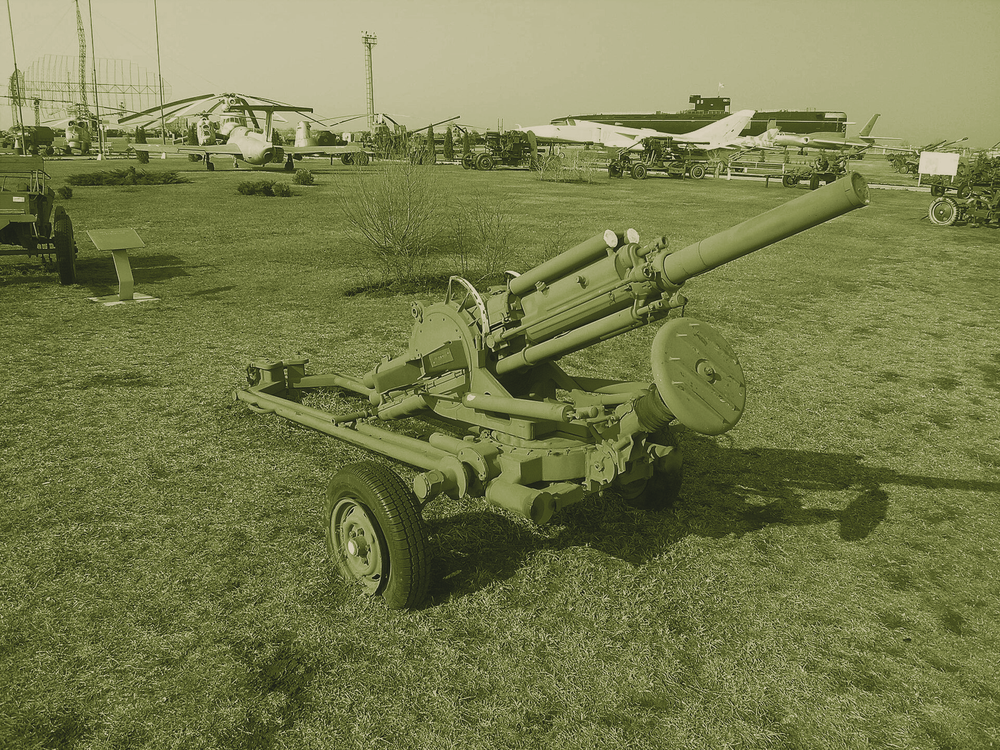
The 2B9 Vasilek is a Soviet 82 mm automatic mortar that fires four-round clips and remains in Russian and Ukrainian service.
The 2S9 Nona-S is a Soviet airborne 120 mm gun-mortar on a tracked amphibious chassis, used by Russian and Ukrainian forces.
The 2S5 Giatsint-S is a Soviet 152 mm tracked gun with an open weapon mount, employed by Russian and Ukrainian forces for long-range indirect fire.
The 2S4 Tyulpan is a Soviet 240 mm tracked mortar for heavy fire against fortified positions, still employed by Russia in Ukraine.
Russia's ISDM Zemledeliye uses a truck-mounted rocket launcher to scatter mines remotely. Its role in Ukraine includes replacing obstacles after lanes have been cleared.
The Stridsvagn 122 is Sweden's Leopard 2-derived main battle tank, combining additional armor with Swedish command systems. It serves in Sweden and Ukraine and is being modernized into the Strv 123A.
Kozak-2 is Practika's Ukrainian 4x4 armored vehicle for protected transport, patrol and support missions, built on an Iveco EuroCargo chassis.
T-16 Armata recovery vehicle: the 2021 test-institute visit, Army-2023 display, recovery equipment, conflicting crane figures and unresolved delivery record.
Sotnik: Russia's proposed Ratnik successor, the missing development milestone, actual component demonstrations and the later Legionnaire research program.
T-15 Armata: the heavy infantry-carrier layout, 30 mm and 57 mm configurations, documented trial activity and the actual scope of its procurement announcements.
Bumerang K-16 and K-17: different weapons, a redesigned hull, the trial chronology, export plans and the unresolved claim of deployment to Ukraine.
BMPT Terminator: the five- and three-person configurations, documented operators, losses in Ukraine, 2025 protection changes and the Spiridon name.
India's Zorawar is a roughly 25-tonne light tank under development for high-altitude and mountain operations, with induction provisionally expected in 2028-29 after further refinement and trials.
China's Type 100 is a medium-weight main battle tank built around an unmanned turret, active protection, hybrid propulsion and networked sensors rather than progressively heavier passive armor.
Ukraine's T-80UD-derived main battle tank family, combining a high-output diesel engine, autoloaded 125 mm gun and Ukrainian protection systems in a fleet built principally for Thailand.
A Soviet tracked mine-clearing vehicle that launches explosive line charges to open lanes through minefields, with a secondary wartime role as a short-range demolition weapon.
The M113 is a lightweight American tracked armored personnel carrier whose simple construction, extensive variant family and large surviving inventory have sustained its use from Vietnam to Ukraine.
The D-30 is a Soviet 122 mm towed howitzer distinguished by its three-leg carriage and 360-degree traverse, widely exported and still heavily used in the Russia-Ukraine war.
The Carl-Gustaf M4 is Saab's fourth-generation 84 mm reusable recoilless rifle, combining a lighter launcher with a broad family of anti-armour, anti-structure, anti-personnel, smoke and illumination ammunition.
Ukraine's amphibious 8x8 armored personnel carrier, combining a rear troop compartment with heavy turret armament and a domestically controlled wartime production base.
The PT-91 Twardy is a Polish main battle tank derived from the T-72M1, combining a 125 mm autoloading gun with ERAWA reactive armour, Polish fire control and an uprated diesel engine.
Israel's Namer is a heavily protected tracked personnel carrier built on the Merkava Mk 4 chassis, combining tank-derived armor, rear-ramp infantry access and Trophy active protection.
The BM-27 Uragan is a Soviet-designed 220 mm multiple rocket launcher that delivers heavy area fire from a 16-tube launcher, with Russia and Ukraine retaining the system in frontline service.
The BMP-1 is a Soviet amphibious tracked infantry fighting vehicle that introduced mass-produced protected infantry mobility with integral anti-armour firepower and remains in combat service in Russia and Ukraine.
The MT-LB is a Soviet amphibious tracked carrier and artillery tractor whose availability, adaptability and low ground pressure have made it a ubiquitous transport and improvised weapons platform in the Russo-Ukrainian war.
The XM30 is the US Army's competition for a hybrid-electric, heavily armed successor to the M2 Bradley, contested by American Rheinmetall's Lynx XM30 and General Dynamics Land Systems' Wolf.
The MAC OWL Sova is a Ukrainian mine-resistant armored vehicle combining STANAG Level 4 mine protection with an integrated ten-module electronic-warfare dome intended to defeat FPV drones.
The FNSS U-MAV, designated İ-ZAHA in Turkish, is an uncrewed amphibious vehicle intended to lead high-risk landing waves alongside Türkiye's crewed Marine Assault Vehicles.
A wire-guided missile that requires its operator to hold the crosshair on a tank for the whole flight — up to four kilometres, several seconds, motionless. In a battlefield watched continuously by drones, that is the hardest thing a soldier can be asked to do.
A 1961 shoulder-fired launcher that found a second career nobody designed: its PG-7 shaped-charge grenade is one of the most common warheads bolted onto FPV attack drones, so much of the armour destroyed in this war is hit by RPG ammunition.
The 152 mm half of the Soviet self-propelled artillery pair still fighting on both sides. It outranges and outweighs the Gvozdika, it trails only the Msta-S in Russian self-propelled artillery losses, and drones now kill it before it fires.
The amphibious 122 mm howitzer that both armies still fire daily, and that both are losing faster than they can replace. Oryx has documented about 400 Ukrainian losses of the type — and Russia is reported to be stripping barrels off its own.
A tank designed in 1961, pulled from Siberian storage yards and sent to Ukraine because Russia has run out of newer ones. At least 334 have been destroyed, and the T-62's real significance is as a measure of how far the Russian tank reserve has been drained.
A Kharkiv-built Soviet tank from 1966 that is still the backbone of Ukraine's armoured force in 2026 — kept alive by depot reactivation, Oplot transmissions and anti-drone cages, because Western donations could never replace it at scale.
Russia's radar-cued hard-kill tank shield, and the first serial Russian active protection system credited with shooting down FPV drones. In its combat debut one tank killed seven drones, then ran out of ammunition and died.
The Leopard 1A5 is a late Cold War modernization of Germany's mobility-focused Leopard 1, combining a 105 mm rifled gun with improved fire control and thermal night-fighting equipment.
India's domestically produced 155 mm/45-caliber towed howitzer, developed from the FH-77B lineage with digital fire control, automatic laying and an auxiliary power unit.
China's ZTL-11 is an 8x8 wheeled assault gun combining the Type 08 armored-vehicle chassis with a 105 mm rifled gun for mobile direct fire.
India's heavily upgraded Arjun main battle tank, combining a 120 mm rifled gun, expanded protection and modernized sights with significant mobility, logistics and engine-supply constraints.
China's Type 15, or ZTQ-15, is a light tank optimized for mountains, plateaus, forests, weak roads, and other terrain where heavier main battle tanks face mobility constraints.
The M270 MLRS is a tracked, armored rocket-artillery launcher carrying two interchangeable ammunition pods for guided rockets and longer-range strike missiles.
The KN-25 is North Korea's 600mm "super-large" rocket launcher — the world's biggest-caliber guided rocket artillery, a rocket/ballistic-missile hybrid reaching 380 km, nuclear-tasked and mass-produced. Despite two years of reports, no transfer to Russia has ever been confirmed.
The M1989 Koksan is North Korea's 170mm self-propelled gun — the largest-caliber tube artillery in service anywhere, built to range Seoul. Since late 2024 Pyongyang has shipped 120–200 to Russia, where they now fire on Ukrainian lines and are being hunted by drones and HIMARS.
India's rocket artillery — the Pinaka fires a salvo of twelve rockets in under a minute, saturating targets out to 40 km and, in guided versions, 75–120 km. Battle-proven since Kargil in 1999 and used again in 2025, it is now exported to Armenia.
Britain's tank gets a new gun at last — the Challenger 3 rebuilds the Challenger 2 with an all-new turret and a NATO-standard 120mm smoothbore cannon, ending decades of Britain going its own way with a rifled gun. A modest 148-tank fleet, with first deliveries due in 2027.
The IFV Australia chose over the Lynx — Hanwha's AS21 Redback is a heavily-protected tracked fighting vehicle with a 30mm cannon, Spike missiles, active protection and a helmet that lets crews "see through" the hull. A Korean design built on Australian soil, it beat Rheinmetall to win Land 400.
South Korea's world-class tank — and Europe's new workhorse — the K2 Black Panther pairs a 120mm L/55 gun, an autoloader, an active protection suite and hydropneumatic "kneeling" suspension in one of the most advanced MBTs in service. Poland is buying 1,000, with production moving to Polish soil.
The Czech rifle gone global — CZ's BREN 2 is a light, fully ambidextrous, multi-calibre assault rifle that swaps between 5.56 NATO and 7.62×39 and a range of barrel lengths. The Czech Army's standard arm, adopted by French special and police units and licence-built in Hungary.
Slovakia's autoloading wheeled gun — the Zuzana 2 puts a 360°-traversing 155mm howitzer with an automatic loader on an 8×8 truck, firing to 40 km. The DANA's modern NATO-caliber heir, donated and sold to Ukraine, where it has duelled Russian artillery across the front.
Poland's new amphibious IFV — the Borsuk ("Badger") replaces thousands of Soviet-era BMP-1s with a modern, swimming tracked fighting vehicle carrying an unmanned 30mm turret and Spike anti-tank missiles. A flagship of Poland's massive military build-up, entering service in 2025.
Poland's international mash-up howitzer — the Krab marries a Korean K9 chassis, a British AS-90 turret, a French-pattern 155mm gun and Polish fire control into one 40-km self-propelled gun. Donated and then sold to Ukraine, it has become one of Kyiv's most prized Western artillery pieces.
The most successful modern 8×8 — Finland's Patria AMV is a modular wheeled armoured vehicle adopted by nine nations and licence-built across Europe, Africa and Asia (as Poland's Rosomak, South Africa's Badger and more). One chassis, many roles, combat-tested from Afghanistan onward.
The rifle that made the bullpup mainstream — Austria's Steyr AUG packed a full-length barrel into a compact polymer body with an integral optic and quick-change barrels, decades ahead of its time in 1978. Still produced and found in some 47 countries, it is Austria's defining weapon.
A tank's gun on wheels — Italy's 8×8 Centauro II mounts a full 120mm cannon with main-battle-tank firepower on a fast, road-mobile, mine-protected wheeled hull. The heavier, harder-hitting successor to the original Centauro, built for rapid fire support without a tank's logistics.
Britain's troubled recon vehicle — a tracked, sensor-heavy armoured scout with a 40mm cased-telescoped cannon, meant to be the British Army's digital eyes. Eight years late and beset by noise-and-vibration injuries that hospitalized crews, it finally began entering service in 2025.
France's networked 6×6 cavalry vehicle — the Scorpion-program Jaguar that replaces three older recon and fire-support types with one, mounting a 40mm cased-telescoped cannon and Akeron anti-tank missiles. The digital, missile-armed successor to the AMX-10RC.
Rheinmetall's modular tracked IFV — a clean-sheet fighting vehicle with a digital Lance turret (30 or 35mm cannon + Spike missiles) and a reconfigurable hull. Bought by Hungary, picked by Ukraine as its standard IFV, and headed for Italian co-production.
Rheinmetall's clean-sheet tank — a Panther built around a 130mm autoloaded gun (50% more reach than the Leopard's 120mm), a three-crew turret, integrated loitering munitions and active protection. Germany's bid to leapfrog the Leopard while the Franco-German MGCS tank stalls.
France's 6×6 "gun on wheels" — a fast, 105mm-armed reconnaissance vehicle the press dubbed a light tank when France sent it to Ukraine. Hard-hitting and quick on roads, but thinly armored: a mobile cavalry scout pressed, controversially, toward front-line assault work.
The biggest self-propelled gun in the world — a Soviet 203mm monster firing a 110 kg shell up to 47 km, nuclear-capable, and dragged out of Cold War storage by both Russia and Ukraine for long-range counter-battery duels. Slow and exposed, but it hits like nothing else on the front.
KNDS's wheeled 155mm howitzer — a fully automated PzH 2000-class gun on a Boxer 8×8, and the only turreted howitzer in the world that can fire accurately on the move. Ukraine is the launch customer; shoot-and-scoot survivability for the drone-saturated battlefield.
South Korea's wheeled multi-caliber multiple launch rocket system — firing guided rockets, tactical ballistic missiles, and unguided munitions from a single 8×8 chassis, now spreading across NATO's eastern flank.
AI-enabled rifle-mounted fire-control sight that turns any rifleman into a drone hunter — organic counter-UAS capability for dismounted squads, now fielded across the US Army, Marine Corps, Air Force, and Navy.
Israel's first heavy 8×8 wheeled armored personnel carrier — a high-mobility, Iron Fist APS-protected vehicle designed to replace M113s and field an IFV variant, battle-tested in Gaza since 2023.
Israel’s multi-caliber precision rocket launcher — a wheeled, pod-based system that spans 12 km to 300 km with a single vehicle and has become Europe’s leading non-US alternative to HIMARS.
Israel’s Trophy (Windbreaker) — the world’s most combat-proven hard-kill active protection system, first to intercept an anti-tank missile in combat, now fielded on Merkava, Abrams, Leopard 2 and Challenger 3.
Israel's survivability-first main battle tank — engine-forward architecture, rear-crew-exit, and the combat-proven Trophy active protection system, continuously upgraded since 2003 into the AI-enabled Barak standard.
The West German Cold War infantry fighting vehicle—a tracked, 20 mm–armed troop carrier that, after decades as the Bundeswehr’s backbone, has re-emerged as a refurbished assault workhorse for Ukraine, melding Rheinmetall’s deep industrial capacity with a simple, survivable design.
The Soviet-era 122 mm Grad is the world’s most ubiquitous multiple rocket launcher — 40-tube burst fire, truck-mobile, and a massed-fire mainstay in both Russian and Ukrainian arsenals, now reliant on North Korean and Czech-brokered 122 mm ammunition pipelines.
Ukraine's indigenous 155 mm wheeled self-propelled howitzer — built to NATO caliber, produced at world-record rates, and combat-proven from the Snake Island shelling to the front lines of the Donbas.
Russia's T-72-based 220 mm thermobaric multiple rocket launcher — the Solntsepyok is a short-range assault-breaching weapon that incinerates fortifications and has become a prime target for Ukrainian drone hunters.
China's semi-automatic precision grenade launcher, fielded in 35mm for the PLA and 40mm for export — delivering airburst rounds through a window at 600 m.
China's first indigenous automatic grenade launcher — a gas-operated 35mm weapon that delivers squad-level suppressive fire and has proliferated across conflict zones from Sudan to Iraqi Kurdistan.
China’s standard under-barrel grenade launcher — a muzzle-loaded single-shot 35×32mm caseless system that arms the QBZ-95-1 and QBZ-191 rifle families with HE-frag, airburst and dual-purpose grenade effects.
China's Type 86P fragmentation hand grenade — an ovoid plastic-bodied design packing ~1,600 steel balls that replaced the stick-grenade lineage and remains the PLA's standard-issue close-combat frag.
The AGS-30 "Atlant" is Russia's lightweight, crew-served automatic grenade launcher, a 30×29mm belt-fed successor to the AGS-17 that weighs only 16 kg on its tripod and sustains ~400 rpm for mobile infantry fire support.
The AGS-17 "Plamya" is a Soviet-designed, tripod-mounted 30×29mm automatic grenade launcher in service since 1971, delivering indirect suppressive fire to 1,700 m and widely proliferated across Soviet-legacy and export armies.
The GP-25 “Kostyor” is a 40mm caseless under-barrel grenade launcher for AK-pattern rifles — fielded in 1978 and a fixture of Russian infantry squads from Afghanistan to Ukraine.
The iconic Soviet-era defensive fragmentation hand grenade, known as the Limonka, in continuous combat service since the late 1930s.
The standard Soviet/Warsaw Pact offensive fragmentation hand grenade since 1954 — a lightweight, smooth-bodied anti-personnel weapon built for close combat, in continuous service from Afghanistan to Ukraine.
The M32 MGL is a six-shot revolver grenade launcher in 40×46 mm, fielded by the US Marine Corps and SOCOM, offering rapid semi-automatic fire of up to six rounds in under three seconds.
The standard U.S. belt-fed 40 mm automatic grenade launcher — a crew-served, blowback weapon that delivers high-velocity grenade fire against personnel and light armor out to 2,200 m, and has served in every major U.S. deployment since the Gulf War.
The M320 is a single-shot 40×46mm low-velocity grenade launcher that mounts under a service rifle or operates as a standalone weapon with a collapsible stock, adopted by the U.S. Army in 2009 to replace the M203.
The iconic US under-barrel 40mm grenade launcher — a single-shot, slide-forward pump-action launcher that equips M16 and M4 rifles with high-explosive, HEDP and specialty rounds, the standard squad-level grenade system for 30+ years.
The M67 fragmentation grenade is the standard US defensive hand grenade since 1961 — a spherical, Composition B-filled weapon with a 5-meter lethal radius, used in every major American conflict from Vietnam to the present.
The QJY-88 is the People's Liberation Army's 5.8mm general-purpose machine gun, chambered for China's indigenous intermediate cartridge and intended to replace older 7.62mm GPMGs — a lightweight design that drew criticism for its limited range and penetration.
Austria's polymer-frame, striker-fired service pistol — the ubiquitous 9×19mm sidearm of NATO militaries and law enforcement worldwide, in continuous production since 1982.
China’s bullpup squad light support weapon, chambered in 5.8×42mm and fed from a 75-round drum — the standard PLA squad-automatic of the Type 95 family.
China's lightweight crew-served heavy machine gun — a 12.7×108mm belt-fed weapon that is among the lightest in its class, fielded by the PLA for infantry and vehicle roles.
The QSZ-92 is China's standard-issue PLA/PAP sidearm — a polymer-frame, rotating-barrel pistol chambered in two distinct cartridge families, including a unique 5.8×21mm armor-defeating round, and now being supplemented by the newer QSZ-193.
The RPK-74, the squad-level light machine gun of the AK-74 family, has provided sustained automatic fire for Russian and allied infantry since the 1970s. Featuring a heavier barrel, bipod, and 45-round magazine, it remains in widespread front-line service.
Russia's standard 12.7×108mm heavy machine gun, developed after the Soviet collapse to replace the NSV and fielded on tripods, vehicles, and main battle tanks from the late 1990s onward.
The PKM is the Soviet Union's workhorse 7.62mm general-purpose machine gun — a belt-fed, open-bolt design that has armed infantry squads, vehicle mounts, and tripod emplacements across more than five decades of continuous combat from Afghanistan to Ukraine.
Russia's standard-issue 9mm service pistol — a DA/SA sidearm adopted to replace the Makarov PM, used extensively in the war in Ukraine, and now being supplemented by newer designs.
The M249 SAW — FN's belt-fed, 5.56mm squad automatic weapon adopted by the US in 1984 and exported to 75+ countries, now being supplemented by the 6.8mm XM250.
The M240 — the US standard 7.62mm general-purpose machine gun, built from the FN MAG and fielded since 1995 — anchors infantry, vehicle, and helicopter firepower across NATO and beyond.
The M2 Browning "Ma Deuce" is the century-old .50 cal heavy machine gun that remains the standard NATO crew-served weapon for anti-materiel, anti-personnel, and vehicle defense.
The US military's iconic 9mm service pistol from 1985 to 2017 — a double-action hammer-fired design that defined the NATO sidearm era and remains in wide legacy and allied service.
The standard US military sidearm since 2017 — a modular, striker-fired 9mm pistol built by SIG Sauer to replace the M9, and the source of a contentious safety controversy.
The QBZ-03 is China’s conventional-layout, folding-stock assault rifle developed alongside the bullpup Type 95 — issued to border, airborne and reserve troops, and exported to Myanmar.